
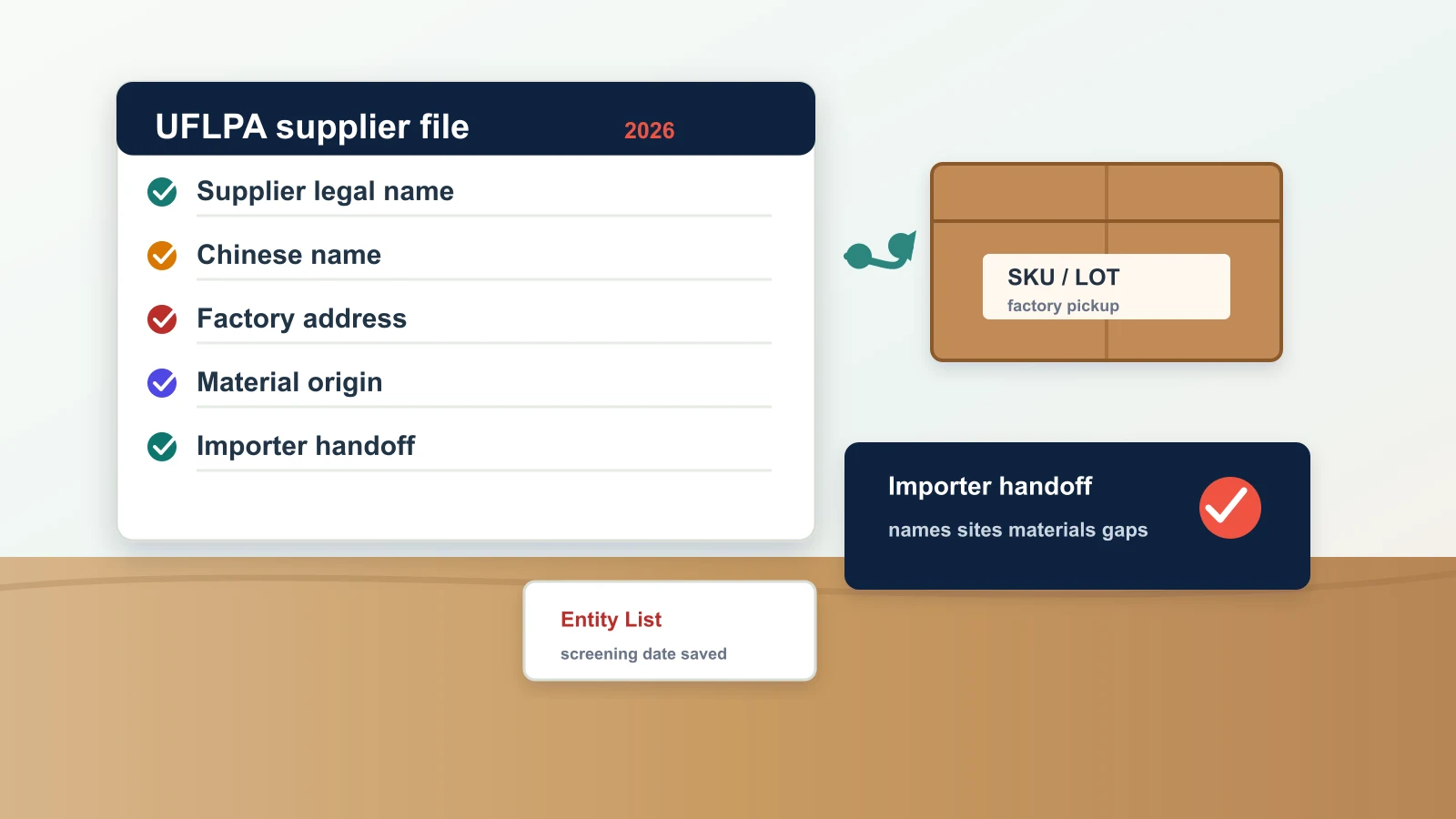
UFLPA - supplier chain - shipment release evidence

UFLPA China Supplier Check Before U.S. Shipment in 2026

Written by Agent HuangPublished on June 27, 2026

China-side sourcing partner helping overseas buyers verify suppliers, inspect goods, and reduce payment or shipment risk before money or goods move.

CBP published consolidated Forced Labor Enforcement Operational Guidance for Importers in June 2026, expanding the practical importer view beyond older UFLPA-only guidance. For buyers sourcing from China, the operational problem is simple: if supplier, factory, material, and document evidence is still unclear when cartons leave China, it becomes harder to answer U.S. importer, broker, or CBP questions later.

Before deposit, final payment, or pickup, buyers should map the supplier chain behind the exact goods being shipped: legal supplier name, Chinese name, production site, product materials, upstream suppliers, invoice trail, packing records, Entity List screening, high-priority sector exposure, and importer handoff. Huang Sourcing can organize and document visible China-side evidence, but UFLPA compliance, forced-labor determinations, customs decisions, and legal conclusions remain with the importer and qualified specialists.

Quick answer

What should buyers check before U.S.-bound China goods ship?

Check whether supplier identity, production site, materials, upstream names, Entity List screening, order documents, and importer handoff can be tied to the exact goods before cartons leave China.

1Map the legal supplier, Chinese name, trade name, bank account, invoice issuer, shipper, and factory location before payment or pickup
2Confirm who actually makes the goods, where production happens, and whether a trader, subcontractor, or upstream plant is involved
3Screen supplier names, Chinese names, affiliates, factories, and known upstream suppliers against the current UFLPA Entity List and buyer risk list
4Treat a clean name search as only one data point; absence from a list does not prove the supply chain is safe or admissible
5Identify high-priority materials and sectors such as apparel, cotton, PVC, silica or polysilicon, tomatoes, aluminum, seafood, steel, copper, lithium, caustic soda, and red dates
6Tie purchase orders, commercial invoices, packing lists, bills of materials, material declarations, production photos, and carton evidence to the same SKU and lot
7Ask the U.S. importer or customs broker which forced-labor, UFLPA, WRO, CAATSA, and admissibility evidence should block shipment release
8Hold release when supplier identity, production site, material origin, subcontracting, or upstream documentation cannot be reconciled before goods leave China

China-side evidence module

UFLPA supplier-chain evidence checklist

The check is practical: identify the supplier chain behind the order, collect evidence while goods are still in China, then separate visible facts from legal and customs conclusions.

Supplier identity

  • Compare English name, Chinese name, business license, platform profile, invoice issuer, payment account, shipper, and contact details
  • Flag unexplained switches between trading company, manufacturer, export agent, bank beneficiary, and company chop before deposit or final payment

Production site

  • Record claimed factory address, production site photos, pickup address, carton location, supplier role, and any subcontractor explanation
  • Separate a factory visit or visible evidence check from a legal conclusion about who controls the supply chain

Materials and upstream chain

  • List key materials, components, fabric, cotton, minerals, battery materials, packaging, and upstream supplier names when available
  • Connect high-priority sector exposure to the importer, broker, lab, counsel, or responsible compliance owner before release

Importer handoff

  • Package final evidence by SKU, lot, supplier, factory, material, carton, and document source for the U.S. importer or broker
  • Name who owns UFLPA compliance, WRO checks, CAATSA review, customs response, and any detention or exclusion answer

Why UFLPA supplier evidence is a current 2026 sourcing issue

CBP released its Forced Labor Enforcement Operational Guidance for Importers in June 2026. The guidance consolidates enforcement context for 19 U.S.C. 1307, UFLPA, CAATSA, WROs, and Findings, and CBP encourages importers to conduct supplier due diligence before goods are detained.

That makes supplier-chain evidence a shipment-readiness issue, not only a legal memo. The buyer may know the sales contact and Alibaba profile, but the importer may need a clearer chain connecting the actual goods, production site, supplier names, material inputs, and upstream records to the shipment.

  • Supplier identity should be checked before money and leverage leave the buyer
  • Production-site and material-origin questions are easier to document while goods are still in China
  • Entity List, WRO, and high-priority sector risk checks should be tied to exact supplier names and SKUs
  • China-side evidence supports importer due diligence but does not decide admissibility

What can a China-side UFLPA supplier check actually do?

A practical check starts with what can be seen, requested, compared, and preserved in China. That includes supplier names, Chinese business-license details, factory or pickup address, production photos, carton labels, product and material declarations, purchase and invoice records, packing lists, and supplier answers about upstream sources.

The purpose is to reduce avoidable confusion before shipment release. If the supplier profile says one company, the invoice says another, the factory address is unclear, or the material declaration cannot be tied to the finished goods, the buyer should know before final payment or pickup.

  • Check names in English and Chinese because Entity List and supplier-chain records may not use the same spelling
  • Capture evidence at SKU and lot level, not only supplier level
  • Preserve screenshots, photos, timestamps, invoices, and supplier answers in one exportable folder
  • Escalate legal, customs, and forced-labor conclusions to qualified specialists

How should buyers use UFLPA Entity List screening?

The DHS UFLPA Entity List is a key screening source, but it is not the whole due-diligence file. Buyers should screen supplier names, Chinese names, affiliates, factories, upstream suppliers, and product-related entities when those names are known. The same search should also note uncertainty, spelling variations, and missing Chinese names.

A clean search result is not clearance. CBP explains that UFLPA applies to goods mined, produced, or manufactured wholly or in part in the XUAR, or by an entity on the UFLPA Entity List. A buyer still needs supply-chain evidence when the product, material, sector, supplier location, or upstream chain creates risk.

  • Screen exact legal names, alternate names, Chinese names, and known related-party names
  • Keep the date of screening and the official source used
  • Do not treat a supplier self-declaration as enough when material or production-site evidence is inconsistent
  • Use importer or broker instructions for any product-specific screening beyond public pages

Which materials and sectors need extra attention?

DHS strategy updates and UFLPA resources identify high-priority sectors that deserve closer attention. Buyers should look beyond the finished product label and ask what materials or subassemblies create forced-labor exposure in the chain.

For China sourcing, that can matter even when the finished product is not obviously regulated. A textile bag may involve cotton, a solar accessory may involve silica-based inputs, an electronics product may involve aluminum, copper, or lithium, and a packaged food or household product may have upstream material questions that the sales supplier cannot answer alone.

  • Ask for bill-of-materials and material supplier context before production, not after detention
  • Connect material declarations to actual production lots and packed goods
  • Separate factory identity evidence from upstream material evidence; both may be needed
  • Have the importer decide when a high-priority sector requires specialist review before shipment

What document trail should be ready before pickup?

The best evidence package is boring and consistent. Purchase order, invoice, packing list, product photos, carton labels, production address, business license, material declarations, upstream invoices or declarations, and buyer-broker instructions should all point to the same supplier chain and shipment.

When the supplier refuses evidence, gives only generic certificates, or changes names and addresses late, the buyer should not bury the issue in chat history. Put the mismatch in a release decision: proceed with specialist approval, require correction, split goods, delay pickup, or stop before payment.

  • Keep supplier screenshots and official documents together with translation notes when needed
  • Match product photos and carton marks to invoice, packing list, SKU, and lot records
  • Request upstream evidence early for materials the importer has flagged
  • Document who approved shipment despite any remaining evidence gap

Evidence to decision matrix

Turn UFLPA evidence gaps into a shipment release decision.

Use this table to decide whether supplier-chain evidence is ready enough for deposit, final payment, specialist review, or a hold before pickup.

Risk node
Evidence basis
Buyer decision
Supplier identity is consistent
English name, Chinese name, license, platform profile, invoice issuer, bank beneficiary, shipper, and contact details can be reconciled.
Proceed with ordinary supplier evidence, request explanation, or pause payment when names and roles conflict.
Production site is clear
Factory address, pickup location, production photos, carton location, supplier role, and subcontractor status are documented for the order.
Release only when the buyer and importer understand who made the goods and where production occurred.
Material and upstream risk is handled
High-priority materials, supplier declarations, upstream records, bill-of-materials notes, and buyer-broker instructions are tied to the SKU.
Escalate to customs, legal, lab, or compliance partners before shipment when material origin evidence is incomplete.
Importer handoff is ready
Final folder includes screening date, official source links, supplier-chain notes, photos, document trail, gaps, and named response owner.
Approve pickup only when the importer or broker has the evidence package needed for its own due-diligence decision.

Evidence basis for this advice.

This guide is based on official CBP and DHS forced-labor source context, then narrowed to supplier identity, production-site, material-origin, and importer-handoff evidence that can be checked before goods leave China.

  • Official CBP forced-labor enforcement guidance, CBP UFLPA page, DHS UFLPA Entity List, DHS UFLPA strategy updates, and CBP forced-labor enforcement context current to June 2026.
  • Buyer-provided supplier names, Chinese names, business licenses, platform records, order files, purchase orders, invoices, packing lists, bills of materials, and broker or importer instructions.
  • Physical product, carton, label, factory, pickup-location, document, correction, and shipment-record evidence observed or collected in China.
  • Specialist guidance from the U.S. importer, licensed customs broker, trade counsel, forced-labor compliance adviser, laboratory, certification body, marketplace, or enforcement-response owner when conclusions exceed visual and document evidence.

What to send before the supplier-chain check.

Send names, order files, material notes, and importer instructions so the report can compare China-side facts against the evidence the U.S. team expects to use.

  • Supplier English name, Chinese name, business license, platform profile, website, contact details, invoice issuer, bank beneficiary, and shipper
  • Factory name, claimed production address, pickup address, production photos, carton-location details, subcontractor notes, and access instructions
  • SKU list, product photos, order quantity, carton count, packing list, purchase order, commercial invoice, proforma invoice, and payment records
  • Bill of materials, material declarations, fabric or component supplier names, upstream invoices or declarations, and high-priority sector notes
  • Importer, broker, customs counsel, marketplace, or compliance-team instructions for UFLPA, WRO, CAATSA, Entity List, and admissibility review
  • Payment deadline, pickup deadline, and written rules for which supplier-chain issues should block deposit, final payment, or shipment release

Supplier-chain red flags before shipment.

Pause payment or pickup when names, production site, materials, and importer responsibility cannot be tied to the same order.

  • Supplier cannot provide the Chinese legal name, business license, production address, or consistent invoice and bank details
  • The sales supplier says it is a factory but pickup, carton, document, or production evidence points to another company
  • Business license, platform profile, invoice issuer, bank beneficiary, export agent, and shipper names do not reconcile
  • Supplier refuses to identify material suppliers, factory location, subcontractors, or upstream sources for a flagged product
  • High-priority materials such as cotton, PVC, silica, aluminum, seafood, steel, copper, lithium, or caustic soda are present but undocumented
  • Entity List screening is impossible because names are missing, translated inconsistently, or supplied only as vague English trade names
  • Product photos, carton marks, invoice, packing list, and material declarations appear to describe different goods or lots
  • No importer, broker, or compliance owner has accepted responsibility for UFLPA and forced-labor due-diligence decisions before shipment

Scope limits

A China-side check is not a UFLPA compliance decision.

The report can show what was visible, provided, and inconsistent before shipment. It cannot decide whether goods are admissible, whether a supply chain is free of forced labor, or whether an importer can answer CBP.

  • Huang Sourcing can compare visible supplier, factory, material, document, carton, and shipment evidence against buyer-provided references in China
  • Huang Sourcing does not determine UFLPA compliance, certify absence of forced labor, act as a U.S. importer, file customs responses, or provide legal advice
  • A China-side evidence check cannot prove full supply-chain traceability, forced-labor absence, admissibility, customs release, Entity List completeness, or WRO avoidance
  • The U.S. importer, licensed customs broker, trade counsel, compliance adviser, marketplace, or responsible party remains accountable for regulated decisions
  • Supplier obstruction, missing upstream records, subcontracting, mixed lots, translated names, sealed cartons, or late supplier changes can limit report confidence
  • UFLPA Entity List entries, WROs, Findings, CAATSA enforcement, CBP guidance, DHS strategy updates, and broker requirements can change, so time-sensitive instructions should be reconfirmed before shipment release

Related next steps

Connect supplier evidence to payment and shipment control.

Supplier verification China checklist

Start here when the buyer needs basic supplier, company, quote, and payment-risk signals before deposit.

Open page

Supplier verification China limits

Use this to separate visible supplier evidence from legal, customs, compliance, and future-performance guarantees.

Open page

Supplier verification vs factory audit

Compare a focused supplier-chain check with a fuller onsite audit or specialist due-diligence project.

Open page

China factory subcontracting risk checklist

Use this when the supplier may not be the actual producer behind the order.

Open page

Alibaba supplier verification before payment

Review Alibaba profile, company, invoice, and payment signals before supplier funds move.

Open page

Factory vs trading company practical signals

Check whether the seller is a factory, trader, exporter, or unclear middleman.

Open page

Buyer-side inspection report guide

Organize the final supplier-chain evidence into a decision-ready report for payment or pickup.

Open page

What to send before China inspection

Prepare names, order files, photos, labels, materials, and release rules before the onsite or desk check.

Open page

Packaging and label checks before payment

Use when labels, carton marks, and product identity also need to match the release file.

Open page

Shipping China samples to the U.S.

Use this when early samples need separate customs planning and importer-broker instructions.

Open page

Huang Sourcing check scope

Confirm which evidence questions fit a China-side check and which require legal, customs, or compliance specialists.

Open page

Frequently asked questions

What is a UFLPA China supplier check?

It is a practical evidence review that maps supplier identity, production site, materials, upstream names, Entity List screening, order documents, and importer handoff before China-sourced goods ship to the United States. It supports due diligence but does not certify compliance.

Does a clean UFLPA Entity List search mean the supplier is safe?

No. Entity List screening is only one data point. UFLPA can also apply to goods mined, produced, or manufactured wholly or in part in the XUAR, and other forced-labor enforcement tools may apply. Importers should use qualified customs and legal support for conclusions.

When should buyers check UFLPA supplier-chain evidence?

Check early when the product, material, supplier, or U.S. importer has a forced-labor risk flag. At minimum, resolve supplier identity, production site, material origin, and importer handoff before final payment or forwarder pickup.

Can Huang Sourcing prove a supply chain is free of forced labor?

No. Huang Sourcing can collect and compare China-side supplier, factory, material, document, carton, and shipment evidence. Forced-labor absence, UFLPA compliance, customs admissibility, and legal sufficiency require qualified responsible parties.

Which products need extra UFLPA attention?

Products involving high-priority sectors or materials deserve extra attention, including apparel, cotton, PVC, silica-based products, tomatoes, aluminum, seafood, steel, copper, lithium, caustic soda, red dates, and any product flagged by the importer or broker.

What should block shipment release?

Block or escalate release when supplier names conflict, the factory is unclear, material origin cannot be traced for a flagged product, upstream supplier names are missing, the importer has no response owner, or the buyer lacks specialist approval for remaining evidence gaps.

Before U.S.-bound goods leave China

Check supplier identity, factory role, materials, and importer handoff while correction is still practical.

Send the supplier names, order files, material notes, carton records, importer instructions, and release deadline before final shipment approval.

Check Supplier Chain Evidence