
Quick answer
Supplier verification is not a factory audit.
Supplier verification helps the buyer decide whether the supplier and payment path are consistent enough to continue. A factory audit checks the onsite factory capability and controls within a deeper scope.
Why buyers confuse supplier verification with a factory audit
Both services are used to reduce supplier risk, so suppliers and buyers often use the words loosely. The practical difference is the buyer decision. Supplier verification asks whether this supplier identity, payment path, product claim, and order-stage evidence are consistent enough to continue. A factory audit asks whether the physical factory and its operating system are strong enough for a defined production relationship.
A buyer before deposit usually does not need a long audit scorecard first. They need to know whether the supplier name, Chinese license, quote issuer, bank account, factory role, and product capability signals fit together. When those basics are unclear, a full audit may be premature because the buyer may not even know which factory should be audited.
- Use supplier verification to decide whether to pay, pause, ask for documents, request onsite proof, or stop before deposit
- Use a factory audit to decide whether a factory can be approved for larger production, vendor onboarding, or deeper capability review
- Do not use supplier verification as proof that the factory passed a full onsite audit
- Do not use an old audit report as proof that today's payment entity, order address, and product source are safe
What supplier verification checks before the buyer commits
Supplier verification is a buyer-side risk filter. It connects the documents and claims in front of the buyer to the next decision: continue, hold, verify onsite, change payment terms, or reject the supplier. The check is especially useful before deposit because that is when the buyer still has leverage and can slow down unclear claims.
Agent Huang looks for alignment across visible evidence. The Chinese legal name should connect to the business license. The quote and proforma invoice should connect to the payment beneficiary. The claimed factory role should connect to an address, product category, sample source, and production evidence. When those signals conflict, the buyer should not treat a sales answer as verification.
- Company identity: Chinese legal name, unified credit code, business scope, company chop, and profile name
- Payment risk: proforma invoice, bank beneficiary, account name, deposit request, quote issuer, and company-name consistency
- Supplier role: factory, trading company, exporter, sourcing middleman, or mixed role based on address and production signals
- Order-stage evidence: sample source, product photos, packaging marks, claimed factory address, pickup address, and current payment deadline
- Decision output: proceed, ask for more proof, schedule onsite visit, hold payment, or stop before deposit
What a factory audit usually checks onsite
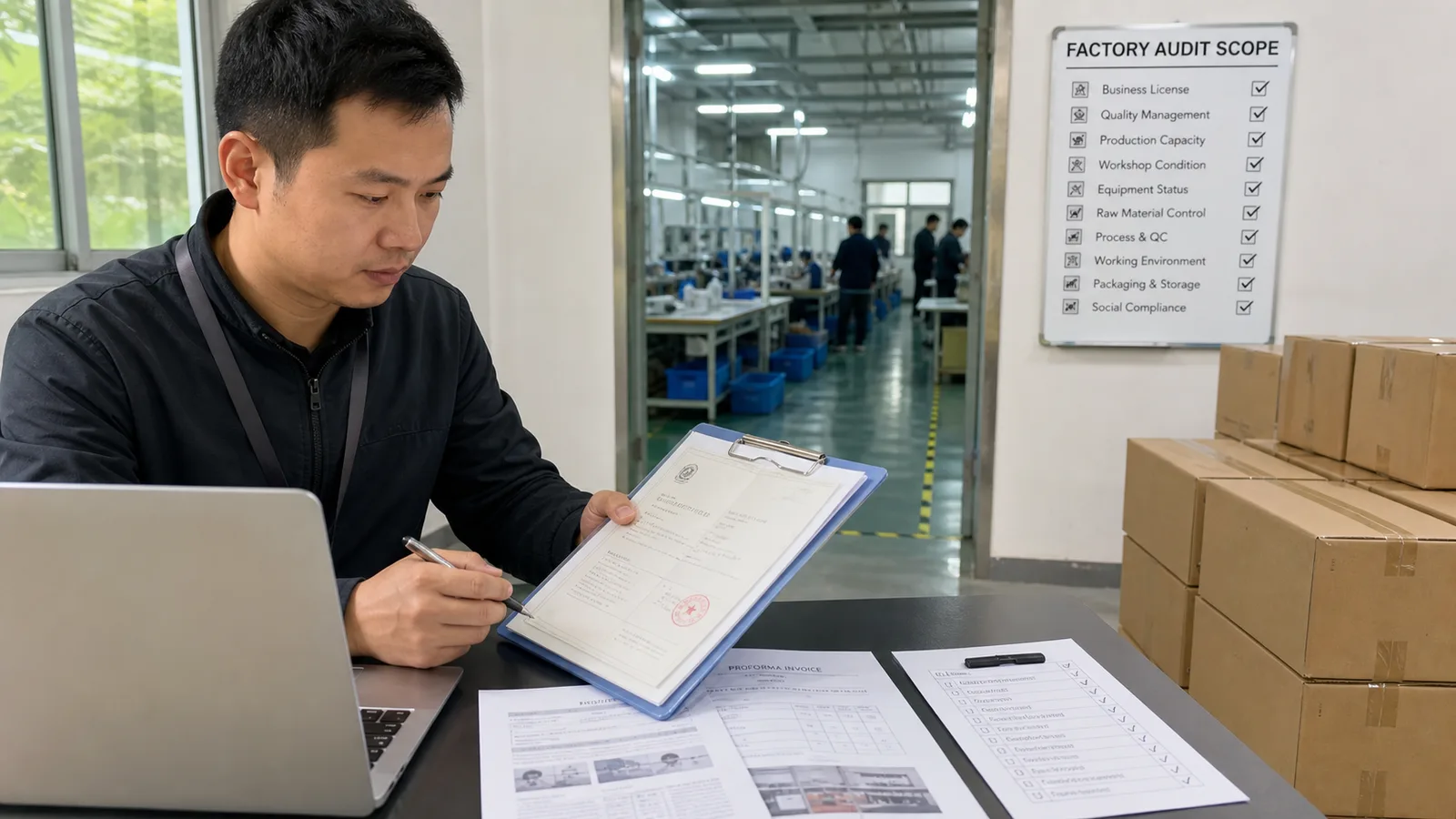
A factory audit is deeper and more site-focused. It normally looks at the production location, management controls, process flow, equipment, warehouse, QC system, document control, capacity signals, and working conditions within an agreed audit scope. The buyer is checking whether the factory itself can support the order or vendor relationship.
That onsite depth is useful when the supplier is important enough to justify it. It is also slower and more dependent on factory access. If the buyer only has a supplier link, a quote, and an urgent deposit request, verification may be the better first step. If the buyer already knows the factory and needs approval evidence, an audit may be the right next step.
- Factory site: production area, warehouse, QC area, packing area, equipment, and product-category fit
- Management system: process control, inspection records, document control, nonconforming product handling, and corrective action practice
- Capacity signals: production line status, machine type, staff arrangement, subcontracting risk, and order load fit
- Audit limits: an audit is a point-in-time onsite review and does not replace shipment-specific QC or product testing
Agent Huang field notes on choosing the right check
The risky moment is when a buyer asks for one kind of evidence and receives another. A supplier may send a business license when the buyer needs factory-site proof. Another supplier may send an old audit certificate when the buyer needs to know whether today's bank account and invoice match the company selling this order.
From a China-side workflow view, the order stage should drive the scope. Before deposit, verify identity and payment risk. Before supplier approval, consider an onsite audit if the order justifies it. Before balance payment, inspect the actual goods. Before pickup or FBA shipment, check carton, label, and handover readiness.
- If the supplier refuses basic Chinese company information, start with verification and slow down payment
- If the buyer must approve a factory for repeated production, define a factory audit scope clearly
- If goods are already finished, a factory audit is not a substitute for QC inspection of that shipment
- If the supplier changes company name, bank account, or pickup address, treat it as a verification issue before money moves