
Quick answer
Supplier verification proves visible consistency, not zero risk.
Supplier verification China helps buyers decide whether the current documents, payment details, supplier role, product evidence, and order-stage facts are consistent enough to continue. It cannot honestly prove that the supplier is risk-free or that every future order will be safe.
How do I verify a Chinese supplier before deposit?
Verify a Chinese supplier before deposit by matching the supplier identity, Chinese legal name, business license, PI issuer, bank beneficiary, product evidence, claimed factory role, and order-stage facts. The buyer decision is simple: pay only when visible evidence supports the next step, and hold payment when the evidence conflicts.
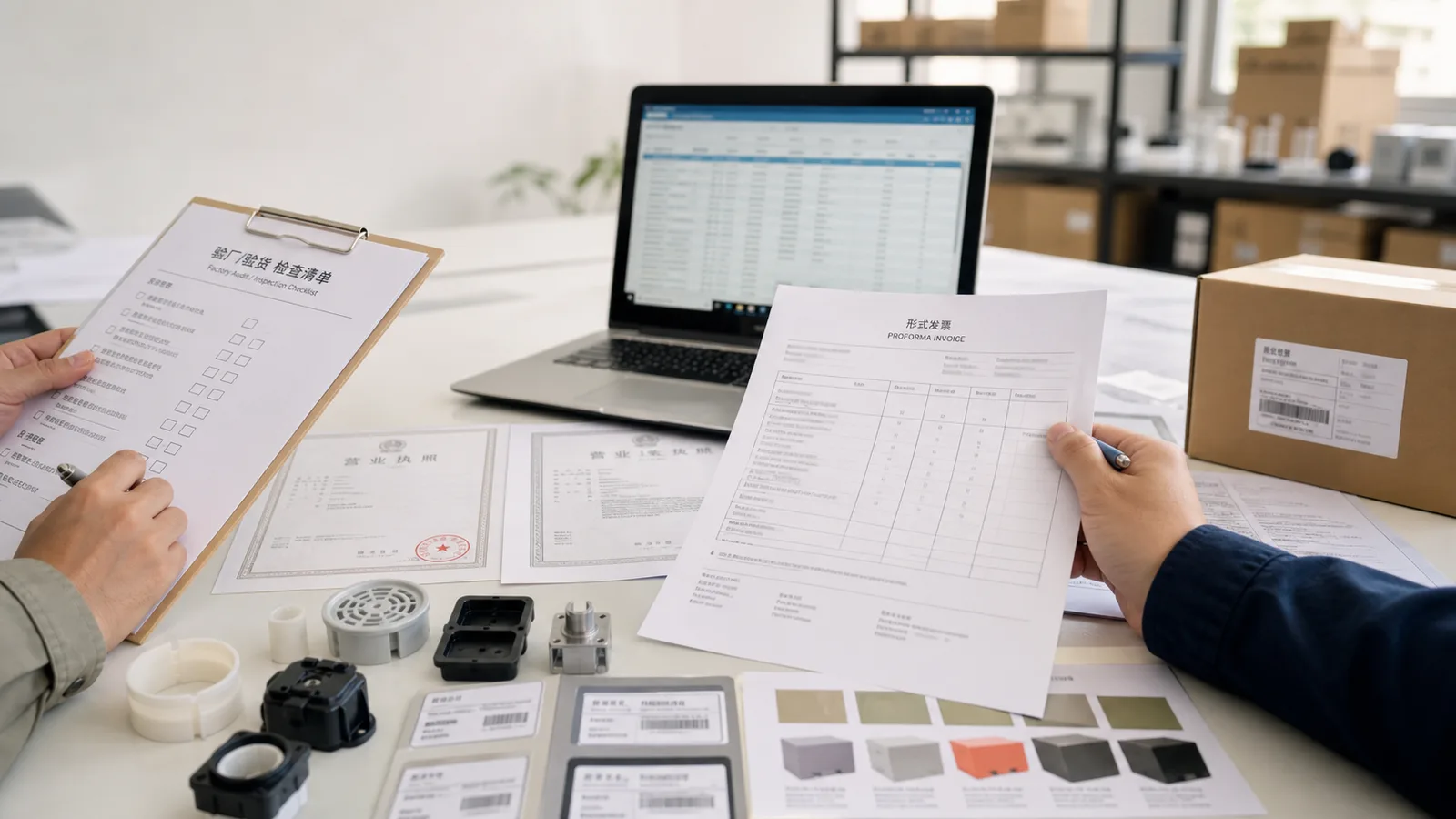
Agent Huang looks for alignment instead of relying on one polished profile or sales answer. The quote, proforma invoice, bank account, address, product photos, sample source, and supplier role should tell one coherent story. When they do not, the buyer still has leverage before deposit and can ask for clearer proof.
- Company identity: Chinese legal name, business license, unified credit code, registered address, and contact details
- Payment path: PI issuer, bank beneficiary, account name, currency, deposit request, and any changed payment instructions
- Supplier role: factory, trading company, exporter, sourcing middleman, or mixed role based on available evidence
- Order evidence: product scope, sample source, specification, packaging needs, claimed factory address, pickup address, and timing
- Buyer decision: proceed, hold payment, request more proof, verify onsite, reduce order size, or stop before deposit
What can supplier verification in China prove?
Supplier verification can prove whether the visible evidence available now is consistent enough for a scoped buyer decision. It can support identity, payment-path, supplier-role, product-fit, and order-stage conclusions when documents and China-side signals align. It should be treated as decision support, not as a promise that all supplier risk is gone.
Useful proof is usually practical and bounded. A verified Chinese legal name can support company identity. A matched PI and bank beneficiary can support payment-path confidence. A claimed factory address plus production evidence can support a role judgment. None of those facts should be stretched beyond the evidence actually checked.
- The company named in the license, profile, quote, PI, and bank path appears consistent or has an explained mismatch
- The supplier role is credible enough for the order stage based on address, product category, photos, samples, and access signals
- The order scope is clear enough to support later inspection, correction, or balance-payment discussion
- The buyer has a practical next action: pay, pause, ask more questions, arrange onsite proof, inspect goods, or stop
What can supplier verification not prove?
Supplier verification cannot prove that a China supplier is risk-free, financially stable, legally perfect, or reliable for every future order. It cannot replace a factory audit, legal due diligence, lab test, regulated compliance review, product certification check, customs advice, pre-shipment inspection, or marketplace approval. Use the result within its scope.
The limit matters because buyers sometimes ask verification to answer questions it cannot honestly answer. A business license does not prove future quality. A matched bank account does not prove all production will pass. A supplier video does not prove every onsite control. Each evidence type has a boundary.
- Legal certainty, dispute outcome, contract enforceability, debt status, tax status, or litigation risk
- Full factory capability, management-system strength, labor conditions, process control, or capacity without an onsite audit scope
- Shipment-specific product quality, hidden defects, every unit condition, or correction completion without QC inspection access
- Laboratory test results, regulated certification ownership, chemical compliance, customs classification, or marketplace approval
- Future supplier behavior, future production quality, future bank-account safety, or damage after goods leave China
Agent Huang field notes on using verification results
Agent Huang treats supplier verification as a payment-timing tool. The best result is not a vague safe or unsafe label; it is a reasoned decision before leverage drops. When names, payment details, product evidence, and address signals align, the buyer may proceed with safeguards. When they conflict, slow down.
The most useful report states what was checked, what matched, what did not match, and what should happen next. If the next question is onsite capability, use a factory audit. If goods are finished, use QC inspection. If cartons are ready for pickup or FBA, check shipment readiness.
- Ask for verification before deposit, not after the supplier already controls the timeline
- Treat unexplained company-name, PI, bank, factory-address, or pickup-address changes as payment-risk questions
- Use verification to decide whether a deeper onsite check is worth booking
- Do not release balance payment based only on early supplier verification when finished goods need QC evidence