
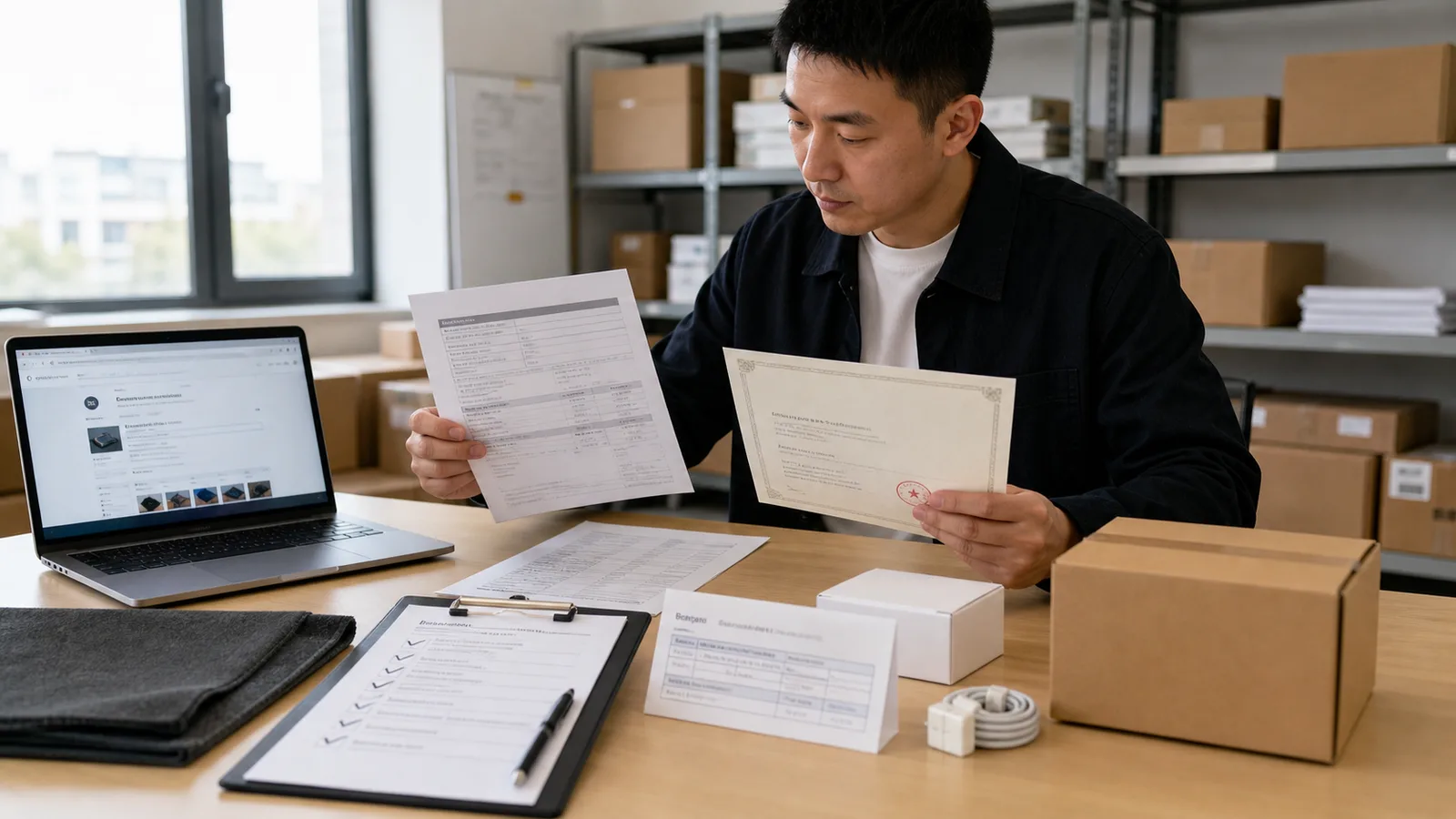
Quick answer
Use the checklist to decide whether the payment should move.
Alibaba supplier verification before payment should connect the supplier identity, PI, bank beneficiary, product evidence, and next checkpoint to one decision: pay, hold, revise, verify onsite, inspect, or stop.
Visual checklist
Four checks before releasing supplier payment.
Use each group as evidence for the next buyer decision, not as a generic paperwork exercise.
Company identity
- Alibaba profile name, Chinese company name, business license, registered address, and contact identity
- Whether the company quoting, invoicing, producing, exporting, and receiving money is the same entity or a clearly explained related entity
- Supplier role signals from address, product category, sample source, factory photos, and willingness to accept verification
Buyer decision
Continue only if the supplier identity is consistent enough. Hold payment or request verification if company names, roles, or addresses conflict.
Payment path
- PI issuer, bank beneficiary, account name, payment currency, bank country or region, and latest payment instruction history
- Written explanation for personal accounts, unrelated companies, Hong Kong entities, or beneficiary names that differ from the supplier profile
- Whether payment pressure is replacing normal document review before the buyer has enough evidence
Buyer decision
Pay only when the beneficiary and payment path make sense. Hold or change terms if the account story is unclear.
PI and order scope
- Exact product name, model, material, size, color, finish, accessories, packaging, labels, carton marks, quantity, price, and lead time
- Deposit, sample fee, tooling fee, balance timing, Incoterms, pickup point, and inspection timing before balance or shipment release
- Correction responsibility if the product, packaging, label, or shipment evidence fails before the next payment
Buyer decision
Revise the PI before payment if it cannot support later QC, payment discussion, or shipment release decisions.
Product and production evidence
- Sample photos, pre-production sample notes, workshop or warehouse context, category fit, packaging sample, label files, and current order photos
- Whether the evidence belongs to this supplier and this order, not a generic catalog, borrowed factory image, or unrelated product line
- The next proof point after payment: sample approval, material photo, production start, inspection booking, or carton readiness evidence
Buyer decision
Proceed only when the product evidence supports the order. Ask for stronger proof, reduce order size, or arrange an onsite check if the evidence is thin.
What to check on an Alibaba supplier before payment
Start with alignment, not trust language. The Alibaba profile, Chinese legal company, business license, quote, PI, bank beneficiary, contact identity, and claimed factory role should not tell different stories. Some differences can be legitimate, but the supplier should explain them before money moves.
Then check whether the order details are specific enough to protect the next buyer decision. If the PI only says a broad product name and total price, it will be hard to argue later about wrong material, wrong logo, missing accessories, weak carton, or unclear labels.
- Company identity: Chinese legal name, license, unified credit code, registered address, contact identity, and supplier profile name
- Supplier role: factory, trading company, exporter, sourcing agent, or mixed role based on visible evidence
- Order scope: model, material, dimensions, finish, packaging, labels, accessories, quantity, lead time, and QC checkpoint
- Payment terms: deposit, sample fee, tooling fee, balance timing, bank beneficiary, currency, and reason for any mismatch
Why the bank beneficiary matters before payment
A supplier can sound professional while the payment path still creates avoidable risk. The buyer should know who receives the money, why that entity receives it, and how it connects to the supplier selling the order. A mismatch is not automatically fraud, but it is not something to ignore.
Before payment, ask for the PI and payment instructions in writing. If the beneficiary changes near transfer date, the bank account belongs to a personal name, or the supplier asks you to pay a different company without explanation, slow down and request proof before release.
- Match the beneficiary against the PI issuer and supplier identity
- Ask for written explanation when the payment entity differs
- Do not let an urgent production slot replace bank-path review
- Keep the buyer decision clear: pay, hold, change terms, or stop
Agent Huang field notes from China-side supplier checks
The strongest warning sign is usually a cluster, not one odd detail. A supplier may use a polished Alibaba page, but the English name, Chinese company name, PI issuer, bank beneficiary, factory address, and product evidence can still point in different directions.
Agent Huang treats the pre-payment moment as the lowest-cost time to slow down. The goal is not to accuse the supplier. The goal is to connect visible evidence to a practical buyer decision before leverage drops.
- Ask practical questions before the supplier controls the timeline
- Use the PI as a future inspection reference, not just a payment request
- Do not accept a profile badge or sales answer as payment-path proof
- Write the next checkpoint before the next payment is due
What to do after the checklist result
A clean checklist does not mean zero risk. It means the visible supplier, payment, product, and order evidence is strong enough for the next scoped decision. The next decision may still be to inspect before balance payment or check cartons before pickup.
If the checklist finds gaps, do not rush to pay and hope the supplier fixes the details later. Ask for missing proof, revise the PI, reduce the first order size, use safer terms, arrange onsite verification, or stop before payment if the evidence remains weak.
- Proceed when identity, PI, bank path, product evidence, and next checkpoint are clear
- Hold payment when company names, beneficiary, product scope, or timeline are unclear
- Escalate to onsite verification when documents cannot resolve the mismatch
- Inspect before balance payment if goods are already in production or finished