
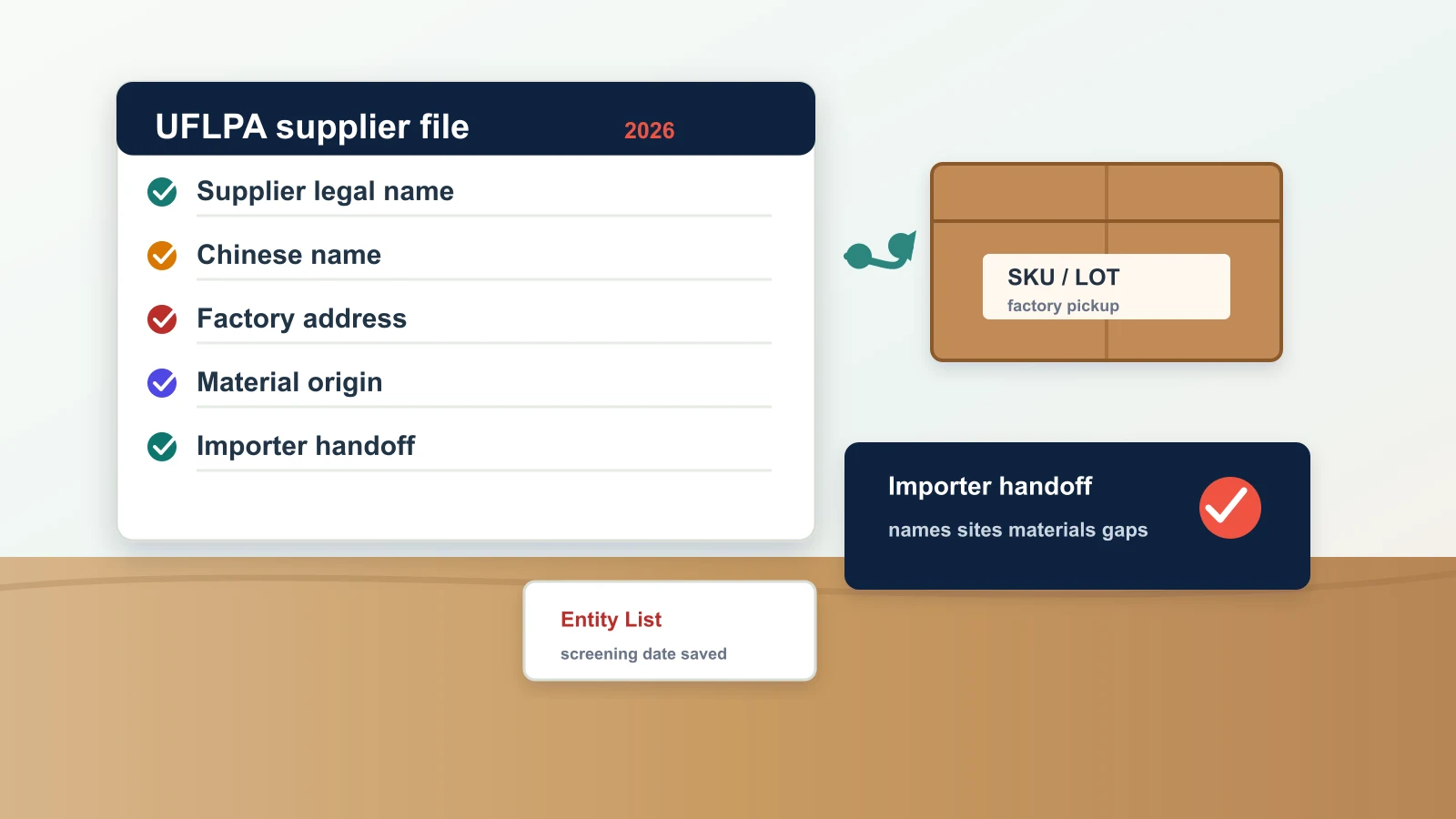
Quick answer
What should buyers check before EU-bound China goods ship?
Check whether product scope, EU exposure, supplier identity, production site, subcontracting, upstream materials, traceability records, and importer responsibility can be tied to the exact goods before payment or pickup.
China-side evidence module
EU Forced Labour Regulation evidence checklist
The check is practical: identify the product and EU owner, map the supplier chain behind the order, preserve traceability files, and separate visible evidence from legal conclusions.
Product and EU exposure
- Record SKU, product type, material, component set, EU destination, online listing target, importer, distributor, marketplace, and release date
- Separate visible product facts from legal scope decisions that belong with the EU economic operator and qualified advisers
Supplier and factory chain
- Compare supplier English name, Chinese name, business license, exporter, invoice issuer, bank beneficiary, factory, and pickup address
- Document whether a trader, subcontractor, processor, packer, or upstream producer is involved in the goods or key components
Traceability and risk records
- Collect bills of materials, material declarations, supplier answers, batch records, upstream names, correction photos, and shipment documents
- Flag vague certificates, recycled old files, missing Chinese names, late factory switches, and documents that do not tie to the order lot
Importer handoff
- Name who owns EU forced-labour regulation readiness, voluntary due diligence, marketplace evidence, legal advice, and authority response
- Package gaps and residual risk in a decision-ready file before deposit, final payment, pickup, listing, or EU market release
Why this is a current 2026 China sourcing issue
The EU Forced Labour Regulation entered the preparation phase before enforcement. The Commission portal says the preparedness package and Single Portal launched on June 26, 2026, and the regulation becomes applicable on December 14, 2027. For sourcing teams, that timing matters because supplier files, factory identity, upstream inputs, and traceability habits need to be built into orders before the first enforcement cases arrive.
The regulation is broad: it targets products made with forced labour and can affect imported goods, EU-made goods, and exports from the EU. A buyer waiting until goods are already packed, paid for, or listed may have less leverage to get factory names, upstream records, lot evidence, or corrective answers from the China-side supplier.
- The Commission has already published preparation tools and guidelines
- EU enforcement starts on December 14, 2027, but sourcing evidence has to be collected earlier
- Supplier-chain uncertainty should become a payment and shipment-release question
- China-side evidence supports the responsible EU party but does not replace legal or authority decisions
Start with product scope and EU market exposure
The regulation applies to products, not only to narrow regulated categories. Official scope guidance says products made in whole or in part with forced labour can be covered at any stage of extraction, harvest, production, manufacture, working, or processing in the supply chain. That is why buyers should look past the final seller and ask where materials, components, processing, and packing actually happen.
EU exposure should also be named clearly. The same China order may be for an EU importer, an online seller targeting EU end users, a marketplace shipment, distributor inventory, or goods later exported from the EU. Huang Sourcing can help organize product and supplier facts, while the EU-side owner decides whether and how the regulation applies.
- Build a SKU table with product, material, component, quantity, order lot, supplier, factory, destination, and EU-side owner
- Flag products with unclear raw materials, labour-intensive processing, opaque subcontracting, or supplier refusal to explain the chain
- Keep online listing and marketplace evidence separate from factory evidence
- Record who approved release when scope or EU market exposure is still under review
Supplier identity must connect to the actual production chain
A clean sales contact is not enough. Buyers need to know whether the quoted supplier, invoice issuer, export agent, bank beneficiary, factory, subcontractor, processor, packer, and upstream material supplier are the same entity or different entities. In China sourcing, that difference often appears only after payment pressure, factory access limits, or pickup address changes.
A practical evidence check compares names and roles instead of assuming them. The file should include English and Chinese names, business licenses where available, invoice drafts, payment beneficiary details, production address, pickup address, supplier explanations, and photo-backed evidence that ties the order to the claimed production site.
- Ask for Chinese legal names, not only English trade names
- Preserve business-license, invoice, bank, platform, and communication records together
- Treat unexplained factory, exporter, or beneficiary switches as release blockers until reviewed
- Document subcontracting and outsourced processing before final payment or pickup
Traceability evidence should be boring, specific, and tied to the lot
Useful evidence is not a generic corporate social responsibility PDF. It connects the actual order to the supplier chain: purchase order, proforma invoice, commercial invoice draft, packing list, product photos, carton labels, production photos, bills of materials, material declarations, upstream supplier names, batch or lot records, and correction evidence when something changes.
When those records do not match, the buyer should turn the mismatch into a decision. The options may be correction, extra supplier proof, specialist review, split shipment, delayed pickup, or written release by the responsible EU-side party. Hiding gaps in chat history creates a weak file for later market, authority, or marketplace questions.
- Keep one evidence folder per supplier, factory, SKU, lot, and shipment
- Match photos, labels, cartons, invoices, packing lists, and material files to the same order
- Request upstream records early for flagged materials or opaque products
- Record unresolved gaps with the name of the person who approved release
Due diligence helps, but it is not the same as proof
The Commission explains that the Forced Labour Regulation does not create new audit or reporting obligations and does not impose a new sustainability due-diligence procedure. It does, however, allow authorities to ask companies for information during investigations, and the non-binding guidelines describe voluntary due-diligence practices that may help companies reduce risk.
For overseas buyers, the practical lesson is to build an evidence trail without overselling what it proves. A China-side report can show what was checked, what matched, what changed, what the supplier refused, and what evidence is missing. It cannot certify absence of forced labour or decide how an EU authority will evaluate a case.
- Use due-diligence files to show process, sources, gaps, and corrective actions
- Avoid claiming a supplier is cleared only because a certificate or self-declaration exists
- Escalate high-risk materials, regions, or supplier refusals to qualified EU-side advisers
- Review supplier-chain files again when production sites, materials, or subcontractors change