
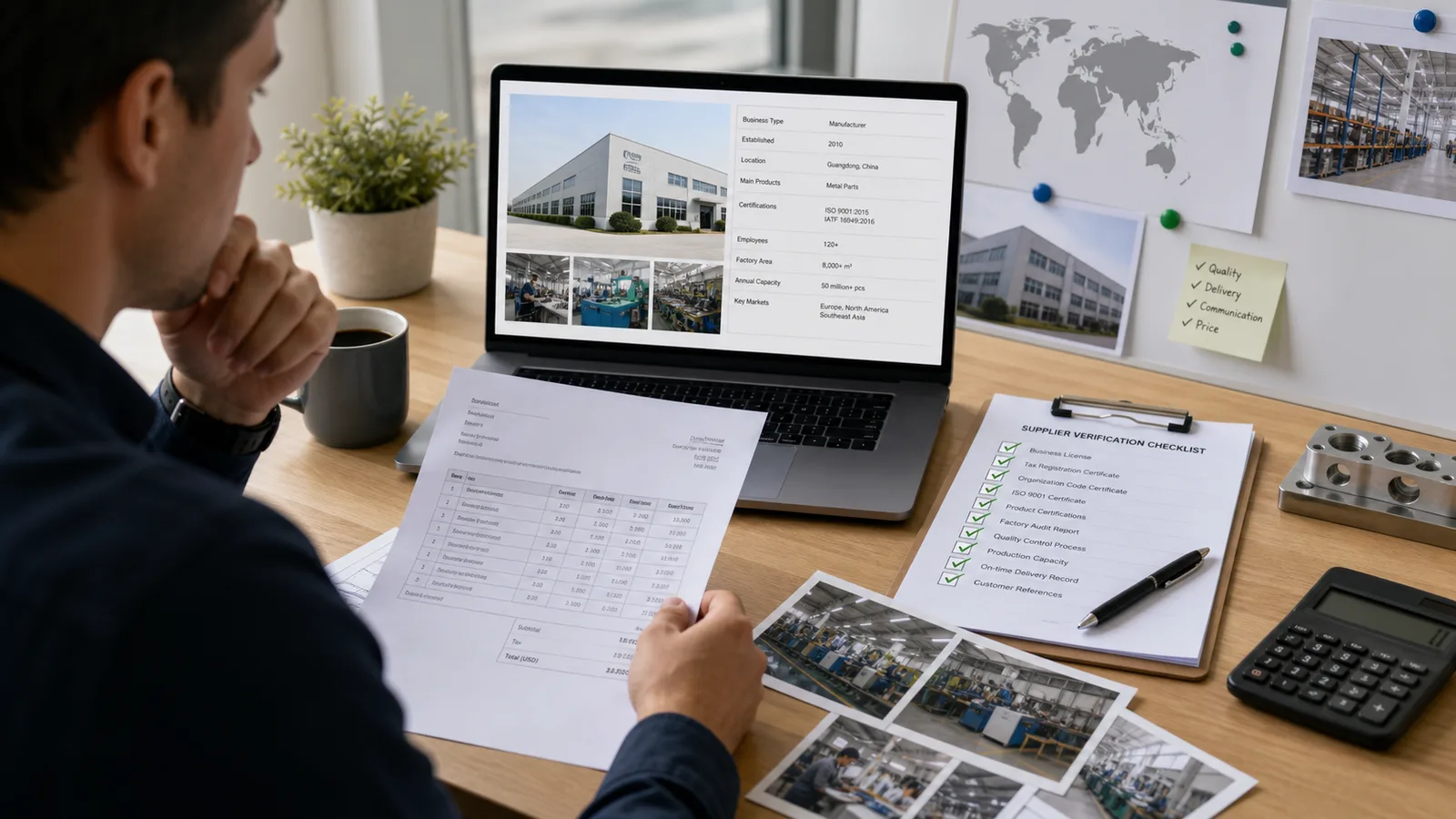
Why verify a Chinese supplier before deposit payment?
Most supplier risk is easier to question before the first transfer. A supplier may have a polished profile, fast replies, and attractive pricing, but the real decision is whether the company details, factory role, quote terms, and payment request are consistent enough to justify deposit payment.
Verification before deposit helps you decide whether to continue, ask for stronger evidence, reduce the order size, change payment terms, or stop before the risk becomes expensive.
Step 1: Check whether the company details match
Start with consistency. The company name on the supplier profile, business license, quotation, pro forma invoice, bank account, email signature, website, and shipping documents should not tell different stories.
A mismatch is not always fraud. Many Chinese suppliers use group companies, trading entities, export companies, or sister factories. But every mismatch should be explained clearly before deposit payment.
- Company name, Chinese name, and invoice name
- Business license details and registered address
- Bank account beneficiary and payment currency
- Website, email domain, and contact identity
- Product range and whether it matches the quoted item
Step 2: Look for factory or trading company signals
Many overseas buyers ask whether a supplier is a factory or a trader. The better question is whether the supplier role is clear enough for your risk level. A trader can be useful, and a factory can still create problems. What matters is whether the supplier can explain production responsibility, quality control, lead time, and accountability.
Buyer-side verification should look for factory or trader signals without treating one label as automatically safe.
- Factory address, workshop photos, and production-line relevance
- Whether the product range is focused or unusually broad
- Who controls sampling, production, inspection, and corrections
- Whether the supplier can arrange onsite checks before payment or shipment
Step 3: Review the quote, PI, MOQ, lead time, and payment terms
A supplier can look legitimate and still create deposit risk through unclear quote terms. Before paying, review what the deposit actually secures: material purchase, tooling, sample confirmation, production slot, packaging, labels, or final goods.
The PI should be specific enough that a later inspection can compare the order against the agreed scope. Vague terms make disputes harder after the deposit has been sent.
- Unit price, MOQ, tooling, sample approval, and lead time
- Payment split, deposit amount, balance timing, and refund language
- Product specifications, packaging, labels, carton marks, and tolerances
- Inspection timing before balance payment or forwarder pickup
Step 4: Ask for evidence before money moves
Good suppliers should be able to provide practical evidence before asking for a deposit. The evidence does not need to be perfect, but it should reduce uncertainty rather than create more questions.
Ask for documents and photos that match the exact company and product being quoted. Generic certificates, copied factory images, or unrelated catalog photos should not carry the full decision.
- Business license and clear company identity information
- Recent factory or warehouse photos related to your product category
- Sample photos, packaging examples, labels, and carton references
- PI, quote, payment instructions, and written inspection agreement
- Contact details for the person responsible for production follow-up
Step 5: Decide whether you need buyer-side supplier verification
If the supplier details are simple, the order is small, and the evidence is consistent, a free risk check may be enough to decide the next question. If the deposit is meaningful, the supplier is new, the claims are unclear, or the payment pressure is high, buyer-side Supplier Verification can reduce visible risk before money moves.
Huang Sourcing can review supplier identity signals, factory or trader indicators, quote terms, payment risk, and practical next questions from the China side before the buyer decides whether to pay.
Red flags before sending a deposit
One warning sign does not automatically mean a supplier is unsafe, but multiple warning signs should slow the decision down. The goal is not to panic. The goal is to ask better questions before the deposit leaves your account.
- The supplier rushes payment before company details are clear
- The invoice company, bank beneficiary, and supplier profile do not match
- The supplier refuses reasonable inspection or evidence requests
- The quoted product range is too broad for the claimed factory role
- The PI lacks product specs, packaging details, balance timing, or correction terms
What Supplier Verification can help check
Supplier Verification is a buyer-side decision support service. It is useful when you need a practical risk summary before deposit, not supplier-side sales support or a guarantee that every hidden issue has been removed.
- Supplier identity and visible company consistency
- Factory or trading company signals from available evidence
- Quote, PI, payment-term, MOQ, lead-time, and deposit-risk notes
- Questions to ask before payment and suggested next steps
- Whether onsite verification, sample consolidation, or QC should be scoped next
What this check does not guarantee
A responsible verification page should be clear about limits. No desk check or onsite visit can remove every sourcing risk. Supplier Verification helps reduce visible supplier and payment risk before deposit, but it does not replace legal due diligence, lab testing, customs compliance review, or a formal factory audit unless those services are specifically scoped.
- It does not promise zero supplier risk
- It does not provide a legal guarantee or contract review
- It does not replace product certification or laboratory testing
- It does not guarantee future production quality without QC inspection
- It does not work as supplier-side sales support