
Quick answer
What should buyers check before a youth ATV lot leaves China?
Match each finished model, youth category, speed configuration, brake and reflector construction, action-plan party, label, manual, serial or VIN range, production lot, and carton to current qualified evidence and controlled manufacturing records. Inspect sampled goods only with an approved safe method. Hold mismatches, but do not treat a static check, supplier ride video, label, or document cover as proof of prescribed ATV performance.
- 1Freeze destination, importer or responsible party, exact model, manufacturer, factory, gasoline or electric powertrain, rider age category, rated and restricted speeds, production lot, assembly state, and carton map
- 2Have qualified parties map the exact product to current ATV, children’s-product, certificate, labeling, fuel or battery, transport, state, marketplace, and destination requirements
- 3Verify the active action-plan party and scope directly with CPSC; do not accept a supplier screenshot, company name, or label alone as proof that the shipped model is covered
- 4Map complete reports, certificates, drawings, manuals, labels, hangtags, model plate, speed-limiter design, brakes, reflectors, controls, suspension, tires, guards, and approved changes to one production version
- 5Compare sampled units for exact identity, visible construction, assembly, controls, cables and hoses, fasteners, guards, reflectors, labels, warnings, manuals, tools, quantities, and pack-out
- 6Use only buyer-approved static or low-risk checks with trained personnel, a secured test area, suitable equipment, stop rules, and no child rider; route prescribed dynamic performance to qualified facilities
- 7Hold missing or mismatched age category, action-plan identity, compliance label, model plate, manuals, speed-limiter parts, brake parts, reflectors, guards, fasteners, reports, or lot traceability
- 8Release only named models, configurations, lots, serial or VIN ranges, assembly states, accessories, and cartons after documented correction and repeat inspection or qualified testing where required
China-side evidence module
Youth ATV lot release checklist
Connect current exact-model evidence and controlled production to sampled physical goods and pack-out. This checklist does not turn a routine inspection into classification, CPSC action-plan approval, dynamic ATV testing, certification, or a safety guarantee.
Controlled product identity
- Destination, responsible party, manufacturer, factory, exact model, VIN or serial scheme, powertrain, youth category, restricted and maximum speed configuration, lot, and approved changes are controlled
- Purchase order, drawings, bill of materials, approved sample, reports, certificates, action-plan reference, labels, manual, online listing, packing list, and cartons describe the same version
Qualified regulatory evidence
- Qualified parties identify current requirements and complete files identify the applicant, manufacturer, factory, exact model, category, tested sample, methods, results, photos, dates, deviations, and limits
- CPSC action-plan status is checked at the official source; a logo, report cover, supplier declaration, marketplace badge, or another model’s certificate is not treated as exact-model evidence
Finished goods and limited checks
- Sampled units match the approved model plate, controls, limiter hardware or settings, brake components, reflectors, suspension, wheels, tires, guards, foot environment, shutdown devices, labels, manuals, tools, and assembly instructions
- VIN or serial, production lot, retail pack, accessory pack, carton marks, destination segregation, quantities, and packing list remain aligned without mixed builds
Hold, correction, and release
- Affected quantity, hold tags, model and component versions, serial or VIN range, carton map, supplier changes, controlled rework, qualified disposition, and repeat checks remain traceable
- Cleared and unresolved models, categories, lots, assembly states, accessories, and cartons stay separated; final release states every open condition
Why youth ATV release evidence matters now
On August 13, 2026, the U.S. Consumer Product Safety Commission recalled about 1,050 China-made Yamazuki XW-A19 youth ATVs sold under the QEASET and HOVERHEART brands. CPSC said the parking brakes failed to hold, the speed-limiting device was not set to the restricted speed required for children ages six and older, and required rear safety reflectors were missing. No incidents or injuries were reported in that notice.
The same CPSC record says an XW-A17 model had already been recalled in June 2026. A separate 2026 Luyuan recall concerned suspension and handlebar requirements on other China-made 40 cc youth ATVs. Those records are different cases with different products and facts, but together they show why a buyer should control age category, brake and speed configuration, visibility hardware, mechanical construction, and model identity before release.
Walmart’s current product-recall page separately lists Yamazuki youth ATVs as an August 13 action for goods sold through Walmart.com, and Yamazuki’s own recall page identifies both XW-A17 and XW-A19 notices. These retailer and company records are current channel signals, not proof of search volume or proof that every youth ATV has the same risk.
- Treat rider age category, maximum and restricted speed, brake system, suspension, controls, reflectors, guards, labels, manuals, action-plan identity, and serial or VIN records as controlled release features
- Do not infer compliant performance from a new appearance, marketplace listing, one supplier video, an action-plan party name, or a static factory sample
- Keep inspection observations linked to test evidence, production changes, complaints, incidents, corrective actions, lots, warehouses, channels, and cartons
- Use final-payment and pickup leverage while affected units, parts, documents, and cartons can still be isolated and rechecked
Evidence checked: CPSC XW-A19 youth ATV recall, CPSC Luyuan youth ATV recall, CPSC XW-A17 youth ATV recall, Walmart product recall channel, Yamazuki recall page.
Define the exact ATV and rider category before checking it
Start with the destination, responsible party, intended rider age, off-highway use, wheel count, straddle seat, handlebar steering, gasoline or electric motor, exact model, VIN or serial structure, displacement or motor rating, battery system where applicable, youth category, restricted and maximum speed configuration, dimensions, weight, suspension, tires, brakes, controls, guards, labels, manuals, accessories, factory, and bill-of-material revision.
CPSC guidance says products meeting the statutory ATV definition must follow federal ATV requirements even when electric. It also warns firms not to misclassify faster, off-road-capable four-wheeled products as children’s ride-on toys. The current CPSC FAQ identifies Category Y-6+, Y-10+, and Y-12+ groups and says each has distinct design, configuration, and performance requirements.
Record who made the classification and requirements decision, the sources and editions checked, assumptions, and unresolved questions. A buyer-side inspection company should not decide the legal category or intended rider suitability at the factory gate.
- Separate an ATV from a ride-on toy, go-kart, recreational off-highway vehicle, utility vehicle, motorcycle, and road vehicle before selecting evidence or checks
- Freeze model name and number, youth category, powertrain, limiter design and setting, brake configuration, suspension, tire specification, controls, guards, reflectors, labels, manual, and action-plan party
- Keep marketing age, package age, model label, manual, online listing, speed claims, sales training, and intended use aligned
- Reject family-level evidence when the tested construction, category, speed configuration, factory, or responsible party cannot be mapped to the shipped model
Evidence checked: CPSC guidance for categorizing youth ATVs, CPSC ATV business FAQ.
What should the action-plan, test, and production evidence connect?
CPSC’s current ATV business information says a new ATV must comply with applicable provisions of the referenced ANSI/SVIA standard, be subject to an active CPSC-approved action plan, bear required identifying and compliance labeling, and be distributed by parties complying with that plan. The action-plan page also asks applicants for model names, specifications, manuals, technical drawings, test reports, and age-category analysis.
Review complete records rather than a cover page or label alone. Connect the applicant or responsible party, manufacturer, factory, exact model, category, tested sample photographs, drawings, bill of materials, braking and limiter construction, suspension, controls, lighting or reflectors, guards, tires, labels, manual, hangtags, receipt and test dates, standard edition, methods, results, deviations, and model-family rationale.
Control post-test and post-approval changes. If the supplier changes the frame, welds, suspension, brake parts, cables, speed-control hardware or software, engine or motor, battery, throttle, kill switch, tires, reflectors, guards, labels, factory, subcontractor, or assembly process, hold the affected lot until a qualified party documents whether existing evidence still applies.
- Verify action-plan status and exact responsible-party identity directly at CPSC; preserve the checked date and source
- Escalate cropped reports, edited results, inconsistent names or dates, missing sample photos, unsupported model-family claims, unreadable labels, or evidence issued to another factory
- Keep regulatory evidence, qualified performance testing, buyer-side inspection observations, freight acceptance, and shipment release as separate decisions
- Do not replace failed, conditional, or missing records with a supplier demonstration, marketplace badge, or similar-model document
Evidence checked: CPSC ATV action plans and active-party list, CPSC ATV requirements FAQ, Huang Sourcing lab report verification guide.
What can a China-side finished-goods inspection check?
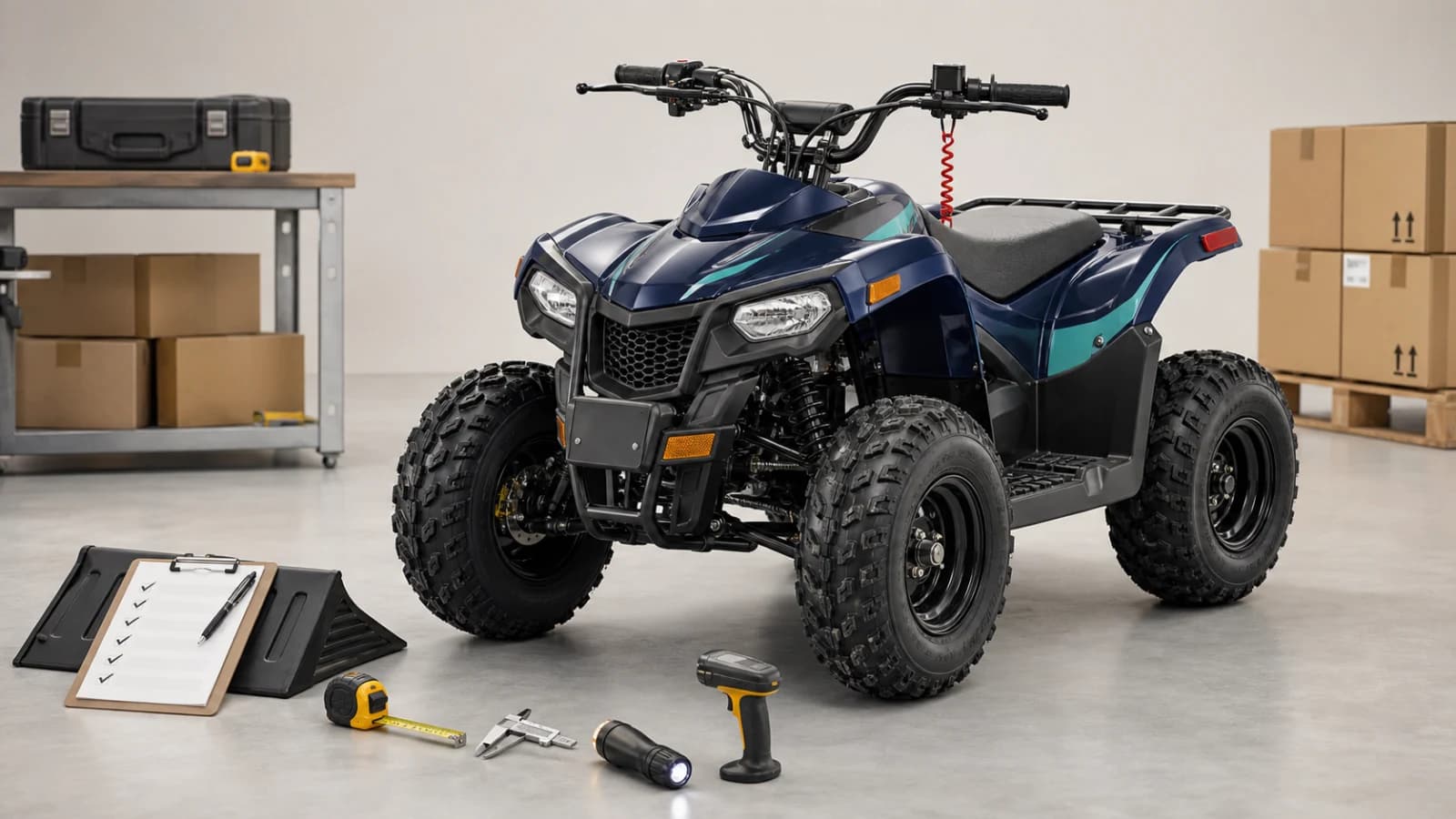
A buyer-side inspection can compare sampled finished goods with approved references while the lot remains accessible. The useful output is a traceable record of model plate, VIN or serial, age-category markings, visible frame and weld condition, suspension and steering assembly, service and parking-brake parts, cable and hose routing, throttle and limiter hardware, engine or motor cutoff devices, reflectors, tires, foot environment, guards, fasteners, fuel or battery-area condition, labels, manuals, tools, quantities, defects, mismatches, and affected cartons.
For partly assembled or crated ATVs, verify the approved assembly state, loose-part list, fastener and torque instructions, tools, protective packing, fluid and battery condition where applicable, carton orientation, handling marks, serial-to-carton map, and evidence that assembly will not conceal damage or omit safety-critical parts. Do not improvise assembly or powered checks without an approved method and suitable facilities.
Measure only buyer-defined accessible dimensions and settings with calibrated tools and record the method, sample, tolerance, reading, and limitation. A visible reflector, parked wheel, limiter screw, warning label, or complete manual is useful evidence but does not establish prescribed performance or compliance.
- Check identity first: model plate, manufacturer and responsible-party names, VIN or serial, production date or lot, category, ratings, labels, manuals, reports, packing list, and carton marks
- Inspect for missing, substituted, loose, cracked, bent, leaking, abraded, pinched, corroded, misrouted, mislabeled, poorly welded, incompletely guarded, or badly packed parts
- Photograph limiter controls or settings, parking mechanism, service-brake components, reflectors, shutdown devices, throttle, suspension, tires, footrests, guards, model plate, warnings, manual, tool pack, and carton identity
- Quantify every mismatch by model, serial or VIN range, lot, sample, defect class, affected quantity, assembly state, and carton range
Keep routine inspection inside a safe test boundary
A routine pre-shipment inspection should not attempt prescribed maximum-speed, restricted-speed, stopping-distance, brake-hold, pitch-stability, endurance, impact, fuel-system, electrical, battery-abuse, or other compliance tests unless a qualified facility, approved procedure, calibrated equipment, controlled course, competent operator, and safety plan are in place. Do not use a child rider for factory acceptance.
Limited static or low-risk checks may be useful when the buyer supplies a written method. Examples can include control movement with power isolated, visible limiter position, parking mechanism engagement, fastener presence, cable routing, wheel rotation while safely supported, tire pressure or dimensions, steering free play, label and manual checks, and other non-destructive observations. The exact scope depends on the product and facility.
Stop on fuel leakage, battery damage, smoke, unusual odor, heat, arcing, brake or steering binding, unexpected movement, throttle return failure, damaged guards, unstable support, sharp edges, loose wheels, structural cracks, or any departure from the approved method. Isolate the sample and preserve its identifiers and time sequence for qualified disposition.
- Define trained personnel, secured area, restraints or supports, ventilation, fire controls, personal protective equipment, instruments, preconditions, stop rules, prohibited actions, and emergency response before any powered check
- Record observations as limited inspection evidence, never as certification, a standard test result, or proof of safe rider use
- Route dynamic speed, braking, stability, suspension, electrical, battery, fuel, durability, and injury-protection questions to qualified laboratories or engineers
- Require correction evidence and repeat the appropriate inspection or qualified test before releasing an affected lot
Connect correction, serials, and cartons to the released lot
A correction is not closed by a supplier message or one repaired sample. Identify affected models, serial or VIN ranges, production dates, lots, parts, settings, assembly states, quantities, warehouse locations, retail packs, and cartons. Record who authorized the disposition, the controlled work instruction, old and new part or setting, completion evidence, and the repeat-check result.
Use quarantine labels and physical segregation so unverified, failed, corrected, and cleared units cannot mix. Sample from the corrected lot under the approved plan and target the original failure node without hiding unrelated open defects.
The release record should name exactly what can move and what remains on hold. If documentary or qualified performance evidence remains unresolved, a good visible inspection does not close that gap.
- Map serial or VIN, lot, age category, model plate, components, limiter configuration, brake parts, reflectors, manuals, accessory pack, retail pack, and master carton
- Preserve before-and-after photos, removed-part controls, rework counts, scrap or quarantine records, retest evidence, inspector notes, and approval authority
- State open conditions, excluded tests, sample limits, mixed-build risk, unresolved documentation, and any downstream assembly required
- Delay pickup when cleared and uncleared units cannot be reliably separated or traced