
Quick answer
How do you verify a supplier's UL certification claim?
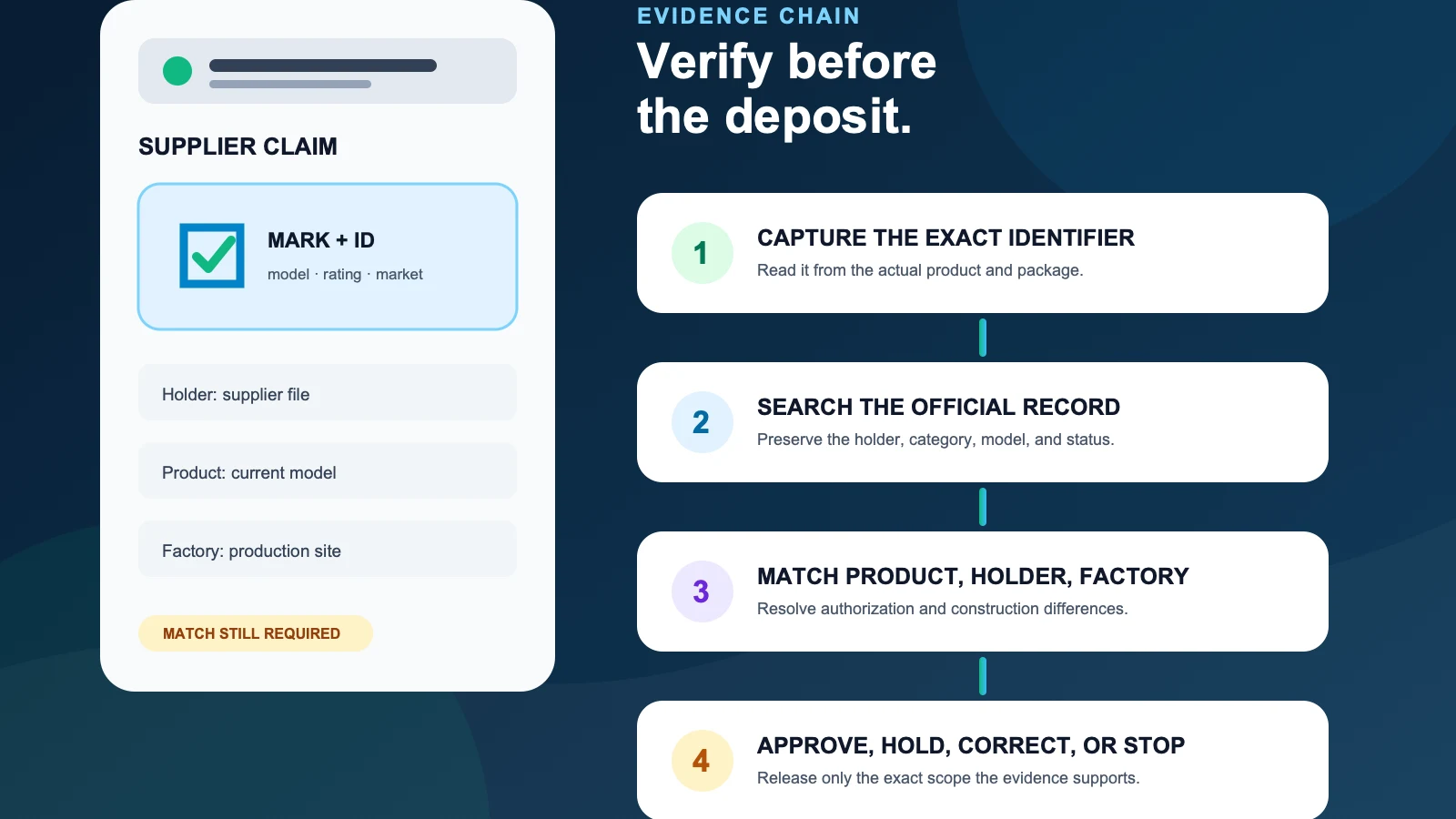
Read the exact identifier from the actual product mark, check it in the official UL Product iQ database, and match the record to the legal holder, product category, certification service, destination, model, ratings, factory relationship, approved construction, and current order. If any link is missing, treat the claim as unresolved and hold the affected deposit or production approval.
- 1Ask for clear photos of the mark on the product and package, including the wording, country code, product identity, file number, issue or serial number, unique identifier, model, ratings, and surrounding labels
- 2Search UL Product iQ using the exact identifier, file number, model, company name, product type, or category control number; preserve a dated copy of the result used for the payment decision
- 3Match the legal certification holder and address to the supplier, manufacturer, factory, brand owner, or documented authorization chain instead of assuming similar company names are interchangeable
- 4Confirm the record covers the exact product category, certification service, destination country, model or series, ratings, conditions, and current status claimed in the quote or listing
- 5Compare the certified construction and named models with the approved sample, drawings, bill of materials, critical components, ratings, labels, manuals, factory, and current production version
- 6Separate UL Listed, Classified, Recognized Component, Verified, certified-to-a-standard, and merely tested claims; each says something different and a component mark does not automatically certify the finished product
- 7Verify supporting reports or certification letters through an official UL channel and investigate changed models, factories, components, ratings, artwork, or identifiers before production approval
- 8Hold the deposit or affected production scope until the certification owner or qualified compliance party documents the match, correction, retest, transfer, alternate route, or rejection decision
Before-deposit evidence module
UL certification verification checklist
This module connects a public certification record to the supplier, product, factory, and payment gate. It does not grant certification, interpret proprietary files, replace laboratory work, or provide a legal conclusion.
Mark and identifier
- Mark type, country code, product identity, file number or unique identifier, issue or serial number, model, electrical ratings, standard claim, label location, and package claim are legible and consistent
- Photos show the actual sample or product rather than a detached label file, supplier screenshot, promotional badge, edited artwork, or unrelated certificate cover
Official certification record
- Product iQ result, certification holder, address, product category, category control number, service, country coverage, model family, ratings, conditions, and current record align with the claim
- Any certification letter or validity question is confirmed through UL Product iQ or independently obtained UL contact details rather than supplier-provided links and contact channels alone
Supplier and product match
- Supplier, manufacturer, factory, brand owner, certification holder, authorization chain, product model, drawings, bill of materials, critical components, labels, manual, sample, and quote identify the same route
- OEM, private-label, alternate-model, multiple-listing, or component claims have written coverage that a qualified party can trace to the exact finished product and destination
Payment and change control
- Deposit release names the cleared model, factory, evidence version, open conditions, responsible owner, and deadline; unsupported models remain excluded
- Later changes in factory, construction, component, rating, model, brand, label, or packaging trigger documented review before balance payment or shipment pickup
Why UL certification verification is a current China-sourcing issue
In July 2026, a U.S. federal court entered a consent judgment and permanent injunction in a case brought by Amazon and UL involving e-bikes marketed with UL marks. The signed order states that the plaintiffs alleged unauthorized use of UL marks and that the consent judgment resolved specified trademark, false-designation, and contract claims. It also states that the defendants did not admit liability or wrongdoing by consenting.
The court record followed a May 2026 CPSC announcement of a national crackdown on fake safety labels and counterfeit certification marks. CPSC said the inquiry included methods used to detect counterfeit marks and broader schemes involving falsified testing and deceptive import practices, including products originating from China.
These records do not prove that every China supplier, certification claim, e-bike, or marketplace listing is false. They do show why a mark image is not the decision record. The useful buyer control is a traceable match between the official certification source and the exact commercial order before funds commit the buyer to production.
- Treat the official directory record as a starting point, then match it to the exact physical and commercial product
- Preserve the legal status of each public record: allegation, consent judgment, injunction, recall, warning, or final finding
- Keep certification ownership, product compliance, supplier identity, factory capability, and order quality as related but separate checks
- Use the deposit stage to resolve unclear ownership, model coverage, factory authorization, or construction changes while supplier replacement remains practical
Read the signed federal consent judgment and permanent injunction together with the CPSC counterfeit-mark crackdown. The first is a consent judgment with a stated no-admission provision; the second is a regulator announcement and inquiry.
Capture the exact UL mark before searching
Ask the supplier for unedited, high-resolution photos of the mark as it appears on the product and package. Record every word and identifier around it: Listed, Classified, Recognized Component, Verified, country code, product identity, file number, issue or serial number, unique ID, model, ratings, and any standard reference. Ask which legal entity is the certification holder and which factory applies the mark.
UL explains that enhanced marks can include certification attributes, country codes, and a unique identifier, while legacy configurations may use a company name or file number. The visible elements vary by certification scheme. Do not conclude that a circle logo by itself proves the scope, market, product, or current authorization.
Separate the certification mark applied to the product from an optional promotional badge, a component mark inside the product, a laboratory logo on a report, or marketing language such as tested to a standard. Photographing each claim in context makes later mismatches easier to isolate.
- Request product, nameplate, package, manual, listing, and certification-letter views for every model
- Do not accept a clean artwork file as evidence that the shipped product is authorized to carry the mark
- Record the market claimed by the mark; U.S. and Canadian coverage should not be inferred from each other
- Flag missing, blurred, altered, inconsistent, or reused identifiers before searching broader company names
UL's enhanced and smart mark guidance explains certification attributes, country codes, unique identifiers, and the distinction between marks and promotional badges.
Search UL Product iQ and preserve the result
UL describes Product iQ as its database for verifying product or component certification. Search the exact file number or unique identifier first, then refine by model, company, product type, category control number, rating, or other record fields. A keyword hit is not enough; open the relevant record and compare its complete scope.
Record the certification holder, address, product category, category control number, certification service, country coverage, model or series, ratings, limitations, and status shown for the product. If the record is unclear or a supplier presents a separate certification letter, use contact details obtained independently from UL to ask about validity.
Save the date, search terms, result, and person responsible for the decision. Public records can change, and a reproducible evidence trail is more useful than a chat message saying that someone saw the model online.
- No exact record: hold the claim rather than substituting a similar model or company
- Holder mismatch: require a documented OEM, private-label, or authorization path reviewed by a qualified party
- Category mismatch: determine whether the record covers a component, a finished product, or another certification service
- Market or rating mismatch: keep the unsupported destination, voltage, configuration, or model outside the release scope
Start with UL's official Product iQ certification database guidance, which lists supported search fields and UL's independent contact route for validity questions.
Match the certification holder to the exact supplier product
Map the commercial chain: seller, contracting supplier, manufacturer, factory, brand owner, certification holder, applicant, and importer. Similar English names, Chinese names, group companies, trading companies, and shared addresses do not establish that one entity can use another entity's certification mark.
Then match the product. Compare product category, model and series logic, ratings, construction, critical components, intended use, brand, labels, manual, destination, and any conditions of acceptability with the quote and approved sample. Ask a qualified compliance party or the certification owner to document how private-label or alternate-model coverage applies.
Supplier verification and certification verification answer different questions. A valid company registration does not prove product certification, and an official product record does not prove that the quoting supplier controls the named factory, will build the certified construction, or can meet the order terms.
- Use legal names and registered addresses, not chat display names or marketplace storefront names
- Trace who owns the certification and who is authorized to apply or reproduce the mark
- Require exact model-family logic instead of treating a shared housing or brand as coverage
- Resolve unexplained manufacturer, factory, or brand differences before paying a nonrecoverable deposit
Verify that the factory will build the certified construction
Connect the directory record to controlled production references: approved sample, drawings, bill of materials, critical-component list, ratings, specifications, label artwork, manual, packaging, change log, factory identity, and production location. A genuine certification for one construction does not automatically cover a visually similar substitute.
Before deposit, document which factory will make the order and what evidence supports that factory relationship. During production and before shipment, compare sampled goods and labels with the approved references. Escalate substitutions in safety-relevant components, materials, wiring, batteries, chargers, enclosures, ratings, factories, models, or marks for qualified review.
A factory visit or inspection can document identity, visible construction, markings, packaging, and production mismatches. It cannot see every internal difference, reproduce certification testing, or decide whether a change remains within a certification file. Keep those decisions with the certification owner, laboratory, or other qualified compliance resources.
- Freeze the exact factory, product version, critical components, ratings, and label file before production starts
- Assign change approval instead of allowing silent supplier substitutions after sample acceptance
- Map affected lots and cartons when a change or mismatch is discovered
- Release corrected production only after documentary disposition and repeat inspection are traceable
Keep reports, certification, and change control separate
A test report records work performed on a stated sample. A certification record identifies a certification service and scope. A mark shows a product claim that must be authorized and correctly applied. None of those items alone proves that current mass production matches the evaluated construction.
Verify full laboratory reports through the issuing source and match the report sample to the product, factory, materials, components, models, dates, methods, results, and limitations. Use Huang Sourcing's separate laboratory-report guide for a detailed report-integrity and sample-match workflow.
Create a written change process for model, factory, component, material, rating, construction, firmware where relevant, label, manual, brand, or packaging changes. The responsible certification owner and qualified compliance parties should decide whether the record remains applicable or whether an update, alternate listing, additional evaluation, retest, or new certification is needed.
- Do not call a product “UL certified” merely because a component has a Recognized Component mark
- Do not treat a passed report from any laboratory as authorization to apply UL trademarks
- Do not assume an official certification record covers later changes or production at an unexplained factory
- Keep supplier approval, deposit release, production release, balance payment, and shipment pickup as separate gates
Use the separate China laboratory report verification guide for laboratory status, report integrity, exact sample, model, factory, date, result, amendment, and production-match checks.