
Furniture power kits · compatibility evidence · lot release
Recliner Battery Pack Checks Before Shipping from China
Before paying the balance or releasing recliner battery packs from China, match the exact battery, charger, cable set and intended furniture application to accepted technical evidence and identifiable production lots. Hold changed components, unsupported compatibility claims, mixed kit contents or unresolved recalled-stock identities before cartons move.
Written by Huang Sourcing Editorial TeamPublished on October 7, 2026
Based on cited public records and buyer-side sourcing analysis; limits and specialist responsibilities are stated below.
Quick answer
What must match before a recliner battery shipment moves?
A connector fitting a chair and a successful recline demonstration are insufficient release evidence. Ask who has accepted the complete power configuration, which furniture loads and features that acceptance covers, whether sampled goods match it, and which lots the decision includes. Keep technical acceptance, inspection observations and shipment authorization connected but separately documented.
The September 2026 Blue Cactus recall makes exact pack identity a current buying issue. Its notice describes overheating, without establishing a particular charger, connector or furniture load as the root cause. The configuration checks below are buyer-side analysis, not a diagnosis of that case.
Buyer-side release module
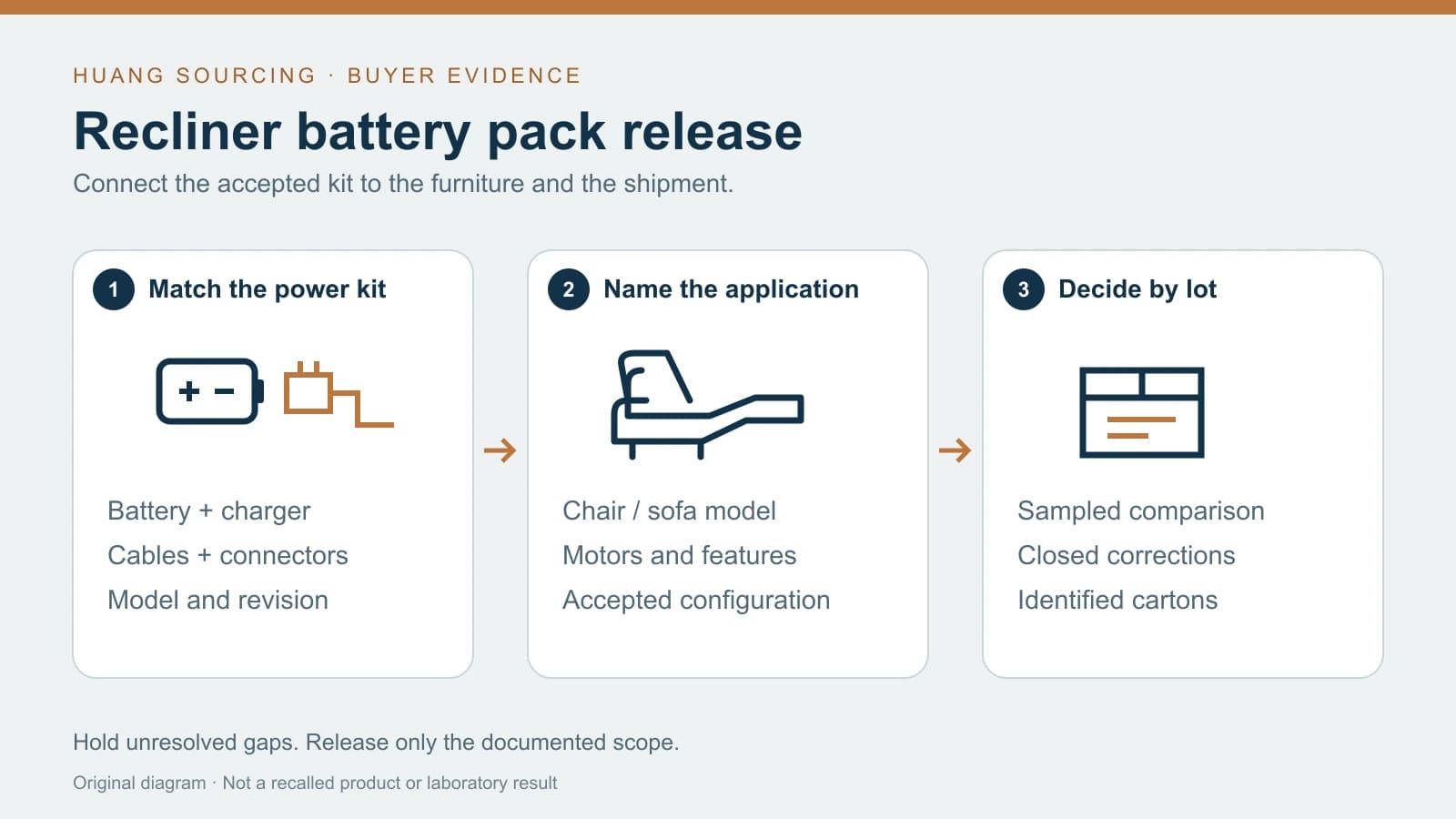
Four checks before balance payment or pickup
Agree who accepts technical coverage, what can be observed safely at the factory and how the decision will identify the actual cartons.
- 1
Define the furniture application
List chair or sofa models, motor/control configuration, intended features, charger use and operating modes. Ask the responsible technical party to define the accepted combinations and limits; capacity alone does not describe the load.
- 2
Freeze the complete power kit
Record battery assembly and revision, cell/protection references where available, charger identity and ratings, connector specification, cables, adapters and splitters. Distinguish a battery-only replacement from a complete kit.
- 3
Reconcile evidence with sampled goods
Match full reports, tested sample photos and change assessments to the current configuration. Compare sampled labels, accessible connectors, approved pack contents and safely agreed functions. Record gaps rather than expanding a report’s scope.
- 4
Authorize identified lots after closure
Connect findings and corrections to model, revision, lot, quantity and carton range. Segregate unknown or affected stock, obtain responsible-party acceptance and verify the correction before releasing that named scope.
Application evidence
Does “compatible with recliners” identify your actual kit?
Turn a broad compatibility statement into a matrix of accepted furniture, battery, charger and cable combinations. A connector’s appearance does not establish its electrical assignment, load coverage or the suitability of adapters. Have qualified parties evaluate those details and define the acceptance criteria for the exact application.
| Intended application | Evidence to connect | Unresolved gap |
|---|---|---|
| Single chair with the specified motor/control set | Accepted chair model, battery revision, charger and cable combination; intended operating modes | A supplier demonstrates a different chair and declares universal compatibility. |
| Sofa, loveseat or multiple powered positions | Accepted combined application, motor/control identities, splitter/cable arrangement and qualified load assessment | The same battery is substituted because the connectors fit. |
| Furniture with additional powered features | Documented features, intended use and accepted configuration including those loads | Evidence covers recline motion only while the listing promises other functions. |
| Battery-only replacement | Named retained charger, transformer or cables, compatibility acceptance and clear replacement instructions | A replacement is packed or marketed as a complete ready-to-use kit. |
Capacity markings cannot settle these questions by themselves. Nor should the buyer invent a universal acceptable number of recline cycles, load limit or charging routine. Ask the responsible technical party to define the relevant operating conditions, including additional features and charging arrangements, and record the accepted boundaries.
Which records should reach the inspector?
Send the approved application matrix, current bill of materials, model and revision list, complete reports, sample photographs and qualified change assessments. Where internal cell or protection identities cannot be checked without specialist access, state that limitation and obtain the accepted supporting production records. A supplier’s unchanged enclosure does not show that its internal assembly is unchanged.
Use the China laboratory-report verification guide to request coverage for the actual kit. Keep report identity, tested configuration and current production separate until they have been reconciled. Do not extrapolate evidence for one pack capacity, charger or furniture application to another without an accepted coverage explanation.
Define safe functions and specialist responsibilities before the visit. Do not improvise overload, short-circuit, puncture, thermal or protection-bypass tests, open live packs, or operate damaged batteries. Record abnormal heat, swelling, damage or operation as a stop condition for qualified assessment rather than trying to prove the concern away.
One evidence file, with named owners
- Market, importer, seller SKU, furniture models, features and intended operating modes.
- Battery assembly/revision, approved charger and cable IDs, connector specification and accessories.
- Accepted application matrix, full reports, tested-sample photos and change records.
- Model/lot label reference, production dates, quantity and carton-to-SKU map.
- Open findings, affected-stock boundary, authorized correction and verification scope.
- Named technical acceptance owner and buyer release authority, with payment and pickup deadlines.
A factory inspection request should identify observable comparisons and acceptance references. It should not silently transfer engineering approval to the inspector.
Evidence to decision matrix
Turn an evidence gap into a shipment decision.
Name the affected application, kit version and lot before deciding to hold, correct or release.
Public case example
Blue Cactus: a furniture battery has its own recall identity
What happened: On September 24, 2026, CPSC recall 26-791 identified approximately 51,000 Blue Cactus 2500 mAh reclining-chair battery packs, model RWX-RBP02. The notice describes an overheating fire/burn hazard and four reports of overheating, smoking or ignition. Its remedy is replacement.
Public evidence: The regulator identifies the model on the rear of the pack, use with multiple reclining-chair brands and Amazon sales from May 2023 through July 2026. The manufacturer’s official recall notice supplies affected-model identification and a replacement contact process. Follow the current official instructions for affected stock.
Buyer lesson: Preserve the battery’s own identity and lot records even when it is sold for several chair brands or bundled with furniture. A chair SKU alone cannot establish which battery cartons require containment. Obtain authorized disposition for affected commercial inventory before any release.
Limits: The CPSC record does not establish China manufacture or disclose a root cause that proves charger or furniture incompatibility. It does not show that other suppliers or models share the defect. Huang Sourcing had no stated involvement in this case.
How do battery-only replacements differ from complete kits?
Inspect against a SKU-specific packing bill. A battery-only replacement may depend on retained accessories; a complete kit should contain the exact accepted charger, cables and other listed parts. The Blue Cactus product page separately describes replacement batteries and kits, illustrating why one generic “battery pack” description can obscure the supplied contents. Its marketing claims are not independent evidence of safety.
Match unit ratings, charger labels, accessory IDs, instructions, listing claims and carton marks to the approved kit version. Record missing, substituted or mixed parts by SKU and lot. Do not resolve a missing charger by inserting an unassessed adapter, or use a higher-capacity pack as an assumed equivalent. After authorized corrections, repeat the relevant comparison and retain the affected quantity and carton boundary.
A release file should state the accepted application, kit revision, inspected sample and identified lot/carton scope, alongside remaining exclusions. Keep the balance-payment decision tied to closed findings. If freight is by air, arrange a separate battery shipment-readiness review with the forwarder; product acceptance and carrier acceptance answer different questions.
Evidence basis for this advice.
Case facts come from the cited regulator and manufacturer notices. Application, inspection and release recommendations are buyer-side sourcing analysis.
- The recall establishes its own product identity and remedy. It does not establish a root cause or the status of unrelated products.
- Qualified parties must accept the exact technical configuration and evidence. Inspection compares sampled goods with accepted references.
- Every finding and correction should identify its application, kit revision and lot scope; sampling cannot establish every unit’s safety.
What can a China-side shipment check establish?
It can document sampled identity, accessible construction, condition, pack contents and alignment with accepted references while stock remains available for correction. It cannot certify battery safety, verify every hidden component, approve furniture load compatibility or prove every unit in the order. Have the importer and qualified specialists determine applicable requirements and evaluate the exact design, destination and intended use.
For a recalled pack, follow the official stop-use and remedy notice. An ordinary inspection, relabeling or successful chair-motion video does not authorize affected goods. Seek appropriate handling and disposition instructions for recalled batteries instead of putting them in ordinary waste or recycling.
Make the application and lot scope explicit.
Send the furniture application matrix, battery and charger references, accepted evidence, kit versions and carton map. Huang Sourcing can scope a China-side comparison and document open gaps before balance payment or pickup.
Sources
Public sources checked October 7, 2026 Beijing time. Houston Chronicle’s September 29 reporting provides a separate editorial attention signal. Primary records govern case facts; no cited source implies Huang Sourcing participation.
- CPSC — Blue Cactus battery pack recall 26-791
September 24, 2026 primary record: RWX-RBP02 identity, overheating hazard, approximately 51,000 units, four reported events and replacement remedy.
- Blue Cactus — official recall and product information
Manufacturer’s affected-model and replacement notice; also distinguishes replacement batteries from complete kits. Product claims are not independent safety verification.
- Houston Chronicle — September 29 battery recall reporting
Independent editorial attention signal by Yvette Orozco. The case analysis relies on the primary records above.