
Quick answer
What should buyers check before power banks leave China?
Match the exact model and production lot to approved technical files, then inspect sampled units, identifiers, packs, and cartons for consistency and visible abnormality. Keep laboratory, product-release, marketplace, customs, and dangerous-goods approvals as separate gates.
China-side evidence module
Power bank release checklist
This checklist connects the physical shipment with buyer-approved references. It does not turn a sampled inspection into battery engineering, accredited testing, certification, or carrier approval.
Order and batch identity
- Model, SKU, nominal capacity and energy, input and output ratings, connector layout, color, dimensions, weight, accessories, sales channel, destination, factory, production date, lot, and serial or date-code format
- Purchase order, approved sample, bill of materials, drawings, change record, packing list, retail pack, carton mark, and unit identifiers all point to the same production version
Product condition and construction
- Enclosure flatness, seam closure, fasteners, port alignment, indicator windows, buttons, finish, label permanence, accessories, and absence of visible swelling, cracks, leakage, corrosion, heat or impact damage
- Buyer-approved safe functional sample: charging and output behavior, indicator sequence, port fit, cable fit, basic control operation, abnormal heat or odor stop rule, and result traceability
Technical and compliance evidence
- Applicant, manufacturer, factory, model, cell and pack identity, ratings, photos, sample dates, report scope, results, issue date, laboratory details, and destination-specific requirements
- Qualified decisions for product safety, claimed capacity and performance, applicable certifications, report coverage after changes, marketplace evidence, and whether new testing is required
Pack-out and release control
- Unit warning and rating label, model and serial visibility, barcode, importer or responsible-party information, manual, retail-pack protection, terminal protection, accessories, carton quantity, weight, marks, and lot segregation
- Affected quantity, hold tag, carton map, correction instruction, replacement or rework record, retest decision, re-inspection result, balance-payment status, and forwarder handoff
Why power bank release evidence deserves attention now
Recent official records show a continuing pattern rather than one isolated brand story. In April 2026, CPSC reannounced a recall covering about 429,200 Casely wireless power banks after additional overheating, expansion, and fire reports included one fatality and a February 2026 incident on an airplane. In June 2026, CPSC announced another recall for China-made solar wireless power banks after two reports of battery swelling.
The pattern also includes traceability-sensitive cases. CPSC’s INIU BI-B41 recall covered only named model and serial groups and recorded 15 overheating reports, including 11 fires, three minor burn injuries, and more than $380,000 in property damage. That record makes model, serial, lot, and carton mapping operational evidence, not administrative decoration.
These public records do not prove that every China-made power bank, supplier, or order is unsafe. They show why a buyer should not release an untraceable or visibly abnormal batch and why absence of visible defects cannot replace qualified engineering, laboratory, certification, and transport review.
- A supplier statement that the same cell or same report was used is not enough when the model, factory, bill of materials, rating, report photo, or production date differs
- A clean-looking sample does not prove the internal cells, protection circuit, welds, insulation, capacity, or bulk lot meet requirements
- A report file does not prove that production matches the tested sample or that the report is authentic, current, complete, and applicable to the destination
- Correction leverage is strongest before balance payment and pickup, while segregation, document review, controlled rework, retesting, re-inspection, or cancellation remains practical
Current primary records: CPSC Casely reannouncement, CPSC Super Off-Road recall, and CPSC INIU BI-B41 recall.
Which model, cell, pack, and production lot are being released?
Begin with product identity, not a generic checklist. Record the exact power-bank model, SKU, advertised capacity, watt-hour rating, input and output specifications, connector arrangement, wireless-charging claim if any, dimensions, weight, enclosure, accessory set, destination, factory, production date, lot, and serial or date-code logic.
Then connect the order to the evidence. A buyer or qualified specialist should compare the bill of materials, approved sample, drawings, change notices, report photos, laboratory applicant and manufacturer, cell and pack identity, protection design, label artwork, packaging, and transport documents. If production changed, disclose the change before deciding whether prior reports still apply.
- Ask for an order-specific evidence index listing each file, model, report number, laboratory, issue date, sample identity, factory, lot, and destination
- Compare report and document identifiers with the unit label, retail pack, carton, packing list, purchase order, and final sales claim
- Escalate any changed cell supplier, cell model, pack layout, protection board, enclosure, port, cable, adhesive, insulation, firmware, factory, rating, or capacity claim
- Treat missing, duplicated, overwritten, inconsistent, or easily removable serial and lot marks as a release problem until traceability is restored
Use the China laboratory report verification guide to structure source-file, model, sample-photo, laboratory-scope, and production-match questions.
What can a buyer-side inspection check on the physical batch?
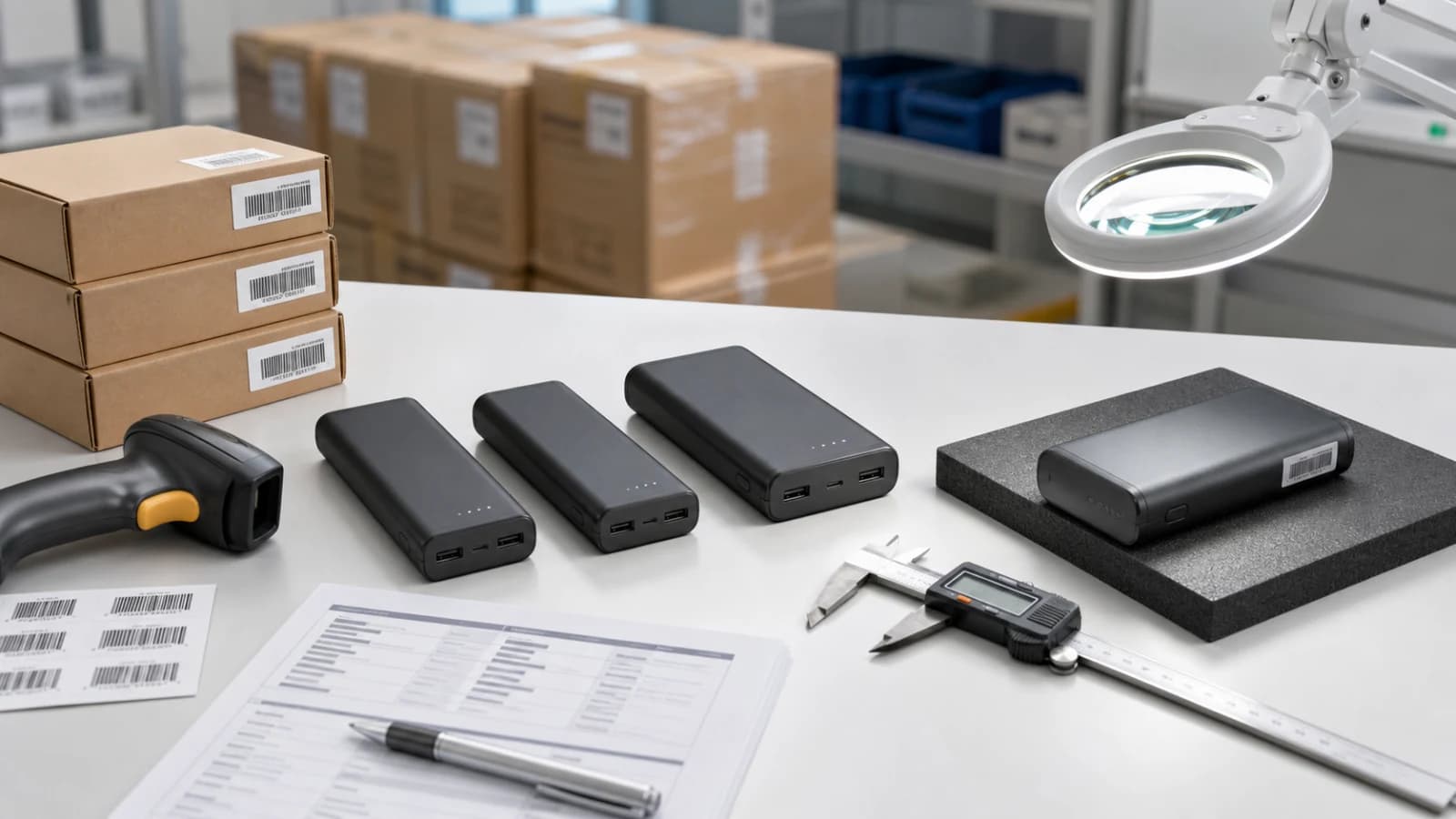
A useful inspection compares sampled units with approved references and records every result by SKU and lot. It should cover enclosure geometry, seams, buttons, ports, indicators, finish, unit labels, accessories, retail packaging, carton protection, quantities, and any visible sign of swelling, heat, leakage, corrosion, impact, or undocumented rework.
Functional checks need a buyer-approved method, suitable equipment, safe charging conditions, and stop criteria. A short sample check may confirm basic input, output, indicators, controls, or connector fit. It must not be described as proof of rated capacity, protection performance, abuse tolerance, cycle life, or battery safety.
- Photograph the full unit, ratings, model and serial or date code, every port, seams, indicators, accessory set, retail pack, lot mark, and carton mark in context
- Compare dimensions and weight against approved tolerances; unexplained drift can be a clue that construction or supplied components changed
- Open cartons across the agreed sampling plan to detect mixed models, lots, label revisions, accessories, packaging, or correction status
- Stop use, isolate the item, protect personnel and property, and follow the buyer’s qualified safety process if swelling, heat, odor, smoke, leakage, hissing, sparking, or damaged cells are suspected
What must remain with laboratories, compliance teams, and carriers?
Product inspection and laboratory evaluation answer different questions. An accredited or otherwise qualified laboratory may be needed for destination-specific electrical, battery, capacity, electromagnetic, chemical, transport, or marketplace requirements. The importer and advisers must decide the applicable standards, sample plan, report validity, certificate language, and whether production changes require new testing.
Transport approval is a separate gate. The shipper, forwarder, carrier, dangerous-goods specialist, and destination authorities decide classification, documentation, state of charge, packing instruction, labels, marks, quantity limits, acceptance, and routing. A passed visual inspection does not authorize air or ocean carriage.
- Do not use an open-circuit voltage reading, short charge cycle, USB load, sample teardown, factory aging sheet, supplier declaration, SDS, or UN 38.3 summary as a substitute for every other required test or approval
- Do not assume a report for a bare cell automatically covers the finished power bank, or that a report for one finished model covers changed cells, ratings, pack layouts, factories, or model families
- Keep product-release, marketplace, customs, and dangerous-goods decisions separately approved and version controlled
- Reconfirm current carrier and marketplace instructions before production, labeling, booking, pickup, and shipment because acceptance rules can change
For the separate carrier handoff, use the lithium battery air-shipping checklist.