
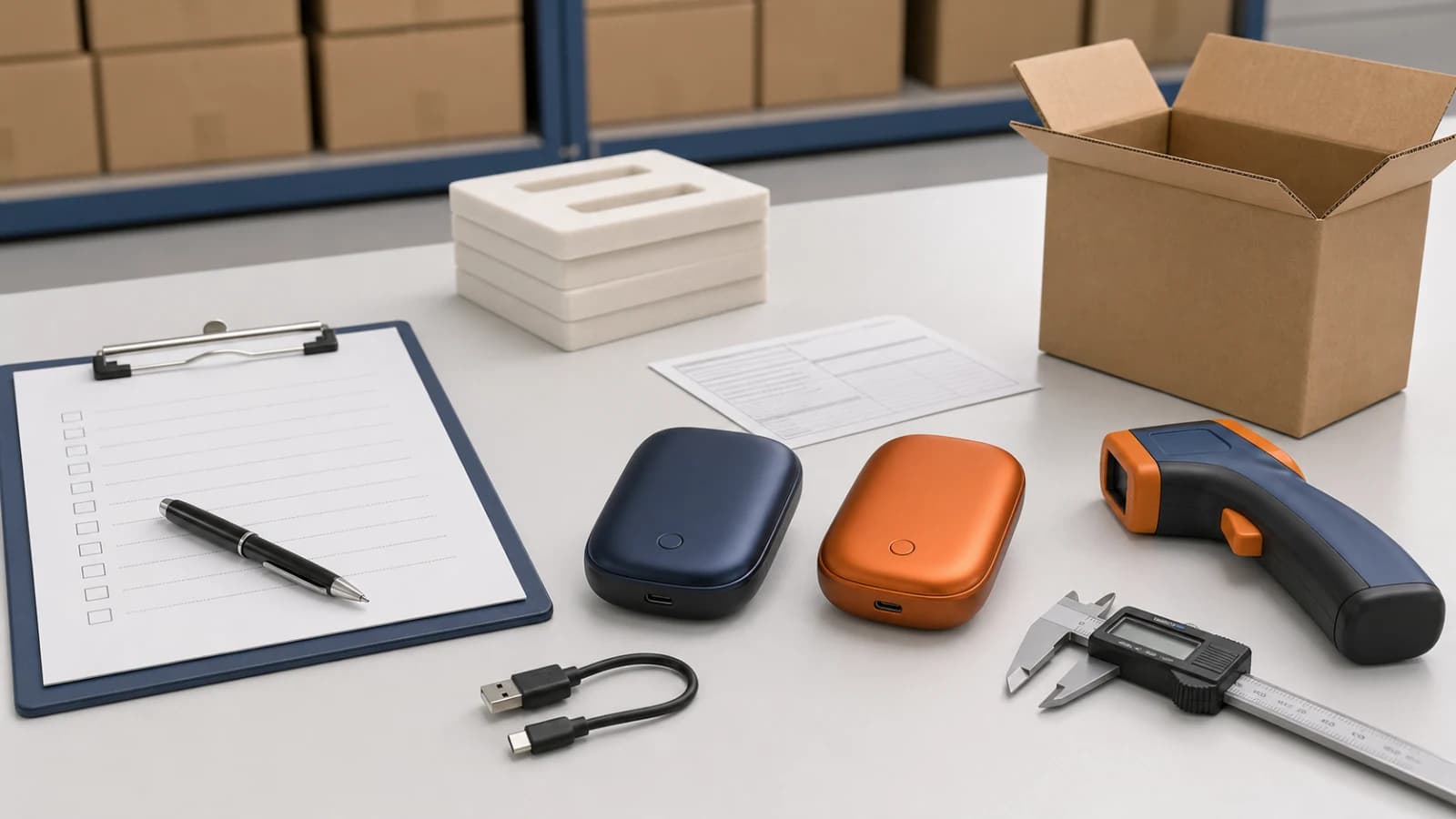
Quick answer
What should buyers check before rechargeable hand warmers leave China?
Match the exact model and production lot to approved technical files, then inspect sampled units, identifiers, packs, and cartons for consistency and visible abnormality. Keep laboratory, product-release, marketplace, customs, and dangerous-goods approvals as separate gates.
October 2026 update
Can a different brand share the recalled components?
Yes. The HotHands manufacturer notice states that its recalled H163650 warmers share identical lithium-ion battery and electrical components with the earlier OCOOPA recalled product. This statement concerns those products; it is not proof that every private-label hand warmer shares their construction.
Ask the supplier for a written cross-reference connecting each retail brand and SKU to the factory model, cell and pack part IDs, electrical assembly revision, bill of materials, production dates and carton ranges. Compare that file with complete reports and production records. If the supplier cannot bound a possible match, keep the uncertain lots on hold.
1. Screen identity before operation
Record the destination notice, brand, unit model and batch with photographs of both units in a pair and their retail box. A missing or unreadable identifier leaves the scope unresolved.
2. Trace the component version
Request source part numbers and revision records for the cell, pack and electrical assembly. Ask qualified parties to assess substitutions; a shared shell or a different logo is not component evidence.
3. Bound the held stock
Connect each affected or uncertain version to production dates, quantities and carton IDs. Keep clearly identified stock and unresolved stock separated; record who owns the disposition.
4. Close the scope before payment or pickup
For non-recalled stock, obtain written manufacturer and qualified-party assessment, applicable evaluation and correction evidence, then re-inspect the agreed scope. Recalled products remain subject to their recall process.
Do not charge or heat recalled units to see whether they fail. A passed spot check, fresh label or replacement carton cannot override a recall. Obtain the applicable authorized handling and disposition instructions before moving held battery products.
China-side evidence module
Rechargeable hand warmer release checklist
This checklist connects the physical shipment with buyer-approved and qualified references. It does not turn a sampled inspection into battery or heater engineering, accredited testing, certification, importer review, or carrier approval.
Exact model, ratings, and destination
- Destination, model, capacity, watt-hour rating, charging input, claimed temperature range, intended use, factory, date, lot, importer, sales channel, and approved changes are controlled
- PO, approved sample, drawings, bill of materials, test samples, reports, labels, instructions, retail pack, carton, and packing list describe one production version
Battery, heater, and qualified evidence
- Cell and pack identity, protection board, heater, temperature sensor, control logic, charging parts, wiring, insulation, housing materials, sample photos, results, and limitations align
- Laboratory or certification source, report number, manufacturer, factory, exact model, ratings, current status, UN 38.3 test summary, and destination scope are independently checked
Physical product and pack-out
- Sampled units match the approved enclosure, seams, buttons, ports, magnets or connectors, indicators, dimensions, weight, markings, finish, assembly, accessories, and buyer-approved observation limits
- Model, lot, ratings, warnings, instructions, retail package, barcode, terminal protection, carton quantity, carton marks, packing list, and destination file are consistent and readable
Hold, correction, and release
- Affected quantity, hold tags, carton map, supplier change, controlled work instruction, replacement parts, qualified retest disposition, revised files, and repeat inspection remain traceable
- Cleared and unresolved models, dates, lots, and cartons stay separated; final release names exact scope, open conditions, and the separate transport decision
Why rechargeable hand warmer release evidence matters now
CPSC issued separate HotHands and Gobi Heat rechargeable hand warmer recalls on October 1, 2026. Both notices describe battery and electrical-component overheating hazards and identify China manufacture. They add distinct branded models to the screening file; they do not establish a defect in every similar-looking product.
The HotHands manufacturer notice says its recalled model shares identical lithium-ion battery and electrical components with the earlier OCOOPA recalled product. That is a documented reason to trace components across brand names, rather than screening only the logo on a purchase order.
For buyers, the new decision is whether stock can be separated by brand, factory model, bill-of-materials revision and component lot. Hold uncertain matches for written manufacturer and qualified technical review. Do not assume that a visual inspection, supplier assurance or changed retail label resolves the recall question.
- A supplier claim such as “UL,” “CE,” “UKCA,” “UN 38.3,” “overheat protection,” or a temperature range needs exact-model evidence and is not proof by itself
- Cell, pack, protection board, heater, temperature sensor, control logic, port, magnet, housing, factory, firmware, and rating changes can alter the evidence question
- A genuine report is useful only when sample photos, construction, ratings, factory, results, limitations, and the shipped version align
- Correction leverage is strongest before balance payment and pickup, while segregation, replacement, retesting, re-inspection, relabeling, rerouting, or cancellation remains practical
Current evidence: CPSC HotHands recall, CPSC Gobi Heat recall, and HotHands component statement. CJWW coverage on October 1 is a separate attention signal, not an additional incident count.
Freeze the exact hand warmer model before relying on evidence
Build one controlled model record connecting the SKU and marketplace name to the cell and pack, nominal capacity and watt-hours, charging input, heater, temperature sensor, protection board, control logic, housing, seams, buttons, indicators, ports, magnets or connectors, claimed heat settings, warnings, instructions, factory, production date, and lot.
Do not treat color or a shared shell as a unique identity. Two hand warmers can look alike while using different cells, protection boards, heaters, sensors, wiring, insulation, plastics, charging parts, firmware, or factories. A paired product also needs rules for matching units, accessories, package identity, and batch information.
Put every safety-relevant substitution through written change control. Hold affected production until qualified parties determine whether document review, testing, certification updates, importer filings, transport documents, or new carrier acceptance are required.
- Use a controlled specification, bill of materials, exploded drawing, wiring information, approved sample, label artwork, manual, retail-pack file, carton map, and change log
- Photograph the approved reference from the same angles and detail points required during mass-production inspection
- Require each supplier change to identify the first affected unit, production date, lot, serial or batch range, and carton range
- Reject unexplained evidence for another manufacturer, factory, model alias, capacity, cell, pack, heater, control board, rating, or sample photo
Use the China laboratory report verification guide to structure source-file, model, sample-photo, laboratory-scope, and production-match questions.
What can a China-side finished-goods inspection check?
A buyer-side inspection can compare sampled production with approved references while the goods remain accessible. The useful output is a traceable record of model and lot identity, visible construction, dimensions, weight, assembly, ratings, warnings, instructions, packaging, quantities, defects, mismatches, and affected carton scope.
Inspect enclosure flatness, seams, buttons, switches, ports, magnets or connectors, indicator windows, fasteners, surfaces, sharp edges, loose parts, contamination, odour, finish, labels, accessories, retail-pack protection, and cartons against buyer-approved criteria. Record swelling, enclosure lift, distortion, cracking, impact marks, leakage, discolouration, heat marks, corrosion, loose ports, or rattling as stop-and-escalate findings.
Use only low-risk buyer-approved observations with suitable equipment and written limits. Do not open cells, short terminals, overcharge, crush, puncture, drop, block heat dissipation, bypass protection, run unattended, or improvise abnormal-operation, thermal-runaway, endurance, fire, or abuse tests during an ordinary inspection.
- Photograph each sampled unit or sample number with model and batch or serial code, rating label, seams, buttons, ports, indicators, accessories, warnings, manual, retail pack, and carton context
- Use buyer-approved dimensions, weight tolerances, sampling, defect classes, photo rules, functional-observation limits, accessible-temperature limits, and stop conditions
- Open cartons across the agreed sampling plan to detect mixed models, lots, label revisions, paired units, cables, pouches, packaging, or correction status
- Keep destructive, battery-safety, heater-safety, capacity, endurance, and transport testing separate from ordinary saleable-stock inspection
What should qualified battery and heater evidence establish?
CPSC lists voluntary standards used in work on high-energy-density battery fire risks, including standards for lithium batteries, portable power packs, secondary cells and batteries, and portable rechargeable cells. The responsible importer and qualified technical parties must decide which product, battery, electrical, chemical, labeling, certification, and marketplace requirements apply to the exact hand warmer and destination.
A cell datasheet, safety data sheet, certificate cover, supplier declaration, or brief factory video does not prove the finished product behaves as intended. The evidence file should connect the complete cell, pack, protection board, charging circuit, heater, sensor, control logic, wiring, insulation, housing, tolerances, abnormal-operation behavior, production controls, and change history to the evaluated sample.
Huang Sourcing can organize buyer-approved files and compare visible goods with controlled references. It does not design the product, select legal requirements, certify safety, authenticate every record, issue a laboratory report, authorize a mark, submit importer filings, or make battery or product-safety guarantees.
- Record laboratory role, report number, issue date, standard and edition, clauses, sample photos, exact model, ratings, construction, results, deviations, and limitations
- Map the cell, pack, protection board, charging parts, heater, sensor, control board, wiring, insulation, housing materials, and substitution rules to the tested version
- Ask qualified parties whether charging, overcharge, short-circuit, temperature, abnormal operation, mechanical strength, vibration, shock, fire, endurance, capacity, and claim evidence covers the shipped configuration
- Escalate cropped reports, edited screenshots, missing sample photos, unexplained model families, inconsistent dates, or files that cannot be verified at the claimed source
Review the CPSC high-energy-density battery standards page with qualified parties; do not infer that one listed voluntary standard automatically applies to or approves the exact product.
Keep product release separate from lithium-battery transport approval
The current eCFR text of 49 CFR 173.185 requires lithium cells and batteries to meet the applicable UN Manual of Tests and Criteria subsection 38.3 design tests. For covered cells and batteries, the rule also requires manufacturers and subsequent distributors to make a test summary available with identity, contact, model, physical-description, watt-hour, report, test-result, edition, and responsible-person information.
A matching UN 38.3 test summary addresses a transport evidence requirement; it is not a product-safety certificate, marketplace approval, capacity guarantee, or proof that the mass-produced hand warmer matches the tested battery. The shipper, forwarder, carrier, dangerous-goods specialist, and destination authorities decide classification, state of charge, packing, marks, labels, documents, quantity limits, acceptance, and routing.
Keep product release, importer compliance, marketplace review, customs, and dangerous-goods decisions separately approved and version controlled. Reconfirm current carrier instructions before production, labeling, booking, pickup, and shipment because acceptance rules can change.
- Match the UN 38.3 test summary to the actual cell or battery model, product model where relevant, manufacturer, physical description, watt-hours, report ID, laboratory, test date, and applicable test edition
- Do not use a safety data sheet, supplier declaration, brief charge test, or report for another cell or battery as a substitute for a matching test summary or carrier decision
- Do not assume a test summary for a bare cell automatically covers every assembled battery or changed hand-warmer configuration
- Hold pickup when product evidence, transport evidence, packaging, labels, documents, or carrier instructions do not reconcile with the finished lot
Check the current eCFR text of 49 CFR 173.185 lithium-battery requirements and use the lithium battery air-shipping checklist.