
Quick answer
What should buyers check before a grill brush lot leaves China?
Match the exact cleaning architecture, material and attachment construction, approved references, qualified evidence, production changes, sampled goods, labels, instructions, retail sets, lots, and cartons. Keep saleable-goods inspection separate from destructive retention and durability work. Hold mismatches instead of treating a visual pass or informal pull demonstration as proof that bristles will remain attached through use.
- 1Screen individual brushes, tool sets and replacement heads against current official recall identities; hold affected or uncertain stock even when the supplier reports no customer complaints
- 2Freeze destination, responsible party, exact model, cleaning architecture, materials, dimensions, bristle or coil geometry, handle and head attachment, scraper, production factory, lot, retail set, and carton map
- 3Have qualified parties identify current product-safety, chemical, food-contact adjacency, labeling, reporting, marketplace, and destination requirements; a generic supplier checklist is not a legal determination
- 4Prefer a bristle-free design when the buyer’s risk assessment supports it; changing from wire bristles to a coil, scraper, pad, stone, nylon, or another architecture requires its own hazard review and validation
- 5Map complete test records to the exact tested construction, material, factory, method, conditioning, sample size, acceptance criteria, results, deviations, photographs, and date
- 6Compare sampled production with the approved sample, drawings, bill of materials, head geometry, wire bundles, twist, anchor points, handle, scraper, finish, labels, instructions, quantities, and packaging
- 7Keep non-destructive finished-goods inspection separate from qualified destructive retention, fatigue, corrosion, wear, misuse, and lifecycle testing; define sacrificed samples and lot linkage before the visit
- 8Hold mixed or undocumented models, substituted wire or attachment methods, missing evidence, loose or irregular bristles, damaged heads, sharp unintended edges, corrosion, weak handles, mismatched labels, and untraceable cartons
- 9Release only named models, lots, sets, and carton ranges after controlled correction and repeat inspection or qualified re-testing where the change or failure requires it
China-side evidence module
Grill brush lot release checklist
Connect an approved exact-product design and qualified evidence to the actual production lots and pack-out. This checklist does not convert a routine inspection into engineering validation, laboratory testing, certification, or a safety guarantee.
Controlled product identity
- Purchase order, drawing, bill of materials, approved sample, test report, label, instruction sheet, barcode, online listing, packing list, and carton identify the same model and cleaning design
- Factory, subcontractor, production dates, material grades, wire diameter or alternative cleaning element, head assembly, handle attachment, scraper, finish, lot, retail set, and approved changes are traceable
Qualified evidence
- The buyer-approved test plan defines the product-specific hazards, conditioning, sample selection, destructive methods, acceptance criteria, records, failures, and retest rules
- Complete reports identify issuer, applicant, manufacturer, factory, exact model, tested sample, construction, methods, results, photos, dates, deviations, and limits; a cover page or similar-model report is not enough
Finished goods and pack-out
- Sampled heads, bristle or coil arrays, anchors, twists, joints, handles, hanging loops, scrapers, finishes, labels, instructions, retail packs, sets, and cartons match approved references
- Visible loose strands, gaps, distorted bundles, burrs, cracks, weak joints, sharp unintended edges, corrosion, contamination, mixed builds, damage, and packaging contact are recorded by affected model and lot
Hold, correction, and release
- Hold tags, affected quantity, defects, sacrificed test samples, test results, supplier changes, rework method, repeat checks, cleared lots, and unresolved lots remain separate and traceable
- The release record names exact models, production dates, lots, retail sets, destination labels, carton ranges, open conditions, and the person authorized by the buyer to decide
Why grill brush release evidence matters now
The October 1, 2026 Walmart action adds another documented tool-set example to the category record. Buyers should screen set contents as well as outer SKUs before authorizing cartons; a quiet complaint history is not a release criterion.
On August 27, 2026, the U.S. Consumer Product Safety Commission expanded Conair’s recall of China-made Cuisinart metal wire-bristle grill brushes by about 1,905,805 units, bringing the stated total to 3,625,800. CPSC said small metal bristles could detach, remain on a grill or food, and be swallowed. The notice reports at least 54 detachment reports or reviews, including three people who sought medical treatment to remove bristles from the digestive tract or throat.
That action was not an isolated model notice. CPSC had separately announced 2026 recalls covering more than 10.2 million Nexgrill wire-bristle brushes and more than 3.2 million Weber brushes. A CPSC chairman’s March statement described expanded enforcement attention to hazardous wire grill brushes made overseas. These are separate records with different firms and facts; they show a recurring risk node, not proof that every brush, supplier, factory, or design will fail.
Health Canada’s current barbecue safety page also advises consumers to inspect a brush and grill before every use, replace a brush when bristles loosen, and consider non-metal alternatives. That end-user advice cannot substitute for a buyer’s design review or production validation, but it reinforces why the release decision must address both initial construction and wear over time.
- Treat cleaning architecture, wire and anchor construction, production change control, evidence scope, lot traceability, and instructions as release-critical inputs
- Do not infer retention from appearance, one pull demonstration, a supplier video, a marketplace listing, or another brand’s test method
- Link qualified destructive samples to the production lot without presenting the surviving saleable sample as the tested unit
- Use balance-payment and pickup leverage while affected lots, retail sets, test samples, packaging, and records can still be isolated and corrected
Evidence checked: CPSC Walmart Expert Grill recall, CookOut News October 1 industry coverage, CPSC Cuisinart recall expansion, CPSC Nexgrill grill brush recall, CPSC Weber grill brush recall, CPSC chairman enforcement statement, Health Canada barbecue safety guidance.
Define the exact brush before choosing checks
Start with destination, responsible party, intended grill and cleaning use, exact model, retail set, head width and shape, wire-bristle, coil, scraper, pad, stone, nylon, or mixed architecture, material grades, wire or cleaning-element dimensions, bundle pattern, twist, staple, weld, adhesive or mechanical anchor, head-to-handle joint, handle material and length, hanging feature, finish, instructions, labels, factory, and bill-of-material revision.
“Grill brush” is not one controlled construction. A tri-wire brush, flat wire panel, twisted-wire head, replaceable cleaning head, steam brush, coil scraper, and bristle-free pad can fail in different ways. A supplier’s family name or visual similarity does not make one model’s evidence applicable to the others.
Record who made the product architecture and requirements decision, the official and specialist sources checked, assumptions, and unresolved questions. A buyer-side inspector should compare production with approved references, not invent the product specification at the factory gate.
- Separate wire-bristle, wire-coil, scraper, nylon, pad, stone, steam, replaceable-head, and combination products before setting a sampling or test plan
- Freeze every part that can change detachment, fracture, sharp-edge, heat, corrosion, chemical, handling, or labeling risk
- Match product, instruction sheet, warning, packaging, barcode, online listing, replacement-head claim, and intended-use claim
- Reject “same series” evidence when the tested head, wire, anchor, material, handle joint, factory, conditioning, or model cannot be mapped to shipment
What should the test and production evidence connect?
Build an evidence chain from the buyer-approved product specification to the exact production version. Qualified records should identify the tested sample, drawing and bill-of-material revision, wire or cleaning element, anchor method, handle and head construction, conditioning, use simulation, retention or durability method, measurement equipment, sample size, acceptance criteria, actual results, failures, photographs, deviations, and report date.
Do not turn a generic pull number into a universal safety claim. Product-specific methods and acceptance criteria require qualified engineering and compliance judgment. A single new brush can look uniform and survive a simple pull yet still have an unexamined wear, heat, corrosion, fatigue, food-transfer, or misuse pathway.
Connect incoming-material records and line controls to the same evidence. Wire grade and diameter, bundle count, crimp or twist geometry, staple or weld settings, adhesive lot and cure where relevant, molded-head material, handle fastener, process setup, in-process checks, tool maintenance, operator records, and final lot tests should remain traceable when required by the control plan.
- Verify issuer, applicant, manufacturer, factory, exact model, sample identity, method, equipment, criteria, result, photographs, date, and report integrity
- Escalate cropped reports, edited results, unsupported model families, missing sample photos, inconsistent names or dates, undisclosed failures, or evidence issued to another factory
- Keep legal or marketplace compliance, qualified design validation, routine inspection, lot testing, and the buyer’s commercial release as separate decisions
- Route any change affecting risk through documented review before relying on earlier evidence
Evidence checked: Huang Sourcing lab report verification guide, CDC wire-bristle injury case series.
What can a China-side finished-goods inspection check?
A routine inspection can compare sampled saleable goods with approved drawings, samples, specifications, labels, and packing instructions while the lot remains accessible. The useful output is a traceable record of exact model, head geometry, visible bundle or coil pattern, spacing, alignment, anchor area, twists, joints, handle, scraper, finish, dimensions, weight, workmanship, labels, instructions, quantities, retail sets, damage, and carton identity.
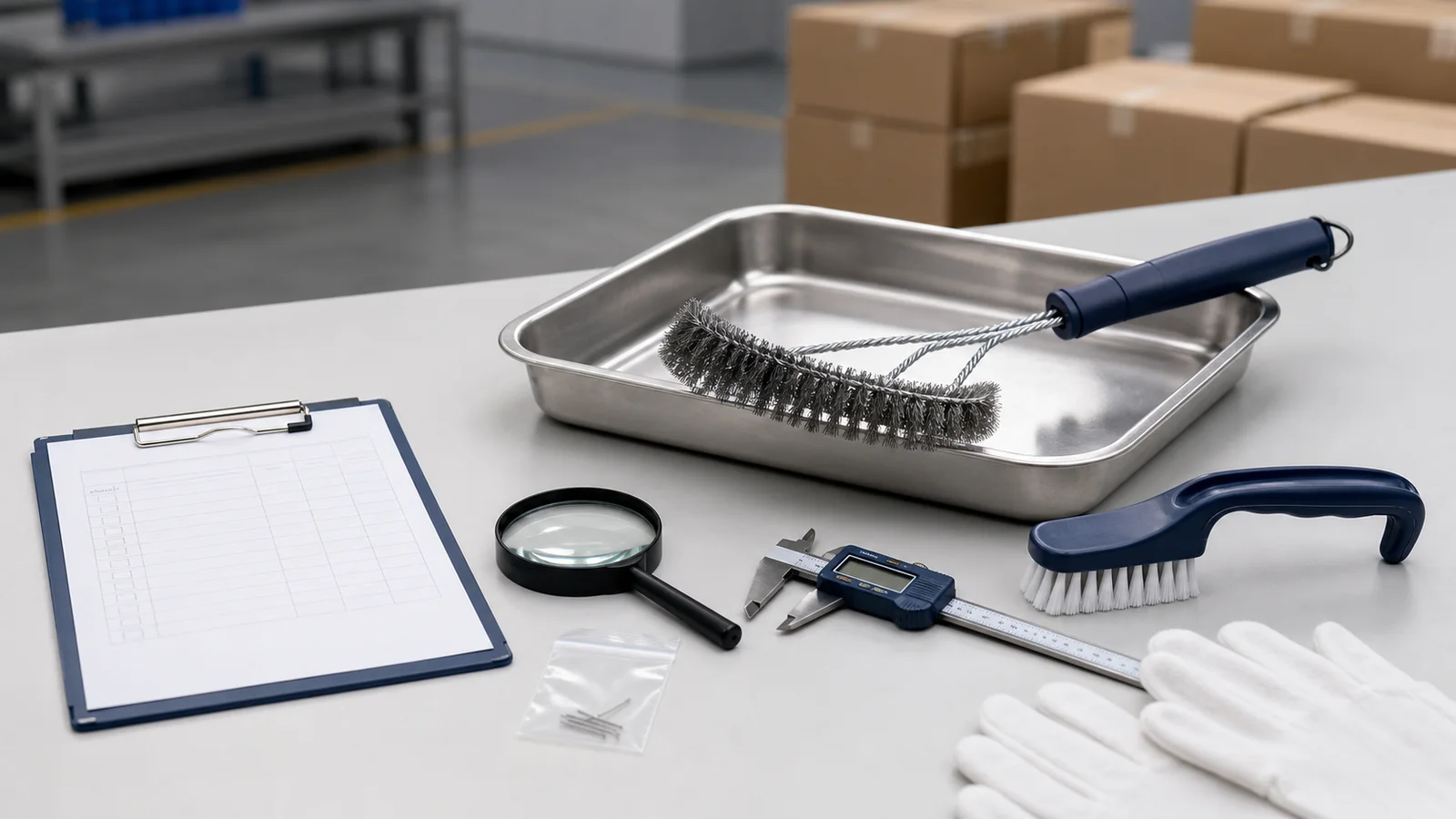
Under magnification, document visible loose or projecting strands, broken or bent wire, sparse or uneven zones, incomplete twists, exposed staple or anchor parts, cracks, burrs, sharp unintended edges, corrosion, residue, weak head-to-handle joints, deformation, and packaging contact that could damage the cleaning head. Preserve reference-scale photographs and identify every finding by sample, model, lot, and carton.
Use calibrated tools only for buyer-defined accessible measurements and record method, tolerance, reading, and limitation. Do not bend, pull, scrape, heat, cycle, or otherwise alter saleable samples unless the approved inspection plan explicitly treats them as destructive samples and defines safe equipment, containment, acceptance, and disposition.
- Check identity first: model, construction, factory, production date or lot, retail set, label, instruction, barcode, packing list, and carton marks
- Compare head width, overall length, handle and joint, scraper, cleaning-element layout, visible anchor pattern, finish, and approved workmanship references
- Photograph close views of head edges, wire or coil ends, attachment areas, joints, surface condition, packaging interfaces, labels, instructions, retail set contents, and carton identity
- Quantify each mismatch by affected model, sample, defect classification, lot, quantity, retail set, and carton range
Separate routine inspection from destructive retention and durability testing
Bristle retention and lifecycle behavior usually require destructive or product-altering work. A qualified plan may address initial retention, conditioned retention, repeated cleaning cycles, head and handle durability, corrosion, temperature exposure, cleaning chemicals, edge conditions, wear, misuse, and alternate designs. The relevant methods, sample sizes, equipment, safety controls, acceptance criteria, and retest rules are product- and market-specific.
If the buyer wants factory-side destructive checks, identify sacrificed units in advance, select them from the target lot under traceable sampling, use a suitable controlled area and calibrated equipment, preserve raw readings and failure photographs, and prevent tested units from returning to saleable stock. A supplier-selected demonstration unit is not equivalent to lot-linked sampling.
Stop when the approved method, fixture, containment, operator competence, reference sample, measurement range, acceptance criterion, or safe disposal path is missing. Route engineering validation and specialist laboratory work to qualified parties; do not improvise a safety claim from an informal pull test.
- Define non-destructive inspection samples, destructive lot samples, laboratory samples, retains, and saleable stock as separate populations
- Record preconditioning, cycles, loads or measurements, equipment ID, calibration status, raw results, failures, photos, sample destruction, and lot linkage when the approved plan requires them
- Treat a failure as a hold and investigation trigger; do not average it away or replace the failed unit silently
- Repeat only under a documented disposition and retest rule that addresses why the first result failed
Control model expansion, substitutions, and mixed cartons
The Cuisinart public record matters partly because the recall scope expanded from identified models to additional models and all Cuisinart wire-bristle grill brushes. A buyer should therefore maintain a model-and-lot map that is wider than one convenient inspection sample and narrow enough to prevent unrelated constructions from inheriting a pass.
Hold a lot when the factory changes wire, coil, head material, bundle count, anchor method, weld or staple settings, adhesive, handle joint, scraper, coating, subcontractor, tooling, production line, label, instruction, retail set, or packaging contact without documented review. Determine with qualified parties whether earlier evidence remains applicable and what comparison or revalidation is needed.
After correction, segregate affected stock, record the authorized rework, verify the changed construction, repeat inspection on a defined sample, repeat qualified testing where the cause or change requires it, and map cleared units to exact cartons. Do not release merely because a supplier says all stock was checked.
- Maintain a controlled model list with construction revision, test-report scope, production dates, lots, retail sets, and carton ranges
- Record the first and last affected lot or date, quarantined quantity, shipped quantity, samples, rework, scrap, retest, and residual uncertainty
- Keep failed, untested, corrected, retested, and released populations physically and digitally separate
- Authorize release at the buyer level only after every open evidence condition is visible in the final report
Evidence checked: CPSC expanded model-scope record, Huang Sourcing QC planning guide.