
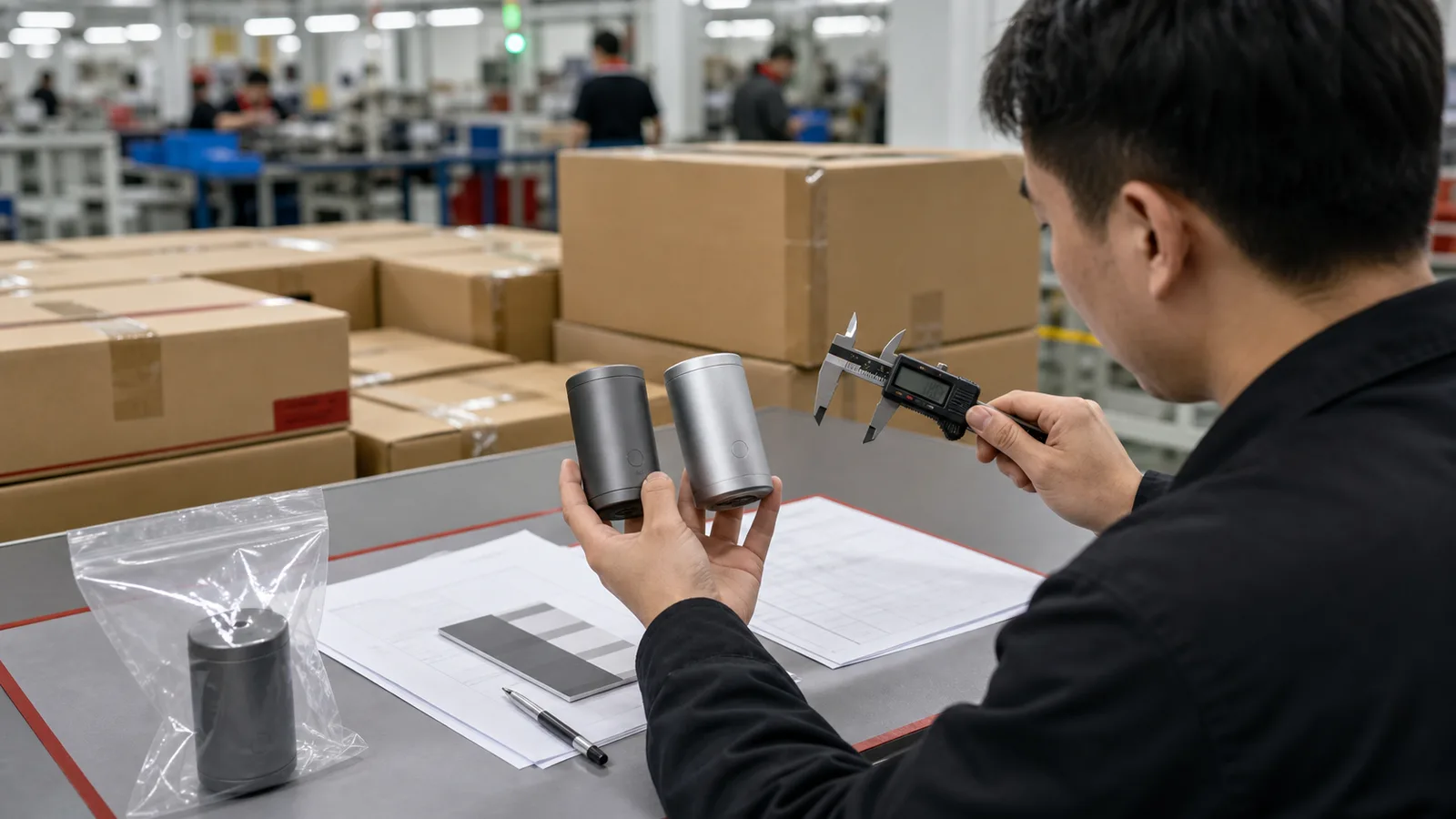
Approved sample · bulk production · QC decision

Golden Sample for China Manufacturing: From Approval to Quality Control

Written by Agent HuangPublished on June 19, 2026

China-side sourcing partner helping overseas buyers verify suppliers, inspect goods, and reduce payment or shipment risk before money or goods move.

A golden sample is the buyer-approved physical reference for bulk production. It can help align color, finish, construction, dimensions, accessories, packaging, and workmanship—but only when the exact sample is identified, sealed, documented, and connected to written specifications.

Do not approve a sample with a casual chat message and expect it to control production. Record the sample version and approval date, photograph it, mark every accepted exception, retain matching buyer and factory copies when practical, and convert important attributes into measurable inspection criteria before the production deposit or bulk-production release.

Quick answer

What makes an approved sample usable for quality control?

Identity, written criteria, custody, and change control. Without those four controls, a factory sample is only an object that looks familiar. It does not reliably show which revision the buyer approved or how much production variation is acceptable.

1Give the approved sample a unique version, approval date, product/SKU, and buyer name
2Photograph all sides, details, accessories, packaging, markings, and any accepted imperfections
3Seal or tamper-mark the retained sample so it cannot be quietly replaced after approval
4Keep one approved reference with the factory and one with the buyer or China-side agent when practical
5Attach the specification, bill of materials, color reference, dimensions, tolerances, and test requirements
6Write down every difference that is accepted for bulk production rather than relying on chat history
7State whether the sample controls appearance only or also construction, function, packaging, and accessories
8Define what happens when production differs: hold, sort, rework, replace, discount, or re-inspect

Control scope

What a golden sample can—and cannot—control by itself.

The physical sample is strongest as a side-by-side reference. Written criteria make that comparison repeatable and prevent appearance from hiding a material, construction, or performance change.

Appearance and finish

Color direction, gloss, texture, print position, logo appearance, surface finish, stitching, visible workmanship, and overall presentation can be compared side by side.

Construction and dimensions

Materials, components, assembly method, dimensions, weight, fit, moving parts, and internal construction need written specifications and tolerances as well as a physical reference.

Function and performance

The sample can demonstrate expected operation, but repeatable test methods, equipment, duration, environment, and pass/fail rules must be documented separately.

Packaging and pack-out

Retail box, inserts, accessories, protective materials, unit pack, carton arrangement, labels, and carton marks should be frozen with approved artwork and packing instructions.

Approval checklist

Turn the final sample into a controlled production reference.

1

Confirm the final version

Compare the candidate against the latest specification and sample-change history. Do not approve when another revision is still in transit or open points remain unresolved.

2

Record and photograph

Assign an ID and date. Photograph the complete product, critical details, measurements, accessories, packaging, labels, and any approved deviations under neutral lighting.

3

Seal matching references

Where practical, sign across tamper tape or use numbered seals on matching buyer and factory samples. Record who holds each reference and its seal number.

4

Release written criteria

Issue the approved specification, tolerances, defect examples, test methods, artwork, packing instruction, and change-control rule with the production order.

5

Connect it to inspection

Tell the inspector where the reference will be, what must be compared, which points are measurable, and which differences require a buyer decision before payment or pickup.

Inspection criteria

Pair every sample comparison with a written control.

Control area
What the sample shows
What must be written
Color and finish
Side-by-side visual reference under controlled, consistent lighting
Color code or master, gloss/texture requirement, approved range, and viewing conditions
Dimensions and weight
Shows the intended size, proportion, fit, and assembled form
Measurement points, units, tolerances, calibrated tool, and sample size
Materials and components
Provides a retained construction reference where visible or safely accessible
Bill of materials, grade, supplier/component code, certificates, and approved substitutions
Function
Demonstrates expected operation and user experience
Test method, duration, load, environment, equipment, and pass/fail limit
Packaging and labels
Shows pack-out sequence, presentation, accessory placement, and protection concept
Dielines, artwork files, barcode/FNSKU data, carton marks, quantities, and label placement

Control every change after approval.

A revised component or “small improvement” can invalidate the reference. Revision control should follow the product, files, production order, and inspection instruction together.

  • Require written buyer approval before changing material, component, color, finish, dimensions, packaging, label, accessory, or production method
  • Give every revised sample a new version; never reuse the old approval ID for a changed product
  • State exactly what changed and whether all other approved attributes remain unchanged
  • Update specifications, photos, artwork, defect examples, and inspection instructions at the same time
  • Quarantine or clearly invalidate superseded samples so they cannot be used during production or inspection
  • Assess whether the change requires a new sample, pilot run, compliance review, laboratory test, or revised quotation

Buyer decision table

What to do when production differs.

Inspection signal
What it means
Buyer action
Bulk unit matches the sample and written limits
The checked attributes conform within the approved comparison and measurement rules.
Review the full inspection result, quantity, packing, labels, tests, and open issues before release.
Visible difference, but no written tolerance
The physical comparison identifies variation but does not define the acceptable boundary.
Hold the affected decision, document both references under the same conditions, and obtain buyer disposition.
Factory reference is missing or unsealed
The inspector cannot prove that the available item is the sample originally approved by the buyer.
Record the limitation and rely on controlled specifications and buyer evidence; consider sending a verified reference before release.
Material or component was substituted
The product may differ in performance, compliance, durability, cost, or customer expectation even if appearance is similar.
Stop automatic approval, trace affected stock, review authorization and evidence, and escalate testing where needed.
Approved sample itself contains a defect
Silence may turn an accidental flaw into an argued production standard.
Mark the flaw as explicitly unacceptable or issue a corrected reference before bulk production.

Evidence basis for this advice.

A defensible sample-based comparison connects the physical reference to controlled buyer files, traceable production units, consistent comparison conditions, and the commercial decision in front of the buyer.

  • A uniquely identified and dated approved reference sample, with clear custody and tamper evidence where practical.
  • Buyer-approved product specifications, drawings, tolerances, bill of materials, artwork, packing instructions, defect examples, and test methods.
  • Documented revision history showing open points, accepted deviations, later changes, and which sample version controls the current purchase order.
  • Inspection evidence captured under consistent comparison conditions, including reference identity, bulk-unit traceability, photos, measurements, tests, and stated limitations.

What to send before booking QC.

Send both the reference evidence and the rules that explain how the inspector should use it.

  • Purchase order, product/SKU list, order quantity, production status, and balance-payment or pickup deadline
  • Golden-sample version, approval date, current holder, seal or tamper-mark details, and approval photos
  • Final product specification, drawings, dimensions, tolerances, bill of materials, and approved substitutions
  • Color or finish master, artwork, packaging files, labels, inserts, accessories, and pack-out instruction
  • Function tests, measurement methods, defect classifications, and buyer-approved acceptance rules
  • Complete change history and a list of any points that remain open, provisional, or outside inspection scope

A sample is evidence of one approved unit. It is not proof that every production unit, hidden material, safety requirement, or future-use condition conforms.

Golden sample scope limits.

  • Golden sample is a practical industry term, not a substitute for a complete contract, specification, or applicable product standard
  • A physical sample can change with age, light, heat, humidity, handling, contamination, or material degradation
  • Visual matching is subjective unless lighting, viewing conditions, reference tools, and acceptable variation are defined
  • Matching a sample does not prove regulatory compliance, chemical composition, durability, safety, or unseen internal construction
  • One approved unit does not establish statistical control across a production lot; sampling and acceptance rules are still needed
  • A factory-held sample with no identity or tamper evidence may have been replaced, altered, repaired, or confused with another version

Frequently asked questions

What is a golden sample in China manufacturing?

It is the final physical sample accepted by the buyer as a reference for bulk production and quality control. Its authority should be tied to an ID, date, purchase order, written specification, approved exceptions, and controlled custody.

Is a golden sample the same as a pre-production sample?

Not automatically. A pre-production sample is produced before the bulk run, but it becomes the controlling approved reference only after the buyer explicitly approves and documents that exact version. Earlier development samples should be marked obsolete.

Should the factory and buyer both keep a golden sample?

Matching retained samples are useful when practical because the factory can control production and the buyer or inspector can verify the reference independently. Both should carry the same identity, approval evidence, and tamper control.

Can a QC inspector reject goods only because they look different from the sample?

The inspector should document the difference against the approved instruction, not invent a commercial decision. Clear tolerances and defect classifications let the report apply a rule; an undefined variation usually needs buyer disposition.

Does matching the golden sample mean the shipment passes inspection?

No. Sample match is one part of QC. The inspection may also need quantity, workmanship, function, dimensions, packaging, labels, carton condition, sampling results, and scope limitations before the buyer releases payment or pickup.

What if the supplier changes a material after sample approval?

Require written disclosure and buyer approval before using the change. Identify affected production, revise the sample and specifications, and determine whether new performance, compliance, laboratory, pilot-run, or inspection evidence is needed.

Before balance payment or pickup

Connect the approved sample to the inspection plan.

Send the sample evidence, final specification, production stage, factory location, and release deadline. Agent Huang will help scope what can be compared onsite before the goods leave supplier control.

Plan Sample-Based QC