
Quick answer
What should buyers check before EU-bound battery goods ship?
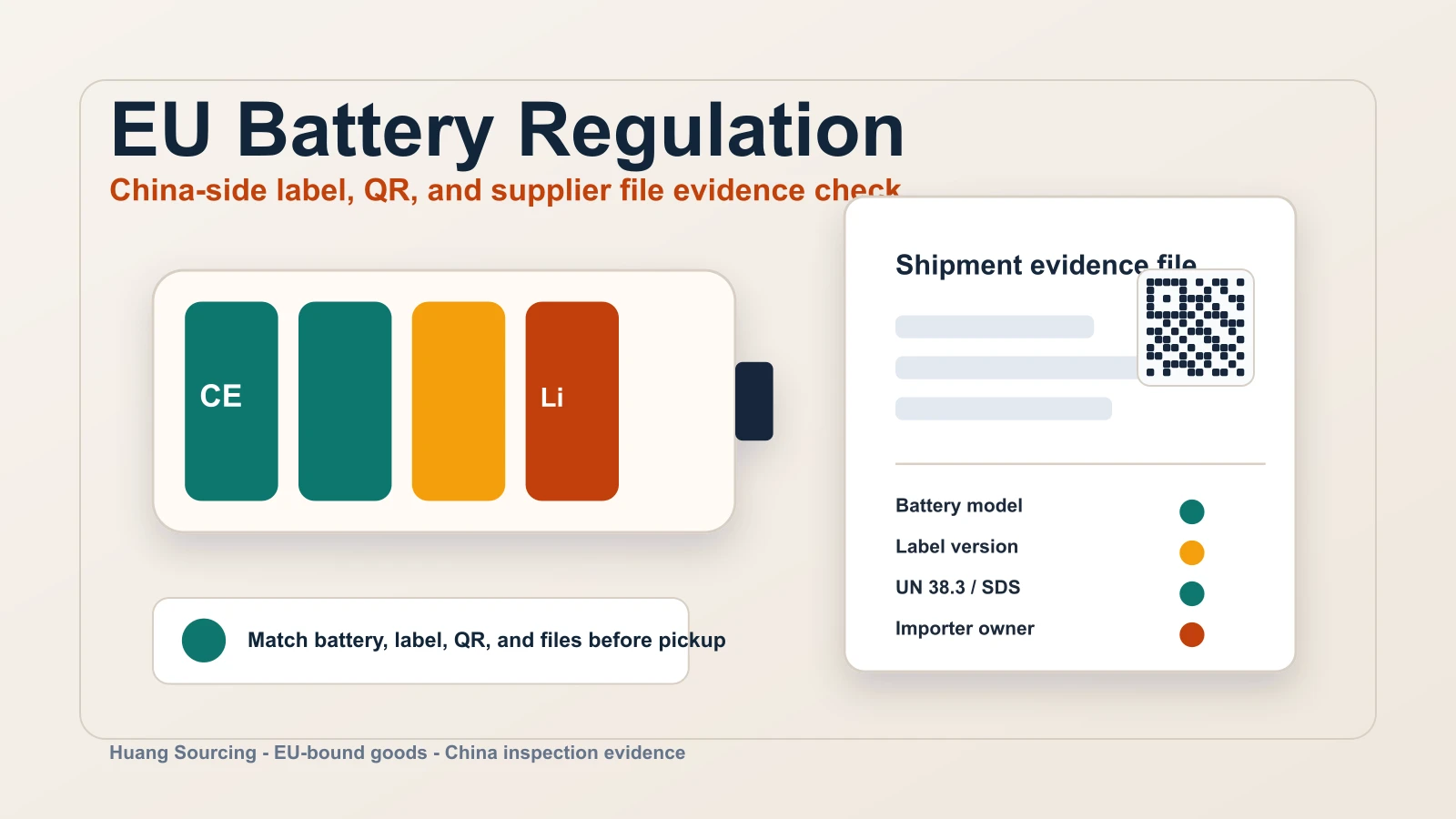
Check whether the actual battery, battery-containing product, label, QR plan, declaration, test file, transport record, and importer handoff match the buyer-approved evidence plan before cartons leave China.
China-side evidence module
EU Battery Regulation readiness checklist
The check is practical: identify every battery in the order, tie it to the product and carton records, then compare visible evidence and supplier files with the EU importer's approved plan.
Battery identity
- Map each battery, pack, replacement battery, and battery-containing product to SKU, model, carton, and packing-list records
- Record chemistry, capacity, voltage, battery category, batch or serial identifiers, manufacturer name, and manufacturing place when visible or documented
Labels and QR readiness
- Check visible CE marking, separate collection symbol, heavy-metal marks, capacity labels, warnings, manuals, and destination-language text
- Confirm whether the buyer has approved QR, declaration, passport, and waste-battery information paths before final printing or shipment release
Supplier and test files
- Compare supplier declarations, EU declaration drafts, technical documentation, UN 38.3, SDS, and test reports with the actual battery model
- Flag mismatched applicant names, manufacturer names, dates, chemistries, capacities, product photos, or old test files before pickup
Importer handoff
- Confirm who owns EU conformity, producer registration, EPR, battery passport data, due diligence review, and marketplace uploads
- Package final evidence by SKU and battery version so the importer can make the legal and compliance decisions before goods leave China
Why the EU Battery Regulation is a current China sourcing issue
The EU Battery Regulation entered into force on August 17, 2023 and is being implemented in phases. In 2026, EU official activity is no longer just policy background: buyers are preparing for battery label, QR, documentation, and battery passport requirements that affect products already being designed, sampled, produced, or packed in China.
The current sourcing risk is practical. A buyer may have one battery file, the supplier may pack a different battery version, and the EU importer may still be missing the evidence needed for conformity, producer responsibility, passport data, or marketplace review. That mismatch is much easier to document before final payment or forwarder pickup.
- Battery evidence should be checked while cartons and supplier leverage are still in China
- A battery file is only useful when it matches the physical battery and product version being shipped
- QR and passport readiness depend on structured data, not only a printed code on packaging
- China-side evidence can show visible mismatches, but specialists decide legal sufficiency
Which batteries should buyers include in the check?
Start with the shipment, not the regulation category. List every loose battery, spare battery, battery pack, charger set, built-in battery, replaceable battery, and product variant that contains a battery. Many sourcing problems come from small differences between similar models, colors, capacities, or supplier substitutions.
Then separate the evidence question by battery category. Portable batteries in consumer goods, LMT batteries in scooters or e-bikes, SLI batteries, industrial batteries above 2 kWh, EV batteries, and stationary storage systems can require different files, labels, test evidence, passport data, and importer decisions.
- Photograph battery labels and product labels together when the battery is incorporated in a finished product
- Keep battery pack, cell, charger, manual, warning label, and carton evidence tied to the same SKU
- Record whether batteries are loose, installed, packed with equipment, or packed separately
- Treat supplier battery substitutions as a release decision, not a minor packing detail
How should labels, CE marking, and QR readiness be checked?
Article 13 includes phased label and marking requirements, including the separate collection symbol from August 18, 2025, general battery label information around August 18, 2026 or later depending on implementing specifications, and QR code marking from February 18, 2027. Buyers should avoid printing at the last minute without confirming the latest EU and marketplace instructions.
A China-side check can compare visible marks against the buyer-approved label plan. That includes CE marking placement, battery category and identifying information, capacity, chemistry, manufacturing details, heavy-metal marks, warnings, manuals, QR placement, legibility, and whether the same information appears consistently on the battery, packaging, product manual, and supplier declaration.
- Capture close-up photos of CE marks, collection symbols, Cd or Pb marks, capacity labels, warnings, and QR codes
- Check that small batteries with limited surface area still have the required information on packaging or accompanying documents when that route is used
- Scan QR samples when the buyer provides a live or staging destination, but do not treat a successful scan as legal approval
- Confirm that old packaging, old manuals, and old battery labels are not mixed into the EU-bound shipment
What supplier files should match the packed goods?
Battery files should be version-controlled. The EU declaration of conformity, technical documentation, label specimen, test reports, UN 38.3 summary, safety data sheet, transport declaration, battery management system evidence, and supplier declarations should use the same battery model, manufacturer, chemistry, voltage, capacity, date, and product relationship as the actual goods.
This is where China-side evidence matters. If the supplier changed cells, battery packs, pack assembler, charger, casing, label artwork, manual, or production site, the buyer should know before shipment release. A report can show the mismatch and preserve evidence for the importer, lab, certification body, broker, marketplace, or legal adviser.
- Compare applicant, manufacturer, factory, battery model, chemistry, capacity, product photo, and test date across every file
- Flag documents that cover only cells when the shipment uses a pack, or only a pack when the finished product changed
- Keep transport safety files separate from EU conformity evidence; both can matter, but they answer different questions
- Create one final evidence folder by SKU, battery version, packaging version, and carton records
What should the EU importer receive before goods leave China?
The importer needs a clean handoff, not scattered chat attachments. The file set should connect product identity, battery identity, label artwork, QR or passport plan, declarations, technical files, test evidence, transport records, EPR or producer-responsibility notes, and correction records to the final shipment.
This also prevents ownership confusion. Huang Sourcing can show whether the physical shipment matches the buyer-provided references, but the importer or responsible economic operator must decide conformity, registration, due diligence, passport data accuracy, and market placement.
- Name the owner for EU conformity, producer registration, battery passport, due diligence, marketplace upload, and correction approval
- Confirm what evidence should block shipment versus what can be documented for later importer action
- Retain correction photos after relabeling, battery replacement, repacking, or manual changes
- Reconfirm time-sensitive instructions close to shipment because implementing acts and marketplace rules can change