
Quick answer
What should an EU-bound buyer check before China shipment?
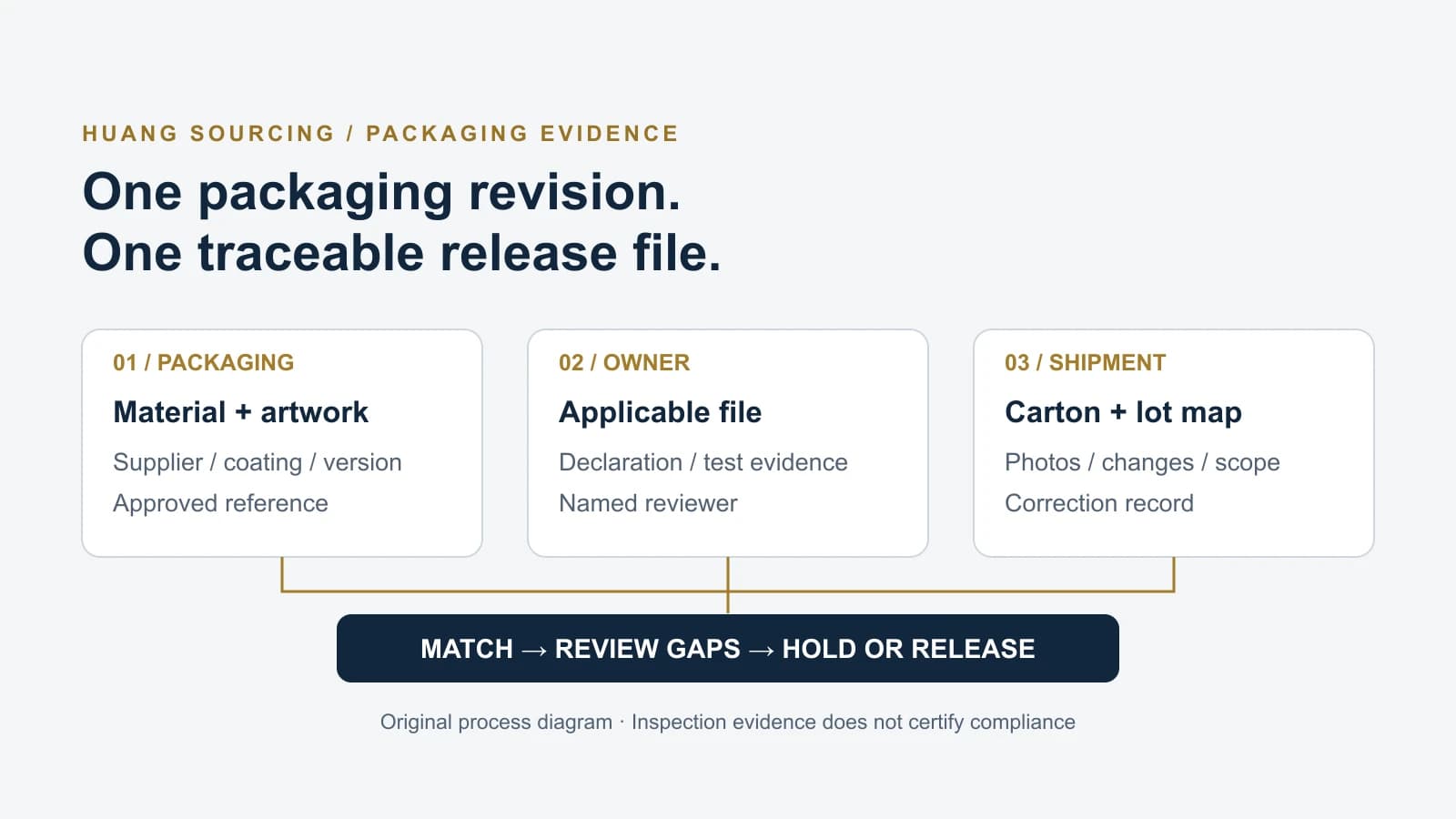
Before release, identify each packaging layer and revision, confirm who owns the conformity decision, and match the approved materials, artwork and supporting files to sampled stock. Escalate food-contact PFAS evidence gaps, unsupported environmental claims and substitutions. Hold the affected quantity until the responsible team accepts the correction and evidence. An inspection records shipment facts; it does not certify PPWR compliance.
China-side evidence module
EU PPWR packaging readiness checklist
The check is practical: identify the packaging layers, connect them to the actual SKU and carton records, then compare visible packaging and supplier files with the EU importer's approved plan.
Packaging identity
- Use one revision code across the material list, artwork, declaration reference and inspection photos.
- Map sales, grouped and transport packs separately; a carton photo does not identify the coating inside a food-contact pack.
Accountable owner
- Record which business is the packaging manufacturer and who reviews the EU conformity file.
- Obtain supplier cooperation for material data and changes; a purchase-order clause does not settle the legal role.
Evidence fit
- Check that laboratory samples and declarations describe the supplied material, coating, supplier and packaging version.
- Treat untraceable or out-of-scope results as a review gap, even when the report has a PASS heading.
Shipment decision
- Record the affected cartons, hold instruction, correction owner and deadline.
- Release on an accepted evidence record; keep future redesign tasks separate from current shipment blockers.
What applies now, and what comes later?
The general application date has passed, and the Commission’s FAQ publication page is dated August 3, 2026. This revision moves the June guide from preparation to a release-file check for orders being packed now. The Commission overview confirms that the rules cover packaging regardless of origin.
Current obligations include conformity documentation and applicable substance restrictions. The harmonised material-composition label has a later trigger: August 12, 2028 or 24 months after the relevant implementing acts enter into force, whichever is later. Recyclability and recycled-content requirements have later, staged dates. Confirm the requirement for the specific packaging before ordering a redesign.
Ask your EU reviewer for a short requirements register: packaging type, applicable obligation, start date, evidence reference and owner. Do not use a supplier’s general “PPWR ready” statement as that register. Existing destination-specific instructions still need to be checked.
- Now: resolve packaging identity, accountable roles and evidence for applicable requirements.
- Later: put future label, recyclability and recycled-content work into a dated plan without treating every target as a September shipment failure.
European Commission: PPWR scope and applicationEuropean Commission: August 2026 FAQ publicationRegulation (EU) 2025/40: Articles 5–12, 15 and 39
Who owns the declaration when the factory packs your brand?
The packaging manufacturer is responsible for the conformity assessment and EU declaration of conformity. An importer must check that the required assessment and documentation exist. The factory, buyer, brand owner and importer are not interchangeable labels. Have a qualified reviewer establish the roles for your arrangement, including private-label production.
For sourcing purposes, create a responsibility sheet with legal entity, packaging type, document owner and contact. Ask the factory which packaging suppliers can provide material details and who must approve a substitution. Keep EPR registration responsibilities on a separate line; an EPR number does not explain whether the particular packaging matches its conformity file.
An inspection booking can use draft files to define what to check. A draft is not the completed declaration required for placing applicable packaging on the market. Treat “we will send the paperwork after departure” as an unresolved handoff, and agree the release condition while the goods remain accessible.
Regulation (EU) 2025/40: manufacturer and importer dutiesCommission guidance: manufacturer responsibility and declarations
What should you do with food-contact PFAS evidence?
Food-contact packaging is subject to the Article 5(5) PFAS limits from August 12, 2026. The Commission guidance says there is no stock-exhaustion transition for packaging produced earlier but first placed on the market after that date. Manufacturing date alone is therefore not an exemption. Have the responsible EU team assess market-placement facts.
The guidance describes a testing approach while noting the absence of a harmonised EU method for PFAS in food-contact packaging. Ask a qualified laboratory or compliance reviewer to specify the suitable sample, methods and interpretation. A photograph, a generic “PFAS-free” statement or an unrelated food-contact report cannot establish that the supplied pack satisfies the relevant limits.
Build a sample-to-shipment link: packaging supplier, material grade, coating or laminate, revision, sample identifier, report reference and production lots using that material. If a coating changes after testing, stop treating the old file as automatically representative. Record the changed quantity and obtain the reviewer’s decision before release.
- Identify each food-contact layer and any change in coating, ink, adhesive or laminate.
- Ask the reviewer whether the results and reporting limits answer the applicable restrictions for that material.
- Keep other food-contact requirements in the review; a PPWR check does not replace them.
Regulation (EU) 2025/40: Article 5 substance restrictionsCommission guidance: PFAS testing and pre-August stock
How do you match the evidence file to the cartons?
Use a packaging register with one row per packaging type and revision, then map the rows to SKUs and carton lots. Include the retail pack, inner protection, grouped pack and transport pack where relevant. Record the basis for treating an item as packaging rather than assuming every insert or accessory has the same status.
At inspection, compare accessible stock with the approved register. Capture the whole pack, material and manufacturer markings, claim text, revision identifiers and the carton reference. Weigh or measure against the agreed specification when included in the scope. Record sample coverage and inaccessible cartons so the buyer can see the limits.
A low-cost substitution can break the file link even when the product itself is unchanged. Different coatings, films, adhesives or packaging suppliers may require fresh specialist review. For mixed stock, identify and segregate the affected quantity instead of accepting one clean sample as representative of the entire order.
- Keep one evidence index: SKU → packaging revision → material supplier → file references → sampled carton IDs.
- Log discrepancies with photos, affected quantity, owner and correction status.
- After repacking or relabelling, capture new evidence and retire superseded artwork from the release folder.
Public case example: ECM BioFilms and unsupported packaging claims
What happened: on October 19, 2015, the U.S. FTC announced its opinion and final order finding that ECM BioFilms made deceptive, unsupported claims about the biodegradability of plastics treated with its additive. The FTC also found that the company enabled customers to pass misleading claims down the supply chain. The public case docket records a 2017 court decision denying ECM’s petition for review.
Buyer lesson: do not copy a material supplier’s environmental claim straight onto retail packaging. Ask what exact material was tested, under which disposal conditions, and whether the proposed wording is supported. If the supporting file cannot be tied to your packaging revision, send it for specialist review before printing or releasing the affected packs.
Limits of comparison: this is a historical U.S. advertising case, not a PPWR decision, PFAS finding or case about this buyer’s Chinese supplier. It remains relevant because a supplier statement can travel into finished-package artwork without its limitations. Huang Sourcing did not participate in the case, and the record does not establish that any current supplier or shipment is non-compliant.
FTC: ECM BioFilms findings and final order announcementFTC case docket: ECM BioFilms and judicial review
What should the release folder contain?
Give the buyer a file index that can be opened without reconstructing a chat history. Include the order and packing list, packaging register, approved artwork, supporting declarations and reports, sampled-stock photos, discrepancy log and correction evidence. Show who reviewed each open point and the date of the decision.
Use clear statuses: accepted for this revision, correction required, specialist review pending, or outside the agreed inspection scope. “Documents received” should not silently become “compliance approved.” If a specialist decision is pending, make the affected quantity and hold instruction visible to the supplier and pickup coordinator.
Approve pickup only after the buyer accepts the shipment facts and the responsible EU team resolves applicable compliance questions. Keep the original files alongside corrections so a later query can follow the packaging version that actually shipped.