
Quick answer
What should buyers check before zipline kits leave China?
Match every model, component version, factory, production date, lot, and carton to a qualified scope decision, complete exact-sample evidence, approved construction, installation and maintenance instructions, warnings, pack-out, and shipment identity. Hold generic, changed, mixed, damaged, unsupported, or untraceable scope before payment and pickup.
- 1Document destination, intended users and age range, installation setting, maximum stated load, kit length, model/SKU, factory, production dates, lot, online claims, instructions, warnings, and package identity
- 2Require the importer and qualified product-safety, engineering, laboratory, and legal parties to identify the current requirements and relevant standards for the exact product and market before approving test scope or production
- 3Map complete reports, calculations, sample photos, methods, results, limitations, cable, connectors, trolley, seat or harness, brake system, hardware, factory, dates, and authorized changes to the order
- 4Compare sampled mass production with the approved sample, drawings, bill of materials, and tolerances for cable construction, diameter and length, terminations, tensioning parts, trolley, seat/harness, brake, stops, guards, fasteners, and accessories
- 5Check permanent product and component identity, rated-load and user warnings, installation and maintenance instructions, traceability, barcode, SKU, retail pack, quantities, carton protection, and carton marks
- 6Keep proof-load, fatigue, braking-distance, dynamic-load, corrosion, anchor, tree, clearance, installation, and compliance conclusions with qualified parties; ordinary onsite observations are not substitute test results
- 7Hold substituted or mixed cables, seats, harnesses, trolleys, turnbuckles, ratchet straps, brakes, stops, connectors, instructions, claims, date codes, lots, or cartons until their scope is resolved
- 8Release only named models, component versions, production dates, lots, quantities, and cartons after documented correction, qualified disposition, and repeat inspection where needed
China-side evidence module
Zipline kit release checklist
Connect qualified product evidence to sampled mass production and pack-out. This module does not turn an onsite comparison into proof-load, dynamic, fatigue, braking, installation, or standards testing, legal advice, or a safety guarantee.
Scope, users, and exact kit
- Destination, intended users, age range, installation setting, kit length, stated load, model, factory, production date, lot, and responsible compliance owner are controlled
- Purchase order, drawings, bill of materials, approved sample, test samples, reports, claims, instructions, warnings, retail pack, carton, and packing list describe the same finished kit
Qualified structural and braking evidence
- Applicable requirements, standard edition, laboratory or engineer, report number, methods, sample photos, components, results, limits, dates, and destination review align
- Evidence covers the shipped cable, terminations, tensioning parts, trolley, seat or harness, brake, stops, hardware, factory, and configuration rather than another prototype or product family
Physical product and pack-out
- Sampled kits match approved component identity, count, dimensions, visible construction, finish, fasteners, moving-part condition, warnings, instructions, and workmanship
- Model, production lot, barcode, SKU, installation file, maintenance information, spare parts, retail package, quantity, carton marks, and carton protection are complete and consistent
Hold, correction, and release
- Affected quantity, hold tags, carton map, supplier change, correction instruction, qualified retest or engineering disposition, revised files, and repeat inspection remain traceable
- Cleared and unresolved models, component versions, dates, lots, and cartons stay separated; the final release names exact scope and open conditions
Why zipline kit shipment evidence matters now
On July 30, 2026, the U.S. Consumer Product Safety Commission announced the recall of about 60,720 TT Trsmima zipline kits and 19,120 sold-separately spring brakes manufactured in China. The record says cable, turnbuckle, or seat components could break or detach, and the spring brakes could fail to slow riders safely. CPSC reported 21 component-failure reports with at least eight injuries and 19 brake-failure reports with at least 12 injuries.
The 2026 event was not the first public record of a China-made backyard zipline component failure. In April 2024, CPSC recalled about 6,600 Jugader kits after 20 reports of stainless-steel cable breakage and nine injuries. That recall offered a replacement cable and updated installation instructions. The newer recall covers different named products and a broader set of failure points, so the records should not be collapsed into one case.
These recalls do not prove that every zipline kit, supplier, factory, cable, brake, or production lot has the same defect. They show a recurring buyer decision: qualify the exact product and its evidence before approving production, then confirm that sampled mass-production components and instructions still match the reviewed version before payment or pickup.
- A listing phrase such as “aircraft cable,” “heavy duty,” “stainless,” or “up to 380 lb” is a claim, not proof of exact-kit performance
- Kit length, slope assumptions, cable and termination construction, tensioning parts, trolley, seat or harness, brake, stops, anchors, user range, and instructions can change the evidence question
- A genuine report or engineering file is useful only when its sample and complete configuration match the current production kit
- Correction leverage is strongest before balance payment and pickup, while replacement, testing, relabeling, segregation, or cancellation remains practical
Current primary records: CPSC Trsmima recall, CPSC Jugader recall, and the manufacturer recall notice.
Define the kit, user, installation, and destination scope first
Freeze what is actually sold: kit length, intended user and age range, maximum stated load, cable construction, diameter and terminations, turnbuckle or ratchet tensioning system, tree protection, trolley, seat, rope, belt or harness, spring brake or other braking system, end stops, carabiners, fasteners, tools, accessories, and every installation or maintenance document. Separately identify stand-alone replacement brakes or components.
CPSC’s playground-equipment business guidance directs manufacturers and importers to review applicable requirements and points home-playground suppliers to ASTM F1148. ASTM’s public F1148-21 scope describes home playground equipment for children over 18 months through 10 years and sections on materials, performance, structural integrity, installation, maintenance, labeling, and information. Those pages help frame questions; they do not establish that a particular kit is covered or compliant. The responsible parties must determine the exact legal and standards route for the finished product, claims, users, and destination.
Installation conditions are part of the use case but cannot be frozen by inspecting a boxed kit in China. Tree or support condition, span, sag, slope, clearance, landing area, anchor design, tension, user behavior, weather, maintenance, and assembly affect the installed system. The product file should state its assumptions, limits, inspection intervals, replacement criteria, and stop-use conditions clearly enough for qualified review.
- Separate children-only, mixed-age, adult, residential, public, commercial, portable, permanent, kit, and replacement-component claims for qualified scope review
- Control every load, length, speed, brake, material, corrosion, installation, compatibility, and supervision claim across listing, packaging, labels, and instructions
- Document the destination, importer, intended users, and installation context before approving the test and evidence plan
- Escalate new lengths, cables, terminations, seats, harnesses, trolleys, brakes, accessories, rated loads, factories, or bundled components before mass production
Review the current CPSC playground-equipment guidance and the ASTM F1148-21 public scope with qualified product and destination support. Neither page is a product-specific applicability or compliance determination.
What should the engineering and test-scope file establish?
Review the complete evidence chain: responsible manufacturer or importer, destination, product classification, applicable requirements and standards, issuing laboratory or engineer, report number, methods, calculations, sample photos, drawings, bill of materials, dimensions, materials, component sources, rated load, test conditions, results, limitations, dates, factory, installation assumptions, and authorized changes.
Evidence for one component is not evidence for the assembled kit. A cable report does not establish the strength of its termination, turnbuckle, ratchet, trolley, seat rope, belt, harness, carabiner, anchor interface, spring brake, stop, or installed system. Conversely, a finished-kit report cannot automatically cover later substituted components, new lengths, higher load claims, different installation geometry, or a new factory.
CPSC’s manufacturing best-practices guidance tells suppliers to identify applicable legal requirements and voluntary standards, address safety in design and production, and maintain quality-control and corrective-action processes. Buyers can use that official guidance to structure evidence and supplier questions, while leaving applicability, engineering adequacy, testing, certification, and legal conclusions to qualified responsible parties.
- Obtain complete reports, calculations, drawings, sample records, and change history instead of a cover page, supplier summary, marketplace badge, or cropped pass result
- Confirm the issuing party, report status, exact sample, complete configuration, factory, dates, methods, results, load conditions, installation assumptions, and limitations through independent contact details
- Ask qualified parties whether a component, material, source, factory, length, load, brake, instruction, or claim change requires new review, calculation, or testing
- Escalate missing pages, altered sample photos, unexplained model families, inconsistent dates, obsolete editions, or files that cannot be confirmed
Compare the report chain with the China laboratory report verification guide and structure supplier questions with CPSC manufacturing best practices.
What can a China-side finished-goods inspection check?
A buyer-side inspection can compare sampled boxed kits with approved drawings, bill of materials, golden sample, report identifiers, component specifications, warnings, instructions, packaging files, and carton records while the order remains accessible. The useful output is a traceable list of sampled model and component versions, measurements, visible defects, mismatches, and affected quantities.
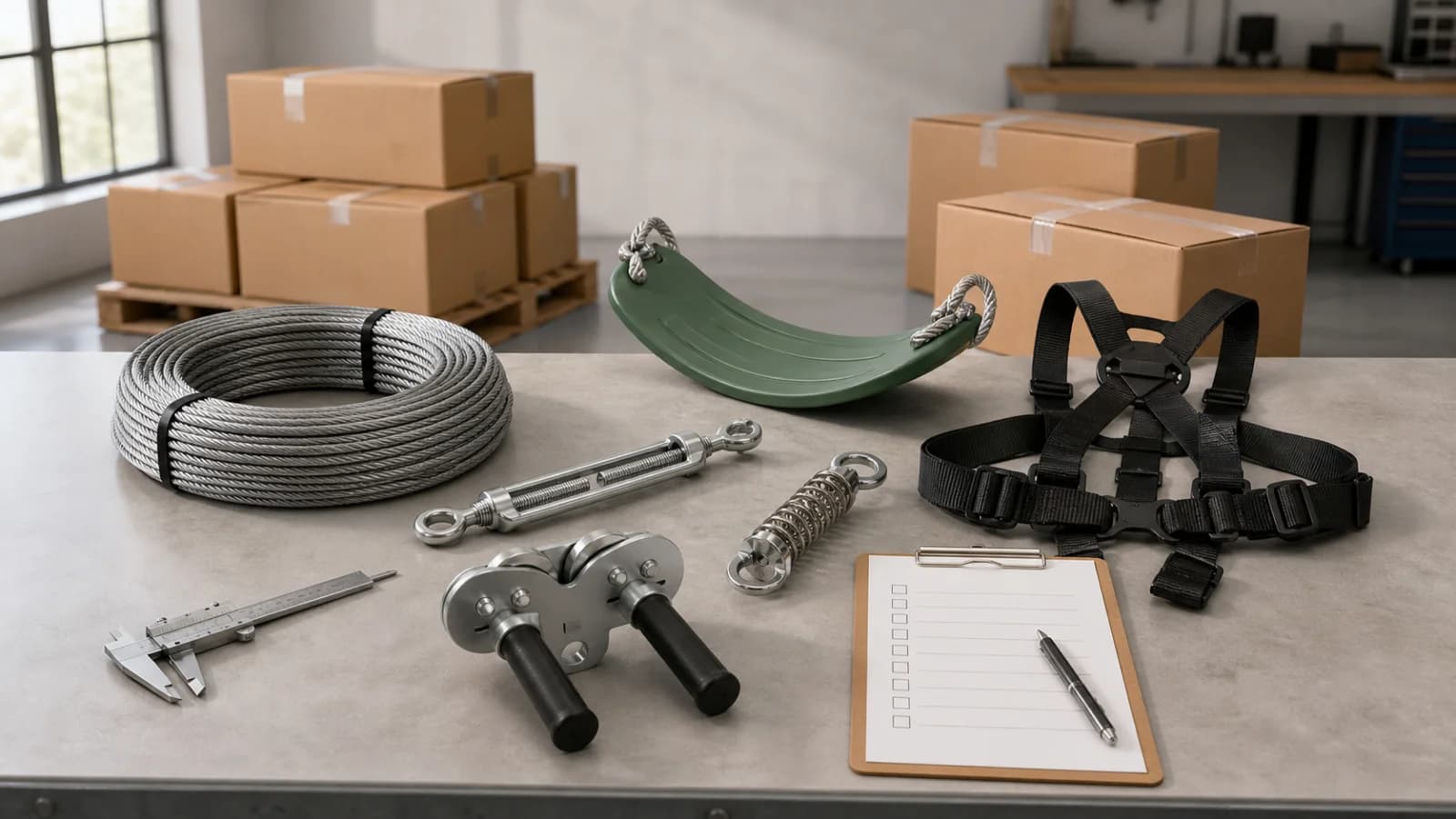
Check model and lot identity; component count; cable label, length, diameter, strand appearance, coating, visible kinks, flattening, corrosion, broken wires, and end terminations; turnbuckle or ratchet dimensions; trolley construction and wheel movement; seat, rope, belt, or harness construction; brake and stop identity; carabiners, fasteners, guards, tree protection, tools, warnings, installation steps, maintenance schedule, spare parts, and retail/carton pack-out against the buyer-approved plan.
Do not suspend a person, rig an improvised anchor, or run an informal loaded ride during an ordinary factory inspection. Proof load, dynamic load, fatigue, braking distance, impact, corrosion, retention, installation, clearance, tree or support, and failure-mode evaluations require controlled methods, suitable fixtures, trained personnel, safe test areas, calibrated equipment, and qualified interpretation. Onsite evidence can show a mismatch or reason to hold and retest; it cannot reproduce an engineering validation program.
- Use buyer-approved sampling, component drawings, measurement points, tolerances, defect classes, tools, photo requirements, and stop rules
- Photograph each sample number, model, production or lot code, cable and termination, tensioning part, trolley, seat/harness, brake, stop, connector, instruction set, package, and carton context
- Quantify substituted, mixed, missing, damaged, corroded, unlabeled, or out-of-tolerance components instead of calling them cosmetic differences
- Keep engineering samples, destructive tests, proof loads, dynamic tests, and installation validation separate from ordinary saleable-stock inspection
Control cable, hardware, brake, instruction, and factory changes
A change that looks minor to purchasing can alter the reviewed system. New cable source or construction, swage or loop, thimble, turnbuckle, ratchet, carabiner, trolley wheel, bearing, handle, seat, rope, belt, harness, spring, stopper, fastener, tree protector, finish, rated load, kit length, factory, package claim, installation step, or maintenance interval should enter written change control before mass production.
Ask the responsible engineering, laboratory, product-safety, and compliance parties whether approved evidence still covers the change. Identify the first affected unit and carton, keep cleared and unresolved production physically separated, and map new samples, calculations, reports, instructions, warnings, or inspection criteria to the revised scope.
If correction follows a failed inspection, retain the original finding. A defensible release shows affected quantity, segregation, controlled rework instructions, qualified disposition, revised evidence, repeat inspection samples, cleared carton range, and remaining open conditions.
- Do not accept undocumented substitutions because a component looks similar or carries the same generic material description
- Trace component supplier and version, assembly, instructions, warnings, finished kit, production date, lot, SKU, and carton through one change record
- Hold mixed old and new configurations until affected scope and qualified evidence are reconciled
- Release a named model, component version, lot, and carton range—not a supplier promise that “all goods are fixed”