
Quick answer
What should buyers check before treadmills leave China?
Freeze the exact model, serial scheme, hardware, firmware, intended use, and market before selecting evidence or inspection criteria. Match the controller, motor, sensor, console, incline and stop systems, power connection, guards, labels, instructions, reports, lot, and cartons. Hold any mismatch. One unloaded demonstration, generic test report, or successful start-stop cycle cannot prove safe performance or compliance.
- 1Freeze destination, responsible party, home or commercial use, intended users, exact model, serial prefix, frame, deck, belt, roller, motor, controller, firmware, console, speed, incline, stop system, cord, accessories, lot, and carton version
- 2Have qualified parties map the exact treadmill and market to applicable safety, electrical, fitness-equipment, labeling, certification, reporting, and filing requirements before selecting evidence or inspection criteria
- 3Map complete reports and certificate or listing references to the manufacturer, factory, exact model, controller, firmware, motor, drive, sample photos, dates, methods, results, deviations, and limitations
- 4Control drawings, bill of materials, controller boards, firmware checksum or release identifier, motor, sensors, wiring, power inlet, belt, rollers, guards, frame, fasteners, labels, instructions, and every approved change
- 5Compare sampled production for identity, assembly, belt tracking and tension references, accessible gaps and guards, controls, emergency stop, incline, power connection, workmanship, noise, labels, accessories, and pack-out
- 6Hold unexplained speed or stop behavior, overheating or odor, unstable incline, missing guards, mixed serial prefixes, changed electronics, unsupported reports, failed units, or cartons that cannot be mapped to a lot
- 7Route speed and stop performance, electrical protection, abnormal operation, thermal endurance, structural loads, stability, durability, entrapment, and software-safety questions to qualified laboratories or engineers
- 8Release only named models, hardware and firmware versions, batches, quantities, accessories, and cartons after documented correction, qualified disposition, and repeat inspection or testing where required
China-side evidence module
Treadmill pre-shipment release checklist
Connect qualified design and test evidence to sampled mass production, incident history, changes, and pack-out. This checklist does not turn a routine no-load comparison into software, electrical, structural, endurance, loaded stopping, or compliance testing.
Controlled product identity
- Destination, use class, responsible party, manufacturer, factory, model, serial prefix, frame, deck, belt, motor, controller, firmware, console, incline, stop system, lot, and approved changes are controlled
- PO, drawings, bill of materials, approved sample, reports, labels, instructions, online listing, accessories, retail pack, and cartons describe one version
Qualified design evidence
- Responsible parties select applicable requirements and complete files identify the tested product, hardware, software, factory, methods, results, photos, dates, deviations, and limits
- A standard name, report cover, supplier declaration, certification logo, or marketplace badge is never accepted without scope and exact-model verification
Finished goods and controls
- Sampled units match approved assembly, belt and rollers, guards, motor and controller identity, console, speed and incline controls, stop system, cord, labels, instructions, accessories, and pack-out
- Model, serial prefix, firmware or revision evidence, production lot, retail-pack barcode, carton marks, quantities, destination segregation, and packing list remain aligned
Hold, correction, and release
- Affected quantity, hold tags, component and firmware versions, carton map, supplier changes, controlled rework, qualified disposition, incident data, and repeat checks remain traceable
- Cleared and unresolved models, versions, batches, accessories, and cartons stay separated; final release states every open condition
Public case example: Volta overheating and affected-order scope
On September 10, 2026, the UK Office for Product Safety and Standards published a recall for the China-made Volta VT40IT incline treadmill. Certain batches could overheat and present a fire risk. The notice lists orders placed between July and November 2025 and affected serial number 04-VT40IT-50133099; its consumer instructions say to check whether the frame serial contains 50133099.
The notice directs affected owners to stop using and unplug the treadmill, with collection and refund arranged through Fitness Superstore. It reports noncompliance with the Supply of Machinery (Safety) Regulations 2008. This is a UK case with its own affected population; it does not establish the cause of the separate U.S. cases below.
Buyer lesson: preserve both the full product identifier and the commercial order window when assessing a notice. Do not interpret a shortened code as a complete serial range or treat a purchase-order date as a manufacturing date. Huang Sourcing had no involvement in this public case.
Evidence checked: UK OPSS: Volta VT40IT recall and identification instructions.
How should buyers reconcile serials, orders, and cartons?
Use the following buyer-side worksheet when a recall, warning, incident report, or unresolved thermal finding may overlap the order awaiting pickup. These are recommended purchasing controls, not a substitute for the responsible importer’s safety assessment or the recall issuer’s instructions.
Start with one row per identifiable unit, or a verified serial interval where the underlying unit list is available. Record the full frame serial, factory model, private-label SKU, purchase order, order date, manufacturing date, component and firmware revisions, carton number, warehouse location, and destination. Leave unknown fields explicitly unresolved instead of inferring them from nearby numbers.
Reconcile the worksheet with the packing list and physical labels. Record how many units are held, cleared, unavailable for inspection, or not yet matched, and make those counts add up to the order quantity. Where labels are only inside sealed cartons, agree access before the inspection visit. A photograph of one accessible unit cannot reconcile the rest of a mixed shipment.
Ask the responsible technical party to document why each potentially overlapping population is included or excluded. Keep the original notice, supplier explanation, technical disposition, and date of review with the worksheet. A supplier statement that the goods are a newer batch is incomplete without evidence tying the changed version to the actual units.
If scope remains uncertain, hold the potentially affected cartons and suspend their pickup authorization. A partial shipment should identify only the independently cleared serials and cartons, with revised quantities and a signed release record. Keep unresolved stock physically segregated so a warehouse substitution cannot undo the decision.
- Evidence field: full frame serial plus readable label photo. Hold trigger: missing, duplicate, altered, or conflicting identity.
- Evidence field: order date and production date in separate columns. Hold trigger: date assumptions used to exclude stock without corroboration.
- Evidence field: cleared serial list matched to carton numbers and quantity. Hold trigger: loose units or replacement cartons outside the approved list.
- Evidence field: named technical decision owner and required correction or testing. Hold trigger: an unloaded demonstration offered as closure for an overheating concern.
Why treadmill release evidence matters now
On August 4, 2026, the U.S. Consumer Product Safety Commission announced a provisionally accepted $16.875 million settlement with Johnson Health Tech over staff charges tied to Horizon T101-05 treadmills. CPSC said the company had received at least 874 reports of unexpected acceleration, stopping, or speed changes, including at least 71 injury reports, before the October 2022 recall. The Federal Register agreement states that the settlement is not an admission by the company or a Commission determination that the company violated the law.
The official record is unusually relevant to sourcing controls because it identifies production changes made in February and September 2021, continuing incident data, a later software-repair recall, and compliance-system requirements. The lesson is not that one factory inspection would have prevented the case. It is that model, serial, hardware, software, production-change, complaint, incident, test, and release records must stay connected after shipment as well as before it.
A separate April 2026 CPSC warning covered China-made Sperax walking pads and treadmills after reports of uncontrollable speed, abrupt stops, falls, overheating, fires, and burns. A January 2026 recall involving China-made Matrix and Vision treadmills concerned loose power-cord connections and overheating. These actions involve different products and facts; together they keep speed control, software, power connections, heat, model identity, and incident escalation current buyer decision nodes.
- Treat controller, firmware, motor drive, speed sensor, console, stop system, incline system, power inlet, cord, and serial scheme as controlled product features
- Do not infer safe or compliant performance from an unloaded factory video, a familiar housing, a generic report, or one successful start-stop cycle
- Keep pre-shipment observations linked to post-sale complaints, returns, service records, software revisions, production changes, and affected serial ranges
- Correction leverage is strongest before final payment and pickup, while versions, lots, units, accessories, and cartons can still be isolated and rechecked
Evidence checked: CPSC Johnson Health Tech settlement announcement, Federal Register settlement agreement, CPSC Horizon T101-05 recall, CPSC Sperax treadmill warning, CPSC Matrix and Vision treadmill recall.
Freeze use, hardware, software, and serial identity first
Start with destination, responsible party, home or commercial setting, intended users, rated user mass, exact model, serial-number structure, frame, deck, belt, front and rear rollers, motor, motor controller, speed sensor, console, firmware or software release, incline motor and mechanism, emergency stop, power inlet and cord, handrails, foot rails, guards, labels, instructions, accessories, factory, and bill-of-material revision.
Do not let one family name hide different controllers, firmware, motors, consoles, power assemblies, frames, or intended uses. The 2022 Horizon recall separated China and Vietnam production through serial prefixes. That does not make serial prefixes proof of safety; it shows why the PO, tested sample, production records, firmware record, product label, service data, retail listing, and cartons should identify the version actually shipped.
ASTM lists F2115-25 as the active treadmill specification and describes controls, accessible stop mechanisms, moving-part guarding, foot rails, handrails, warnings, and other design topics. Its scope page helps buyers frame evidence requests; the importer and qualified advisers must determine which standards, editions, regulations, tests, certifications, and markings apply to the exact product and market.
- Record the requirements owner, sources checked, date, applicable editions, exact-product rationale, assumptions, and unresolved conditions
- Treat a controller, firmware, sensor, motor, wire harness, console, power inlet, cord, belt, roller, guard, frame, fastener, supplier, tool, process, subcontractor, or factory change as controlled
- Keep destination, home/commercial use, voltage, plug, model, firmware, serial range, and accessory versions physically and digitally segregated
- Reject model or firmware identities that appear only in a sales listing but cannot be found in controlled product, production, test, or release records
Evidence checked: ASTM F2115-25 scope and status, CPSC serial-prefix details for the Horizon recall.
What should treadmill design and test evidence connect?
Review complete evidence rather than a report cover, standard name, certification mark, or supplier declaration. Record the issuer, client, manufacturer, factory, exact model, intended use, rated user mass, sample photos, drawings, bill of materials, controller and firmware identity, motor and sensor, power assembly, receipt and test dates, standard edition, methods, results, deviations, limitations, and any model-family rationale.
Compare the tested sample photographs and identifiers with the approved reference, current drawings, firmware or software release record, incoming-component records, mass-production units, labels, instructions, accessories, online listing, retail pack, and cartons. A real report for a similar console, controller, motor, frame, or software version does not answer the shipment question.
Control post-test changes. If the supplier changes electronics, code, calibration values, motor, sensor, belt, roller, incline system, stop mechanism, power inlet, cord, frame, guard, supplier, process, subcontractor, or factory, hold the affected lot until the responsible party documents whether existing evidence still applies or new evaluation is required.
- Escalate cropped files, edited results, inconsistent dates, unreadable identifiers, missing sample photos, unclear methods, unsupported family claims, or evidence issued to another factory
- Link controller, motor, sensor, power, belt, roller, guard, label, and accessory purchase or production records to finished lots and cartons
- Separate laboratory conclusions from buyer-side identity, workmanship, assembly, quantity, packaging, and traceability observations
- Keep failed or conditional results visible; do not replace them with a supplier video, user demonstration, or improvised test
Evidence checked: ASTM F2115-25 treadmill scope, Huang Sourcing lab report verification guide.
What can a China-side finished-goods inspection check?
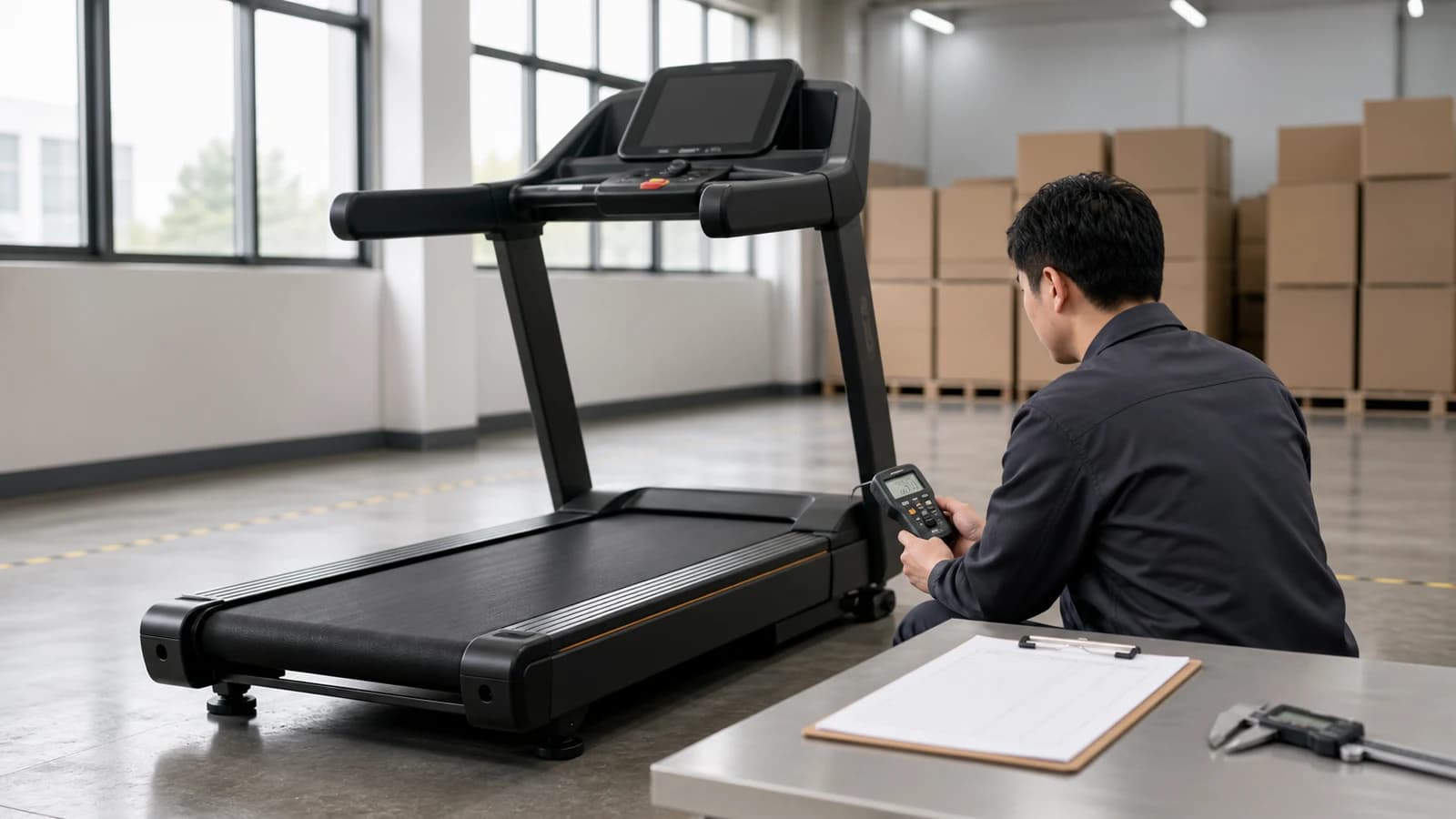
A buyer-side inspection can compare sampled finished goods with approved references while the lot remains accessible. The useful output is a traceable record of model and serial identity, assembly, frame, deck, belt and roller appearance, belt alignment, accessible gaps and guards, foot rails, handrails, console, controls, stop key or button, incline, power connection, accessories, labels, instructions, quantities, defects, mismatches, and affected cartons.
Perform powered checks only at a buyer-approved safe station with a written method, suitable electrical protection, trained personnel, clear stop rules, and no person running on the belt. Observe startup, low and selected approved speeds without a rider, displayed versus independently measured values where the method permits, speed transitions, stop response, incline movement, belt tracking, abnormal vibration, noise, odor, heating, sparking, error codes, and restart behavior.
Stop and isolate the sample on unexpected acceleration, abrupt stopping, failure to stop, runaway incline, unstable belt tracking, rubbing, smoke, odor, excessive heat, arcing, damaged insulation, loose power connection, abnormal noise, error loops, or unsafe access to moving parts. Preserve the unit, controller and firmware identity, settings, video, measurements, time sequence, and carton traceability for qualified disposition.
- Use an approved sampling plan, defect classes, assembly method, measurement list, powered-check method, photo and video list, prohibited actions, and traceability scheme
- Record speed, incline, stop, temperature, noise, and error observations as limited inspection evidence, not proof of prescribed performance or compliance
- Quantify missing, substituted, loose, cracked, misaligned, rubbing, unstable, overheating, mislabeled, unreadable, incomplete, mixed, or poorly packed units and parts
- Do not use a person as a dynamic load, bypass a safety device, open energized enclosures, alter firmware, defeat guards, or improvise electrical, structural, endurance, entrapment, or loaded stopping tests
Connect factory release to complaints, incidents, and changes
Pre-shipment release should create a record that remains usable after sale: exact model, serial range, production date, factory, controller, firmware, motor, sensor, power assembly, test and inspection results, deviations, approved changes, accessories, destination, quantities, and cartons. If complaints arrive, the responsible party needs to identify which units share the relevant configuration.
Separate a one-off service issue from a possible pattern only through disciplined data. Preserve complaint wording, date, model and serial, firmware, use conditions, event sequence, injuries or property damage when reported, returned-part findings, service action, production change, retest evidence, and affected population. Do not wait for a factory root-cause theory before preserving and escalating facts.
The 2026 settlement record is useful because it links incident review, production changes, reporting processes, internal controls, and continuing duties. It does not establish a universal reporting rule for every event or buyer. Importers and manufacturers should obtain qualified legal advice and follow the requirements that apply to their market and role.
- Do not overwrite original complaint, inspection, test, firmware, service, or change records when adding later analysis
- Map every corrective action to affected serials, hardware and software versions, production dates, units, warehouses, channels, and customers where required
- Reassess old evidence when post-sale data points to a failure mode that the original scope did not cover or a change did not resolve
- Keep legal reporting, recall, customer communication, engineering, laboratory, supplier-correction, and shipment-release decisions with their qualified owners
Evidence checked: CPSC settlement announcement and compliance controls, Federal Register agreement and company response.
Where does inspection stop and qualified evaluation begin?
Speed accuracy and transition limits, stop deceleration, emergency-stop performance, controller and software safety, abnormal operation, thermal endurance, electrical protection, leakage current, dielectric strength, grounding, structural loads, stability, fatigue, belt and roller durability, accessible gaps, entrapment, and other safety assessments can require defined loads, conditioning, fixtures, calibrated instruments, repeated cycles, protected facilities, competent operators, and formal interpretation.
A no-load factory check can reveal an obvious mismatch or malfunction, but it cannot predict every loaded condition, software state, component aging path, voltage condition, installation, maintenance issue, or user interaction. A single successful cycle cannot validate a controller revision or close a complaint pattern.
A passed sampled inspection supports a buyer decision only within its stated scope. It cannot cure a design hazard, validate an unapproved hardware or software change, prove every unsampled unit, establish compliance, issue certification, decide regulatory reporting, or guarantee marketplace, recall, injury, fire, or consumer-use outcomes.
Evidence checked: ASTM F2115-25 treadmill specification scope.