
Quick answer
What should buyers check before alarm lots leave China?
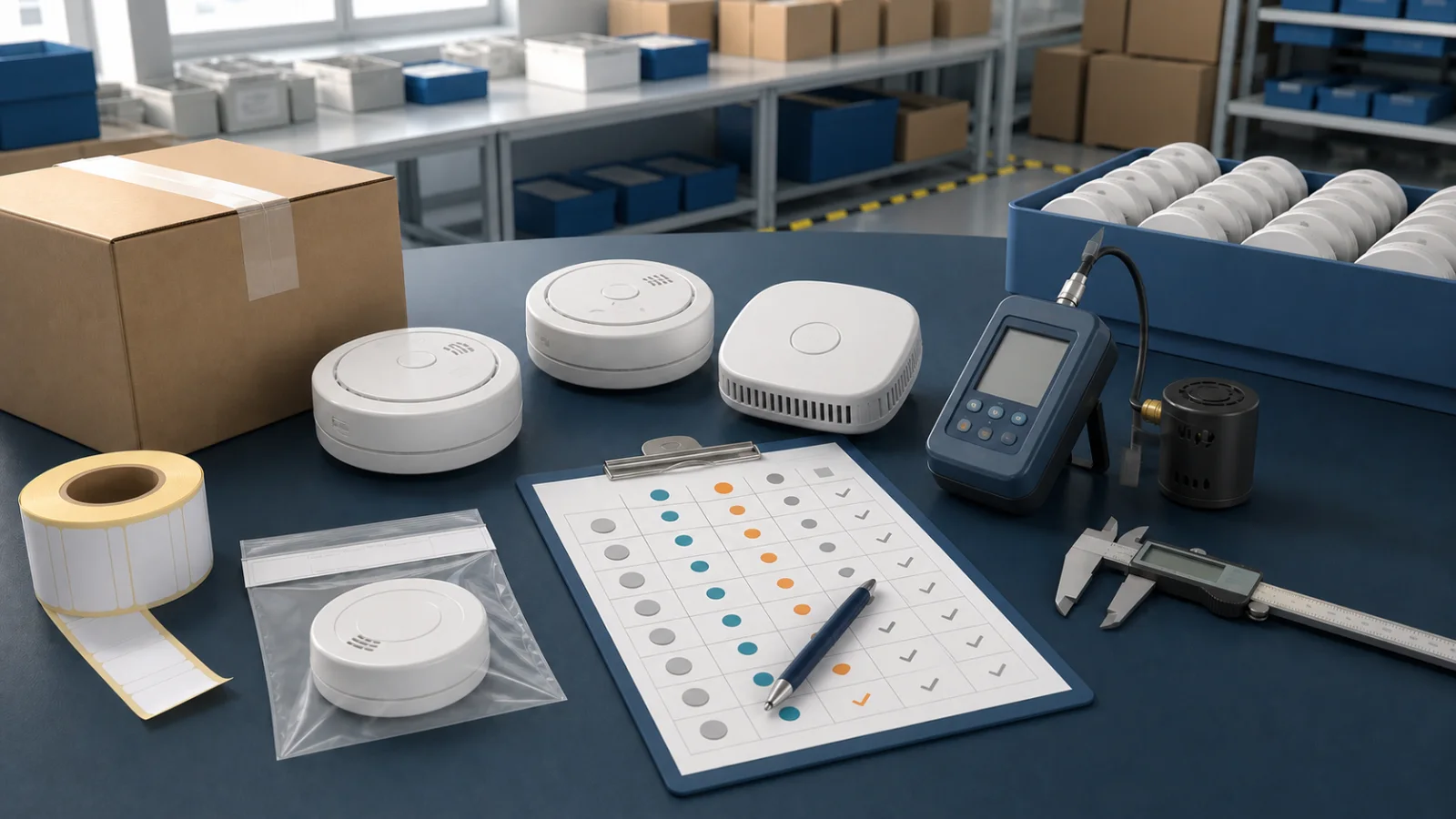
Match each finished model, hardware and firmware revision, production lot, label, package, and carton to current qualified evidence and a controlled manufacturing file. Inspect sampled goods only with approved, safe methods. Hold any mismatch, but do not treat a test button, audible beep, supplier video, or improvised smoke or gas demonstration as proof of prescribed detection performance.
- 1Freeze the destination, importer, retail brand and seller aliases, alarm type, exact model, sensing architecture, power source, manufacturer, factory, production date, lot, package, and carton identity
- 2Have the importer and qualified advisers identify the current rules, standards, certification, listing, installation, language, eFiling, marketplace, and retailer requirements for the exact product and market
- 3Map complete reports and source-verifiable certification or listing records to the exact model, sensors, PCB, sounder, enclosure, power components, firmware, laboratory, dates, samples, methods, results, and limitations
- 4Compare approved sensor part numbers, chamber or inlet design, PCB revision, power and backup parts, sounder, buttons, indicators, enclosure, firmware, labels, manual, package, and bill of materials with current production
- 5Check sampled units for model identity, assembly, openings, battery compartment, terminals, controls, indicators, specified self-test behavior, sound output under the approved method, workmanship, and visible damage
- 6Check manufacturer and importer identity, model, date or lot code, power information, required markings, warnings, instructions, package claims, barcodes, carton marks, quantities, packing list, and certificate data
- 7Hold mixed models, changed critical parts or firmware, missing or mismatched evidence, unreliable self-test behavior, weak or inconsistent sound readings, damaged units, uncontrolled rework, or untraceable cartons
- 8Release only named models, production lots, quantities, packages, and cartons after documented correction, qualified disposition, and repeat inspection or testing where required
China-side evidence module
Alarm lot release checklist
Connect qualified model evidence and controlled production to sampled physical goods and pack-out. This checklist does not turn a routine inspection into smoke or CO response testing, certification, legal advice, installation approval, or a life-safety guarantee.
Identity and market scope
- Destination, importer, retail brand and seller aliases, alarm function, exact model, sensing method, power source, manufacturer, factory, firmware, production date, lot, quantity, and approved changes are controlled
- PO, approved sample, specification, bill of materials, reports, listing or certification records, certificate data, labels, manual, package, marketplace listing, packing list, and cartons describe one version
Qualified performance evidence
- Complete source records identify the exact model, tested samples, sensor and design revisions, laboratory or certification body, methods, dates, results, photographs, conditions, and limitations
- The importer has documented which smoke, CO, electrical, battery, radio, accessibility, marking, installation, certificate, and destination requirements apply
Production and pack-out
- Sampled units match approved sensors, PCB, power parts, sounder, enclosure, controls, indicators, firmware identity, assembly, workmanship, labels, instructions, package, and accessories
- Approved non-destructive checks, quantities, carton marks, barcodes, package protection, packing list, production dates, lots, and correction status remain traceable
Hold, correction, and release
- Affected quantity, hold tags, lot and carton map, supplier changes, controlled rework, qualified retest decision, revised records, and repeat inspection remain linked
- Cleared and unresolved models, firmware revisions, dates, lots, packages, and cartons stay separated; final release names the exact scope and open conditions
Why alarm evidence and lot control matter now
On August 20, 2026, the U.S. Consumer Product Safety Commission warned consumers to stop using KH158 plug-in natural-gas and carbon-monoxide detectors. CPSC said 376,974 units had been sold under 18 brand names, identified 91 reports of failure to alarm in the presence of gas and/or carbon-monoxide leaks, and stated that the China manufacturer had not agreed to a recall. This was a product safety warning, not an agreed voluntary recall.
CPSC issued a separate warning the same day for China-made TJTFJS model TJ00907 combination smoke and CO detectors that could fail to alert consumers to hazardous smoke and fire. The record says some units were sold without the model number on the package. That makes marketplace title, logo, package, and shell appearance insufficient identity controls for shipment release.
Earlier 2026 records show the same buyer-stage risk through different products. CPSC warned about JNHCD combination detectors on July 9 and recalled Treatlife combination detectors on June 25. Together, the records make exact manufacturer, model, revision, evidence, label, lot, and carton mapping more useful than a generic product-family or storefront claim.
CPSC also announced on July 8, 2026 that mandatory eFiling was in effect for certificates covering regulated imported consumer products. The agency said eFiling changes how existing certificate data reaches CPSC, not the underlying testing, certification, or compliance duties. Importers should determine whether and how those duties apply to the exact alarm before shipment.
- A brand name, storefront, product listing, test button, supplier declaration, logo image, report cover, or old model certificate is not a complete evidence chain for the current lot
- A change to a sensor, smoke chamber, PCB, power circuit, sounder, enclosure opening, firmware, manufacturer, factory, or model can change the evidence question
- A self-test or sampled sound reading checks only its defined function and does not prove smoke or CO sensitivity, response time, immunity, durability, or real-emergency performance
- Correction leverage is strongest before final payment and pickup, while affected models and cartons can still be held, reviewed, tested, reworked, relabeled, repacked, or rejected
Evidence checked: CPSC KH158 gas and CO detector warning, CPSC TJTFJS combination detector warning, CPSC JNHCD combination detector warning, CPSC Treatlife combination detector recall, CPSC July 2026 eFiling implementation release.
Freeze the exact alarm function, destination, model, and factory
Do not treat every round alarm as the same product. Record whether the unit detects smoke, carbon monoxide, or both; the sensing method; primary and backup power; battery type and access; standalone, interconnected, radio, app, hub, display, voice, accessibility, or other functions; intended location; destination market; and installation configuration.
Build one controlled model record connecting every retail brand, seller alias, sales SKU, ASIN or other channel identifier to the manufacturer, factory, exact model, hardware and firmware revisions, sensor and chamber identity, PCB, power circuit, sounder, enclosure, labels, manual, accessories, package, production date, lot, and cartons. If one shell or listing covers several internal builds, split the versions before approval.
The importer and qualified product-safety advisers should identify the current rules, recognized standards, editions, deviations, certification or listing route, certificate duties, eFiling fields, installation code, local requirements, and market claims. CPSC currently directs consumers in the KH158, TJTFJS, and JNHCD warnings to buy alarms meeting UL 2034 and/or UL 217; exact product obligations and evidence still require responsible review.
- Control retail brands, seller aliases, model suffixes, alternate names, channel identifiers, hardware and firmware revisions, sensor part numbers, PCB markings, power options, labels, packages, listings, and carton identities
- Identify the first affected date, production line, lot, quantity, package, and carton range for every approved or suspected change
- Keep smoke-alarm evidence, CO-alarm evidence, radio evidence, electrical or battery evidence, and installation claims mapped to the relevant function
- Reject broad “same series” or “same housing” coverage without a documented rationale that matches the tested or listed design
Evidence checked: CPSC KH158 warning and consumer standard reference, CPSC TJTFJS warning and product identity details, CPSC FY2025 standards activity report, CPSC carbon monoxide alarm standards page.
What should qualified alarm evidence connect?
Review complete source records rather than a cropped certificate or report cover. Capture the issuer, laboratory or certification body, authorization status, applicant and manufacturer, factory, exact model, hardware and firmware, samples, photographs, receipt and test dates, methods, clauses, conditions, individual results, failures, corrections, limitations, surveillance status, and current public listing where one exists.
Connect that evidence to the bill of materials and current production. At minimum, control the smoke or CO sensor, chamber or gas inlet, PCB, microcontroller and firmware identity, power supply, backup source, battery contacts, charging parts if any, sounder, buttons, indicators, display, radio module, enclosure openings, fasteners, labels, and manual. Similar appearance does not establish equivalent performance.
Keep certification, independent testing, factory controls, and buyer inspection in separate scopes. Source verification can show whether a record exists and what model and factory it covers. Qualified testing evaluates defined performance. Factory controls maintain the approved design. Buyer inspection checks sampled production against approved references and reports deviations for a release decision.
- Confirm records through the claimed issuer or official public directory where an appropriate route exists
- Match tested or listed identifiers and photographs to the approved sample, current goods, internal controlled records, package, and listing
- Escalate expired, suspended, withdrawn, edited, incomplete, inaccessible, or contradictory records and evidence issued to another model, factory, applicant, sensor, or revision
- Require qualified review when a report does not clearly cover every alarm function and sale configuration claimed on the product or package
Evidence checked: CPSC FY2025 smoke-alarm standards activity, Huang Sourcing UL verification guide, Huang Sourcing laboratory report verification guide.
Control sensors, electronics, firmware, and substitutions by lot
An approved sample is useful only when production remains tied to it. Compare the controlled bill of materials, drawings, PCB revision, firmware release, approved supplier list, incoming records, line issue records, programming logs, in-process tests, finished-lot results, retained samples, labels, and correction history.
Critical-looking changes are not limited to the sensor. A different chamber geometry, vent opening, PCB layout, component value, power circuit, battery contact, sounder, enclosure material, molding condition, coating, firmware threshold, debounce logic, silence behavior, display logic, radio module, assembly pressure, or contamination control can require engineering, compliance, or qualified test review.
When a substitution appears, identify the exact old and new parts, supplier, specification, first production date, affected quantity, hardware and firmware revisions, open records, and carton scope. Segregate affected goods until responsible parties document whether the existing evidence remains applicable or new evaluation is required.
- Tie incoming labels and internal part codes to approved manufacturer part numbers and controlled specifications
- Use programming records and an approved readout method to identify firmware; do not rely on a handwritten carton note
- Keep approved and changed production physically separated with hold status visible at unit, inner-pack, carton, pallet, and packing-list levels
- Treat sensitivity, gas concentration response, false-alarm immunity, long-term drift, battery life, radio performance, and environmental durability as qualified evaluation questions
What can a China-side finished-goods inspection check?
A buyer-side inspection can compare sampled mass production with approved references while the goods remain accessible. The useful output is a traceable record of model and lot identity, external and approved internal comparison, assembly, controls, indicators, battery compartment, terminals, sound openings, labels, instructions, packages, quantities, cartons, defects, mismatches, and affected scope.
Use only buyer-approved, safe, non-destructive checks and tools. These may include visual comparison, dimensions and mass, fit and fastening, battery insertion and retention, power-up, indicator sequence, self-test initiation, specified display or voice behavior, low-power simulation under a defined method, and sound pressure at an agreed distance and environment. Record tools, settings, sample, raw readings, results, and limitations.
Do not inject smoke, aerosol, canned gas, exhaust, calibration gas, flame, heat, or improvised contaminants during routine inspection unless a qualified procedure, safe facility, competent operator, selected sample plan, calibrated equipment, ventilation, and responsible disposition have been formally approved. A test button usually exercises only the designed self-test path.
- Use buyer-approved sampling, defect classes, tolerances, fixtures, batteries, environment, tools, functional steps, stop rules, and photo requirements
- Check identity before and after unpacking so every finding remains tied to a model, hardware and firmware revision, production date, lot, package, and carton
- Quantify cracked housings, blocked openings, loose parts, poor contacts, missing fasteners, inconsistent indicators, failed self-tests, abnormal sound readings, cosmetic defects, and pack damage
- Keep smoke sensitivity, CO concentration response, nuisance resistance, endurance, EMC, radio, environmental, life, and real-emergency conclusions outside routine inspection
Connect alarm labels, instructions, certificate data, and cartons
Match approved product and package artwork to the destination, alarm function, model, manufacturer and importer, date or lot code, hardware or firmware identifier where controlled, power and battery information, required warnings, installation and replacement instructions, test and maintenance directions, language, certification or listing references, barcode, and sales channel.
A correct-looking label cannot repair failed evidence, an unsupported component change, or a production build that differs from the tested or listed design. Conversely, qualified evidence does not excuse an incorrect model, date code, warning, manual, package claim, or carton identity.
For U.S. regulated imports, the importer should determine the applicable certificate and eFiling requirements for the exact product. CPSC says mandatory eFiling for most regulated imported consumer products took effect July 8, 2026 and does not create new underlying testing or certification obligations. Keep filed data aligned with the finished product and its supporting records.
- Do not let the alarm, label, manual, reports, listing or certification record, certificate data, package, marketplace listing, packing list, and carton describe different models or parties
- Photograph identity and warning details in context and retain a carton map for mixed models, languages, power options, production dates, or lots
- Hold unreadable, removable, missing, mixed, contradictory, or unauthorized claims until approved correction and recheck
- Use the importer and legal or compliance team’s approved content; an inspection compares implementation and does not author regulatory instructions
Evidence checked: CPSC mandatory eFiling implementation announcement, Huang Sourcing CPSC eFiling buyer checklist.
Where does inspection stop and qualified alarm testing begin?
Qualified smoke and CO alarm evaluation can involve controlled fuels or gas concentrations, chambers, airflow, temperature and humidity, sound measurements, power conditions, response timing, nuisance sources, environmental conditioning, durability, software behavior, calibration, safety controls, defined samples, and competent interpretation. Those tasks belong with appropriate laboratories, certification bodies, manufacturers, importers, and product-safety specialists.
A test button, smartphone sound-meter app, burning paper, cigarette, aerosol spray, vehicle exhaust, or unapproved gas source must not be presented as proof that the product meets a standard. Such shortcuts can be unsafe, contaminate products, damage sensors, create false confidence, and still fail to reproduce a prescribed method.
A passed sampled inspection supports a buyer decision only within its stated scope. It cannot cure missing evidence, validate an unapproved design change, prove every unsampled unit, certify compliance, or promise customs, marketplace, installer, regulator, recall, or real-emergency outcomes.