
Hardware + firmware · thermal evidence · lot release
Smart Glasses Checks Before Shipping from China
Before paying the balance or authorizing pickup for China-made smart glasses, match the actual hardware revision, installed firmware, battery and charging accessories to the approved configuration and qualified evidence. Hold any lot with unexplained heating, an undocumented software change, or serial numbers that cannot be connected to the release record.
Written by Huang Sourcing Editorial TeamPublished on October 2, 2026
Based on cited public records and buyer-side sourcing analysis; limits and specialist responsibilities are stated below.
Quick answer
What must match before an smart glasses lot moves?
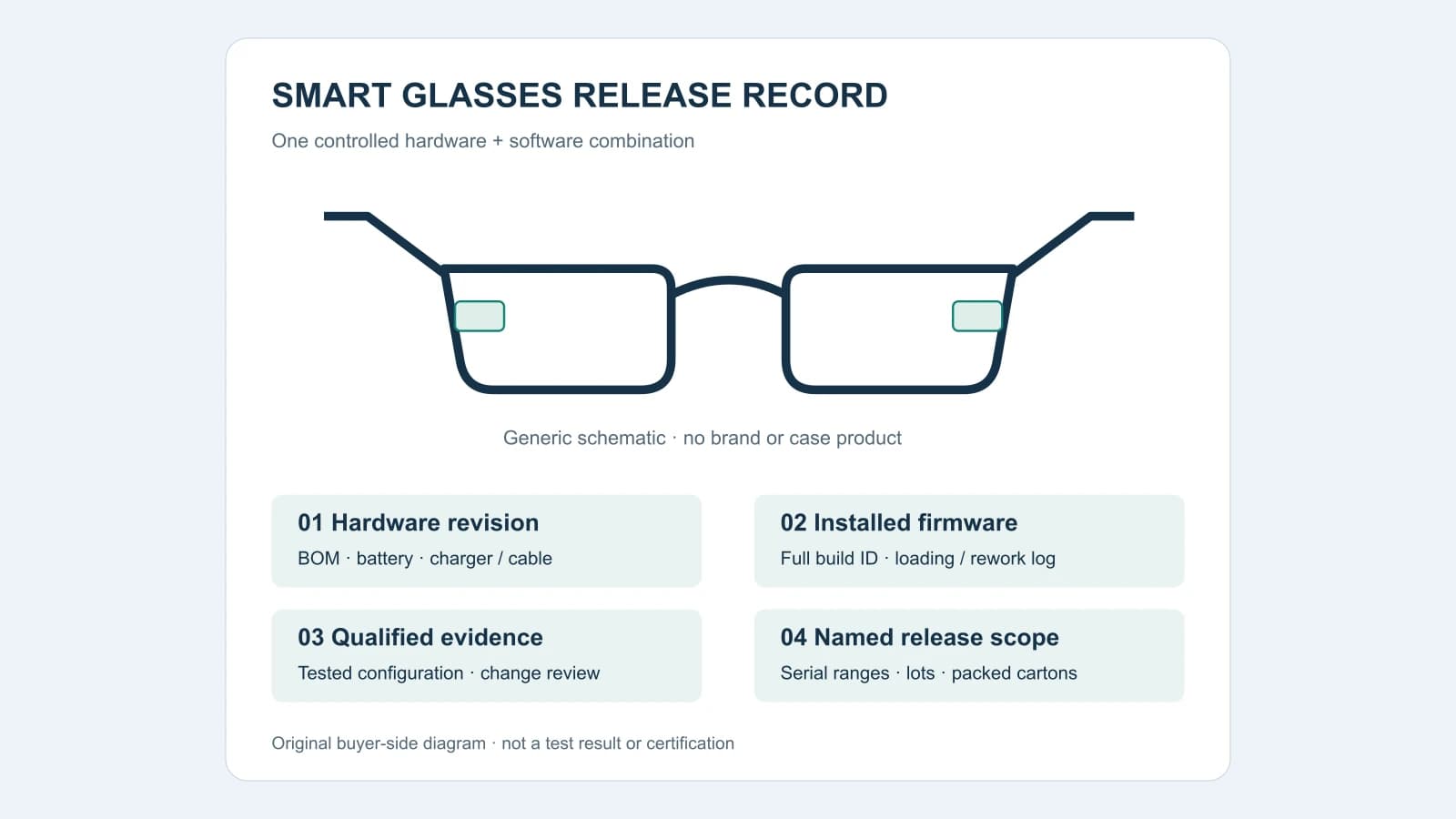
Make the release decision on a controlled hardware–software combination, not on a product name or a successful short demo. Ask qualified parties to assess thermal and electrical evidence for the intended uses, compare sampled production with the approved configuration, and record which serial numbers and cartons are cleared. A factory function check cannot establish safe extended use or substitute for qualified testing.
The September 2026 INMO AIR3 recall makes this a current shipment question: the published repair involves a firmware update. Our buyer-side conclusion is to control firmware identity alongside hardware and evidence. It is not a claim that software alone caused the hazard or that any particular build clears another model.
Buyer-side release module
Four checks before balance payment or pickup
Agree the sample plan and stop rules while the goods remain accessible. Keep qualified testing and certification separate from a shipment inspection.
- 1
Freeze hardware and software together
Record model, hardware/BOM revision, battery and charger/cable version, firmware build, app version where relevant, intended modes, factory, lots and serial ranges. Retain an approved reference unit.
- 2
Match the qualified evidence
Have the responsible importer and qualified lab reconcile tested-sample photos, hardware and software identity, operating modes, test conditions, results and limitations. Escalate every safety-related change for review.
- 3
Compare sampled production
Use an approved safe plan to record device identity, installed build, pairing and agreed functions, hinge/enclosure condition, accessory identity, labels and pack contents. Stop on abnormal heat, swelling, odor or damage.
- 4
Close corrections before named release
Segregate unresolved or mixed versions. Preserve original and corrected build records, qualified disposition, any required retesting and repeat inspection. Release only documented serial ranges and cartons.
At the factory
Can a firmware screenshot clear the shipment?
A screenshot can record what one unit displays. It does not establish that every carton contains that build or that the build has qualified evidence for the hardware. Photograph the serial identity and software information together; record the full identifier exposed by the device, not just a marketing version name. Ask the supplier how the build is loaded, checked and controlled after rework. If offline updates, companion apps or region variants change the configuration, add them to the approved reference.
For a proposed update, request the supplier’s release notes, affected hardware revisions, intended-use limitations and qualified change assessment. Have the importer and qualified specialists decide whether the revised combination needs additional testing. A firmware number from an unrelated recall is not a universal acceptance target. If the supplier cannot identify which build the laboratory evaluated, hold the scope rather than assuming that a newer number is safer.
Sample across named lots and carton ranges using an agreed plan. Compare enclosure and hinge condition, charger and cable identity, startup, pairing, accessible version records and pack contents against the reference. Keep measurements and observations within the approved procedure. Do not wear inspection units to assess skin comfort, run improvised extended-load trials, bypass protection settings, or open battery enclosures. Stop abnormal operation and preserve identifiers for specialist assessment.
Request one configuration release pack
- Destination, importer, exact models, intended modes, factory, lots, quantities and serial-to-carton map.
- Approved unit, hardware/BOM revision, battery, charger/cable versions and controlled change history.
- Firmware build identity, loading/rework records, release notes, relevant app/region versions and update method.
- Complete reports, tested-sample identity and configuration, operating conditions, results, limitations and qualified change assessment.
- Labels, instructions, accessory list, failed-unit IDs, containment, correction records and repeat inspection evidence.
For affected INMO stock, follow the official recall and manufacturer-assisted repair process. A routine shipment inspection does not authorize redistribution of recalled goods.
Evidence to decision matrix
Turn a mismatch into a named lot decision.
A short successful demo does not clear a changed build, unmatched thermal evidence, mixed accessories, or unresolved failure.
Public case example
INMO AIR3: a firmware repair with a defined product scope
What happened: On September 24, 2026, CPSC announced recall 26-797 for China-made INMO AIR3 smart glasses. It says the left temple can overheat during extended use. About 1,643 units were sold in the U.S., with about 120 additional units in Canada. The firm reported 10 overheating incidents, including burning sensations on the face and left ear.
What evidence was public: CPSC identifies the AIR3 model and right-temple markings, directs consumers to stop use and contact INMO for a free repair, and says the firm will assist with an online V3.16 update. Health Canada’s joint notice also names firmware 3.16 for the affected product. Neither notice publishes a complete laboratory file or establishes that every similarly designed wearable has the same hazard.
Buyer lesson: Treat installed software as part of the production configuration. Ask which hardware and build were evaluated, how correction is verified on named units, and how those units map to packed cartons. This release workflow is our sourcing analysis, not a regulator’s prescribed inspection method.
Limits of comparison: The remedy is specific to the recalled AIR3. It does not prove a firmware-only root cause or that version 3.16 is suitable for another device. Huang Sourcing did not inspect, develop, repair or participate in this case.
Evidence basis for this advice.
This guide uses current CPSC and Health Canada public recall records, independent editorial coverage, and buyer-side sourcing analysis. Official records control the case facts; the proposed shipment workflow is our analysis.
- The September 24 recall supplies the model, reported hazard and published repair; it does not disclose a complete technical root-cause or testing file.
- Android Authority’s September 24 report is a separate coverage signal, not a separate set of incidents or evidence of search volume.
- Configuration comparison can document sampled production and gaps. It cannot certify thermal safety, every unit, or destination-market compliance.
Keep product, update and transport decisions separate.
Qualified specialists should establish the applicable electrical, thermal, radio, optical and other requirements for the exact destination, intended use and design. This article supplies no temperature threshold, lab standard selection, certification or customs conclusion. A battery transport report does not establish the safety of a face-worn finished device; a product report does not replace the carrier’s current transport requirements.
Hold unmatched or mixed configurations until the responsible parties accept a documented disposition. For a build correction, retain before-and-after identity and records that show the affected quantity was addressed. Re-inspect identified stock and keep unresolved cartons held. Do not convert one updated reference unit into a blanket order pass, or allow an automatic update after inspection to silently change the approved release configuration.
If stock matches a recall, keep it segregated and ask the responsible importer and qualified parties to confirm the official disposition. Health Canada’s notice expressly warns against selling, redistributing or giving away recalled products in Canada. Our general workflow cannot override a recall or authorize resale.
Make the hold or release scope explicit.
Share exact models, hardware and firmware revisions, battery and accessory versions, full reports, approved unit, serial ranges, lot/carton map and pickup date. Huang Sourcing can scope a China-side comparison and document gaps for qualified review.
Sources
Public sources checked October 2, 2026 Beijing time. CPSC and Health Canada control recall facts. Android Authority’s September 24 coverage is an independent attention signal, not proof of rising search volume or another incident set. None implies Huang Sourcing involvement.