
Charging compatibility · pack contents · lot release
Sleep Machine Charging Checks Before Shipping from China
Before paying the balance or authorizing pickup for China-made portable sleep machines, match the device, supplied cable, specified power adapter, charging instructions and qualified test evidence. Hold lots with an unexplained accessory substitution, contradictory power requirements, or date codes that cannot be traced to the intended market and cartons.
Written by Huang Sourcing Editorial TeamPublished on October 3, 2026
Based on cited public records and buyer-side sourcing analysis; limits and specialist responsibilities are stated below.
Quick answer
What must match before a sleep machine shipment moves?
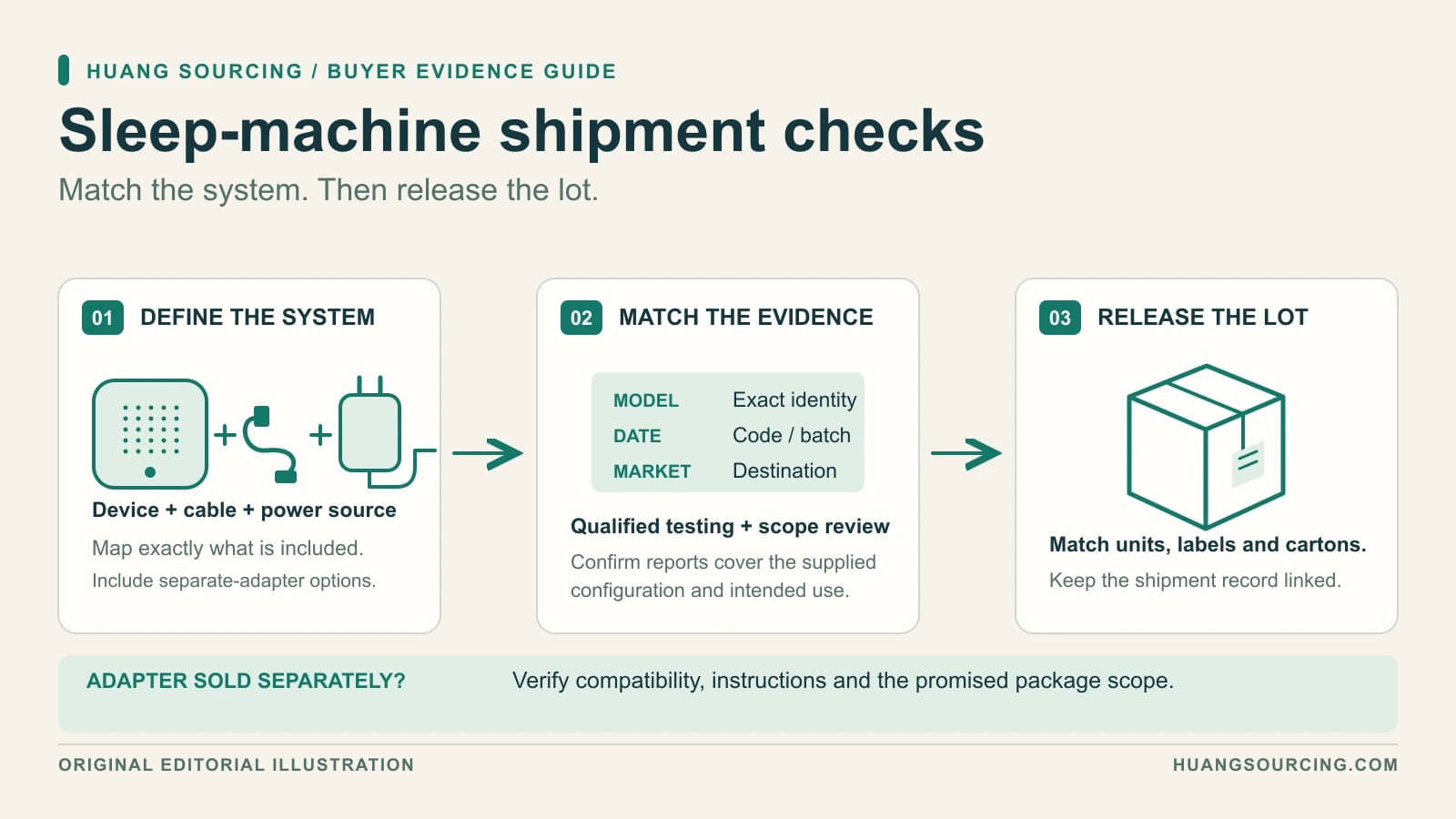
Approve a documented charging configuration, including what the customer must supply when no adapter is included. Compare the packed product and instructions with that configuration, then connect accepted evidence and closed corrections to named lots. A working sound demo, a matching USB connector or a battery transport document cannot establish finished-product charging safety.
The manufacturer’s UK recall notice describes overheating when the affected device is used with certain charging devices that were not supplied with it. That makes the adapter-excluded retail pack a concrete sourcing question: who defines, evaluates and communicates the acceptable charging configuration?
Buyer-side release module
Four checks before balance payment or pickup
Agree the sample plan and stop rules while the goods remain accessible. Keep qualified testing and certification separate from a shipment inspection.
- 1
Define the complete charging configuration
Record the model, hardware and battery revision, cable identity, supplied or customer-supplied adapter requirements, destination and intended operating modes. Retain approved references and the current bill of materials.
- 2
Connect reports to that configuration
Have the importer and qualified lab reconcile full reports, sample photographs, charger and cable identity, charging conditions and limitations. Ask for a documented change assessment if any relevant component or instruction has changed.
- 3
Compare actual units and retail packs
Use an agreed safe inspection plan to compare markings, ports, cables, included adapters, instructions and pack contents. Record model and date codes with lot and carton IDs. Stop on abnormal heat, swelling, odor or damage.
- 4
Release only the reconciled lot scope
Separate mixed or unmatched stock. Close evidence gaps and corrections, obtain responsible-party acceptance, and repeat the relevant checks. Record which date codes, quantities and cartons are released and which remain held.
At the factory
What changes when the adapter is sold separately?
The release file still needs a defined power-supply specification. Ask the supplier and qualified lab to identify the device input requirements, permitted charging arrangement and any restrictions that belong in the instructions. Record whether an adapter is included, optional or customer-supplied. Keep that decision consistent across the purchase specification, retail box, manual and destination-market listing artwork provided for review.
For an included adapter, record its exact model and markings alongside the device and cable. For a cable-only pack, check that the reviewed instructions identify the required supply clearly. If one document says “any USB charger” while another specifies a narrower arrangement, hold that version for technical reconciliation. Do not invent a wattage rule or assume that a physically matching connector proves compatibility.
Compare production against the approved reference using a plan agreed with the responsible parties. Record device and box codes together, cable identity, charging-port condition, pack contents and instruction revision. Perform only the agreed checks with the approved configuration. A short playback or charging indication is a function observation, not an electrical or thermal safety assessment.
Request one configuration release pack
- Destination, importer, model, hardware revision, battery identity, intended modes and factory.
- Cable part ID and adapter model if included; reviewed supply requirements if sold separately.
- Complete reports, sample photos, tested charging arrangement, limitations and component change records.
- Approved device markings, manual, retail box and accessory list for each market version.
- Unit and box date codes, quantities, lot-to-carton map, open issues and correction records.
Screen recall identity before operating samples. For affected Love to Dream stock, follow the manufacturer’s U.S. recall instructions or the applicable destination notice. Replacing a charger is not the published remedy for recalled units.
Evidence to decision matrix
Turn a mismatch into a named lot decision.
A sound demo does not clear an undocumented charging arrangement, mixed market pack, or unresolved safety issue.
Public case example
Love to Dream: charging compatibility and different market scopes
What happened: On September 24, 2026, CPSC recalled China-made Love To Dream portable sleep machines because an incompatible charger can cause battery overheating and fire or burn injury risk. Its notice reports no incidents or injuries and offers a refund for affected units.
What evidence was public: The U.S. record and the earlier September 10 UK OPSS notice identify the same model with different affected date-code lists. These are separate market scopes, not interchangeable lists or two independent sets of incidents.
| Market / record | Model | Affected date codes |
|---|---|---|
| U.S. CPSC 26-798 | LTD-SM23 | 7W15TN |
| UK OPSS 2609-0065 | LTD-SM23 | 7T12TN, 7W15TN, 8P01TN |
Buyer lesson: Build a model–date-code–market map before inspecting mixed inventory. Connect each unit and retail pack to a carton range, then assess charging evidence for the exact configuration. This is our proposed sourcing workflow, not an inspection procedure prescribed by either regulator.
Limits of comparison: The notices do not publish a complete failure investigation or a universal charger specification. An unlisted date code is not proof of general product safety. CPSC identifies its recalled units as China-made; OPSS records the UK product’s origin as unknown. Huang Sourcing did not inspect, supply or participate in this case.
Evidence basis for this advice.
This guide draws on cited regulator and manufacturer recall records, with a separate current coverage signal. The inspection and release recommendations are buyer-side sourcing analysis.
- Official notices establish the reported hazard, identifiers and action for their own market. They do not establish the safety of other models or lots.
- The proposed evidence pack connects product configuration, instructions and stock identity. It cannot replace qualified design assessment or laboratory testing.
- Sampling records only the agreed inspected scope. Release decisions should identify unresolved conditions, responsible parties and the precise cartons covered.
What can a shipment check establish?
It can record whether sampled goods and retail packs match approved documents, and make discrepancies visible before payment or pickup. It cannot certify electrical safety, safe sound exposure, suitability for infant use, every unit in the order, or destination-market compliance. Have qualified specialists determine the requirements and evaluation needed for the exact design, intended use and market.
Do not charge recalled units, try combinations of unknown adapters, open battery enclosures or reproduce an overheating condition during a routine inspection. Stop and escalate abnormal operation. Keep affected stock segregated and obtain an authorized disposition. The manufacturer’s U.S. notice directs affected customers to stop use and follow its recall process; ordinary relabeling or a passed spot check cannot override that instruction.
For non-recalled stock with a documented change, retain before-and-after component and instruction records. Ask qualified parties whether additional evaluation is required, verify the correction on identified stock, and re-inspect the relevant scope. Keep battery transport documentation and carrier acceptance separate from finished-product charging evidence.
Make the hold or release scope explicit.
Share the model, battery and cable identities, adapter inclusion policy, reviewed instructions, full reports, date codes, market versions and carton map. Huang Sourcing can scope a China-side comparison and document gaps before the balance-payment or pickup deadline.
Sources
Public sources checked October 3, 2026 Beijing time. Official records control case facts. NBC Select coverage provided a separate attention signal. No source implies Huang Sourcing involvement.