
Quick answer
What should buyers check before pressure washers leave China?
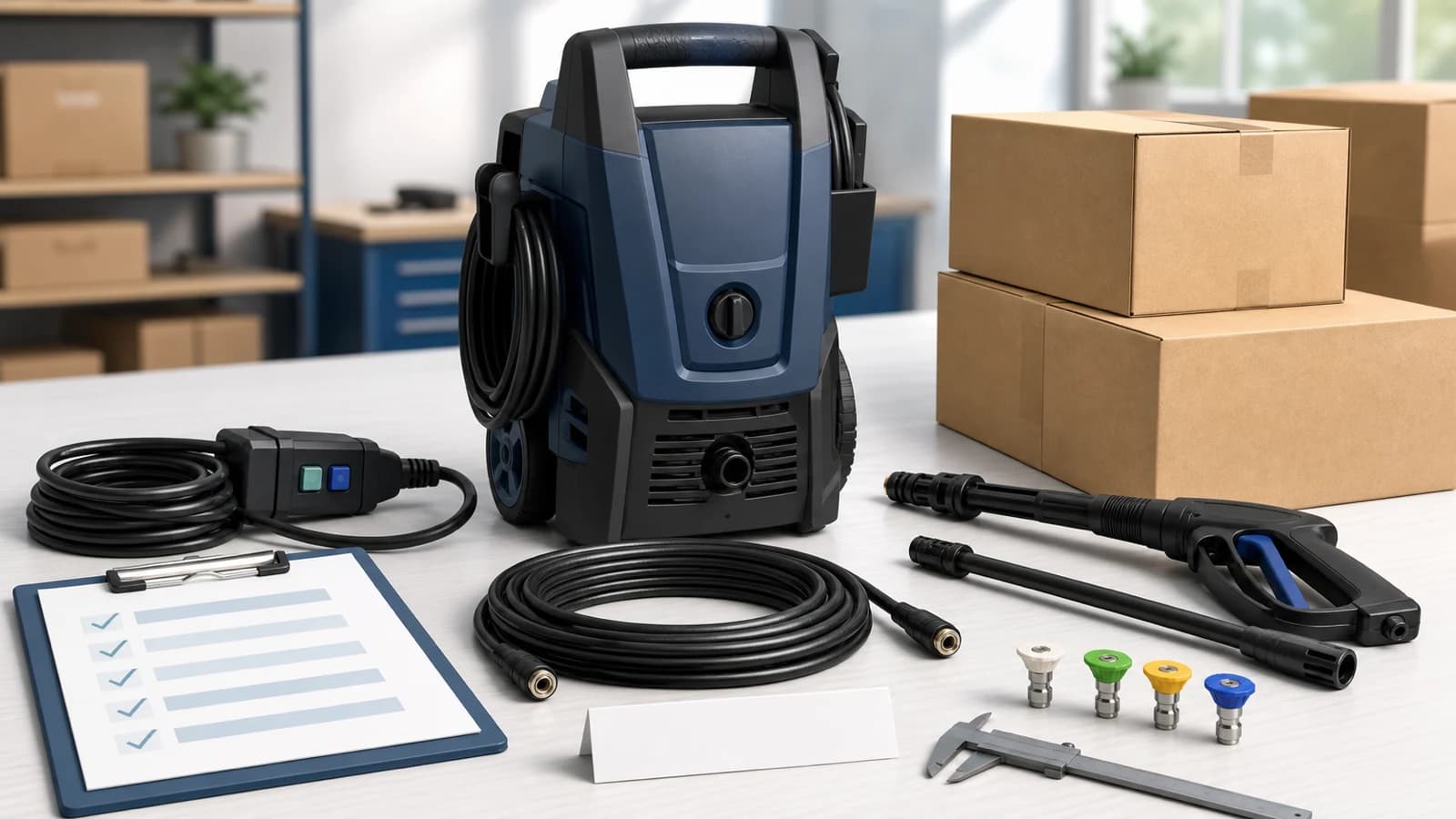
Freeze the exact market and electrical version before selecting evidence or inspection criteria. Match the model, rating, plug, integral GFCI, cord and strain relief, motor, pump, hose, gun, nozzles, manufacturer, factory, production lot, labels, instructions, and cartons. Hold any mismatch; a test/reset button, supplier video, standard name, certification logo, generic report, or improvised wet factory test does not prove electrical performance or compliance.
- 1Freeze destination, importer, exact model, electrical input, plug, integral GFCI, cord length, strain relief, motor, pump, hose, spray gun, nozzle set, instructions, labels, production lot, and carton version
- 2Have the importer and qualified compliance parties map the exact product to applicable electrical, wet-use, pressure-equipment, labeling, certification, and filing requirements before selecting evidence or inspection criteria
- 3Map complete reports and listing or certificate references to the manufacturer, factory, exact model, electrical construction, plug, GFCI, cord, sample photos, dates, methods, results, deviations, and limitations
- 4Control drawings, bill of materials, wire and cord specifications, GFCI part and supplier, plug mold, strain relief, switches, connectors, enclosure, motor, pump, hose, gun, nozzles, labels, instructions, and every approved change
- 5Compare sampled production for model and rating identity, integral GFCI presence and configuration, cord length, plug and strain relief, dry workmanship, accessory set, approved functional checks, labels, and pack-out
- 6Hold missing, bypassed, loose, substituted, damaged, mixed, or untraceable electrical parts; unsupported reports; improvised wet tests; incorrect labels; or cartons that cannot be mapped to a production lot
- 7Screen the exact model and production lot against current regulator warnings and recalls; quarantine any potentially affected inventory while the importer verifies scope and official instructions
- 8Route GFCI trip values, leakage current, dielectric strength, insulation, water ingress, pressure endurance, hose burst, and other prescribed performance questions to qualified laboratories or engineers
- 9Release only named models, electrical versions, batches, quantities, accessories, and cartons after documented correction, qualified disposition, and repeat inspection or testing where required
China-side evidence module
Electric pressure washer release checklist
Connect qualified electrical evidence to sampled mass production and pack-out. This checklist does not turn an onsite comparison into GFCI, dielectric, insulation, ingress, pressure-endurance, certification, legal, or safety testing.
Controlled product identity
- Destination, importer, manufacturer, factory, model, electrical rating, plug, integral GFCI, cord length, motor, pump, hose, gun, nozzles, production lot, and approved changes are controlled
- PO, drawings, bill of materials, test samples, reports, listing or certificate references, labels, instructions, retail pack, and cartons describe one version
Qualified evidence
- Responsible parties select applicable requirements and complete files identify the tested product, electrical construction, safety components, factory, methods, results, photos, dates, deviations, and limits
- A standard name, test-report cover, supplier declaration, or certification logo is never accepted without scope and exact-model verification
Finished goods and pack-out
- Sampled units match the approved GFCI and cord configuration, plug, strain relief, switches, enclosure, hose, gun, nozzles, dry workmanship, ratings, warnings, instructions, and accessories
- Model, serial or lot code, electrical rating, production identity, retail-pack barcode, carton marks, quantities, destination segregation, and packing list remain aligned
Hold, correction, and release
- Affected quantity, hold tags, component lots, carton map, supplier changes, controlled rework, qualified disposition, revised files, and repeat checks remain traceable
- Cleared and unresolved models, electrical versions, batches, accessories, and cartons stay separated; final release states every open condition
Why pressure washer release evidence matters now
On September 24, 2026, the U.S. Consumer Product Safety Commission warned consumers to stop using FOTING pressure washers. CPSC reported missing integrated immersion protection, also called an integral GFCI, and an inadequate-length power cord. The agency said Success Way Ltd. of China had not agreed to an acceptable recall. This is a CPSC product safety warning, not a recall announcement.
On September 17, CPSC separately recalled 329 LANCHEZ electric pressure washers, model KLC-BULL135C. The notice limits the recall to washers without a GFCI or adequate-length power cord. CPSC reported one missing-GFCI report and no injuries. The warning and recall are different actions involving different products and parties; buyers must check the exact model and lot rather than treat one brand name or housing style as proof of scope.
On August 27, CPSC had announced separate recalls of China-made YERYORK model YE-006 and Steelite model AZ6041VC pressure washers for missing integral GFCI and inadequate cord length. A current independent recall roundup also lists the September LANCHEZ action, but the regulator records control the specific case facts.
Those actions followed the August 20 recall of about 2,200 Workbless models WB0301 and WB0302 in the United States. Health Canada published the coordinated recall for another 657 units and identified the China distributor and manufacturer. The U.S. and Canada records describe the same Workbless models, so they help cross-check public facts but do not count as separate defect events.
The broader pattern includes August 13 CPSC recalls for SUGIFT and COMMOWNER and April actions covering BAYOTAK and SEN-QII. These records involve different companies, models, quantities, sales periods, and remedies; they do not prove a shared factory, root cause, or defect in every China-made pressure washer. They do show why integral GFCI identity, cord construction, exact-model evidence, change control, and lot-level release remain current buyer decision points.
- Treat the integral GFCI, supply cord, plug, strain relief, electrical rating, instructions, and exact model as controlled product features rather than loose accessories
- Do not infer performance from a similar housing, a test/reset button appearance, a marketplace listing, or a generic report
- A visually present GFCI can still require qualified verification of part identity, construction, trip behavior, and product-level coverage
- Correction leverage is strongest before final payment and pickup, while component lots, finished batches, and cartons can still be isolated and rechecked
Evidence checked: CPSC FOTING product safety warning, CPSC LANCHEZ pressure washer recall, Factfiled September recall roundup, CPSC YERYORK pressure washer recall, CPSC Steelite pressure washer recall, CPSC Workbless pressure washer recall, Health Canada coordinated recall, CPSC SUGIFT pressure washer recall, CPSC COMMOWNER pressure washer recall, CPSC BAYOTAK pressure washer recall, CPSC SEN-QII pressure washer warning.
How should a buyer respond to a warning or recall before release?
First search the current regulator record for the actual brand, model, product label, sales configuration, and any stated affected version. Match those details to the purchase order, finished units, production dates, component lots, packing list, and carton map. The September LANCHEZ recall expressly limits its scope to units lacking the specified GFCI or cord length; the FOTING warning identifies a product hazard but does not publish a complete factory bill of materials or lot-level clearance method.
If a shipment could fall within a warning or recall, stop payment and pickup for the affected inventory and ask the importer to follow the current official consumer and regulatory instructions. Segregate cartons and preserve product, label, component, purchase, and inspection records. A factory retrofit, different plug, outside GFCI outlet, new sticker, or supplier assurance is not an independent basis to call a publicly identified hazardous product cleared.
For a different or revised model, obtain a qualified assessment of the exact GFCI and cord construction, any applicable standard and destination requirement, and whether existing reports still cover that build. Then compare sampled production and pack-out with the approved version. Record who authorized release and which models, component lots, batches, quantities, and cartons were cleared; unresolved versions stay on hold.
- Known potentially affected goods: quarantine, confirm scope with the importer and authority, and follow the official remedy or warning instructions
- Different or corrected goods: require controlled design records, qualified disposition, applicable retesting, finished-goods comparison, and carton-level traceability before release
- Unknown identity or mixed stock: hold the full unresolved set until model, electrical version, component lot, and carton boundaries can be established
Evidence checked: CPSC FOTING warning and consumer action, CPSC LANCHEZ recall scope and remedy.
Freeze the market, electrical construction, and accessory set first
Start with destination and exact model. Freeze the rated voltage, frequency, current or power, protection class where applicable, plug geometry, integral GFCI part and supplier, power-cord type and total length, conductor specification, strain relief, switch and connectors, motor, pump, enclosure, hose rating, spray gun, lance, nozzle set, detergent attachment, labels, instructions, production factory, and bill-of-material revision.
Do not let a family name hide multiple electrical versions. A supplier may use the same housing for different markets, plugs, cord assemblies, motors, pumps, manuals, or accessories. The PO, controlled drawings, approved sample, qualified evidence, production records, product label, retail listing, and cartons should identify the version actually being shipped.
Have the importer and qualified legal, regulatory, testing, and engineering parties decide which requirements, standards, certifications, markings, instructions, and filing obligations apply. UL Standards & Engagement lists UL 1776 as an active standard covering portable, stationary, and fixed high-pressure cleaning machines, but a scope page or standard name alone does not show that a particular product was evaluated or meets a destination requirement.
- Record the requirements owner, sources checked, date, applicable editions, model-family rationale, assumptions, and unresolved conditions
- Treat a new plug, cord, GFCI, motor, pump, enclosure, hose, gun, nozzle, supplier, tool, process, subcontractor, or factory as a controlled change
- Keep U.S., Canada, EU, UK, and other destination versions physically and digitally segregated
- Reject model numbers that exist only in a sales listing but cannot be found on the product, retail pack, production record, or controlled cross-reference
Evidence checked: UL 1776 scope and status.
What should the electrical evidence connect?
Review complete evidence rather than a report cover, standard name, certification mark, or supplier declaration. Record the issuer, client, manufacturer, factory, exact model, sample photos, electrical diagram, critical-components list, plug and cord construction, GFCI identity, motor, pump, enclosure, receipt and test dates, standard edition, methods, results, deviations, limitations, and any model-family coverage.
Confirm report numbers, listings, or certificate references with the claimed issuer or official directory when a verification route exists. Compare the tested sample photographs and identifiers with the approved reference, current bill of materials, incoming-component records, mass-production units, labels, instructions, retail pack, and marketplace data. A real report for a different cord assembly or model does not answer the shipment question.
Control post-test changes. If the supplier changes the GFCI, cord length or type, plug mold, conductor, strain relief, switch, connector, insulation system, motor, pump, hose, enclosure material, tooling, supplier, firmware, or assembly process, hold the affected lot until the responsible party documents whether existing evidence still applies or new evaluation is required.
- Escalate cropped files, edited results, inconsistent dates, unreadable identifiers, missing sample photos, unclear test methods, unsupported family claims, or evidence issued to another factory
- Link critical-component purchase records and incoming checks to the production lots and cartons under review
- Separate laboratory conclusions from buyer-side identity, workmanship, quantity, packaging, and traceability observations
- Keep failed or conditional results visible; do not replace them with a factory video or an improvised onsite demonstration
Evidence checked: UL 1776 product scope, Huang Sourcing lab report verification guide.
What can a China-side finished-goods inspection check?
A buyer-side inspection can compare sampled finished goods with approved references while the lot remains accessible. The useful output is a traceable record of model, electrical rating, plug, integral GFCI configuration, cord length, strain relief, switches, connectors, enclosure, hose, gun, lance, nozzles, accessories, labels, instructions, quantities, defects, mismatches, and affected cartons.
Inspect dry, accessible construction without defeating safety devices. Check the molded plug and GFCI housing, button presence and movement, cord marking and measured overall length using the buyer-approved definition, cable entry and strain relief, fasteners, enclosure gaps, sharp edges, cracked or distorted parts, connector fit, hose and gun identity, nozzle count and color map, wheels and handle, rating label, warnings, manual, retail pack, and carton protection.
Any energized or water-flow check needs a buyer-approved written method, a safe controlled station, suitable upstream protection, trained operators, calibrated equipment where required, acceptance criteria, stop rules, and isolation from ordinary packing activity. Stop on leakage, damaged insulation, abnormal sound, odor, heating, sparking, nuisance tripping, failure to stop, unstable pressure, hose or fitting distress, or any unsafe condition; preserve the affected sample for qualified disposition.
- Use an approved sampling plan, defect classes, measurement list, functional-check method, photo list, prohibited actions, and traceability scheme
- Record GFCI and cord observations as configuration evidence, not proof of prescribed trip current, trip time, dielectric performance, or compliance
- Quantify missing, substituted, loose, cracked, pinched, miswired-looking, leaking, mislabeled, unreadable, incomplete, or poorly packed units and parts
- Do not open sealed electrical assemblies, bypass protection, touch wet energized parts, spray toward power connections, or improvise dielectric, leakage-current, ingress, pressure, or hose-burst testing
Connect ratings, instructions, evidence, and cartons
Match the model, electrical rating, manufacturer or responsible-party identity, serial or lot code, warnings, instructions, retail pack, online listing, qualified evidence, packing list, and cartons. Responsible parties should approve the exact content and placement; an inspection should compare the controlled artwork and physical result rather than create missing compliance language at the factory.
For products subject to CPSC-enforced rules, CPSC explains that domestic manufacturers and importers of general-use products certify applicable requirements through a General Certificate of Conformity based on testing or a reasonable testing program. The importer and qualified adviser should decide whether and how that framework applies to the exact pressure washer; an inspector does not issue the certificate or turn a voluntary-standard reference into a legal conclusion.
CPSC also states that beginning July 8, 2026, importers of most regulated consumer products must electronically file certificate data through U.S. Customs and Border Protection. When applicable, keep product identifiers, manufacturer, production date and place, rule citations, test basis, shipment data, and physical labels aligned. A successful filing cannot cure a changed, mismatched, or failed product.
- Do not let product ratings, report identifiers, certificate or filing data, retail pack, carton labels, and packing list describe different models or parties
- Hold unreadable, removable, missing, mixed, or contradictory model, rating, warning, instruction, and lot information until corrected and rechecked
- Photograph the plug, GFCI, cord marking and length method, product rating label, serial or lot code, accessories, retail pack, and carton together with sample identity
- Keep the importer as decision owner for requirements, certificate content, filing, destination acceptance, and shipment release
Evidence checked: CPSC general-use certification guidance, Huang Sourcing CPSC eFiling guide.
Where does inspection stop and qualified testing begin?
GFCI trip current and time, leakage current, dielectric strength, grounding continuity, insulation systems, water ingress, abnormal operation, temperature rise, pressure endurance, hose burst, spray-gun strength, durability, and other safety or compliance assessments can require defined conditioning, fixtures, calibrated instruments, repetitions, protective facilities, competent operators, and formal interpretation. Those tasks belong with qualified laboratories, engineers, and responsible compliance parties.
An inspector should not bypass the GFCI, alter the cord, open sealed live parts, defeat interlocks, spray an energized electrical connection, ground through a person, raise pressure beyond an approved method, or improvise shock, leakage-current, dielectric, ingress, endurance, or burst tests. A factory demonstration is not evidence merely because the product runs and water exits the nozzle.
A passed sampled inspection supports a buyer decision only within its stated scope. It cannot cure missing evidence, validate an unapproved change, prove every unsampled unit, issue a certification or GCC, complete importer filing, or guarantee customs, marketplace, shock, electrocution, recall, or consumer-use outcomes.