
Folding locks · configuration evidence · lot release
Infant Bouncer Checks Before Shipping from China
Before paying the balance or authorizing pickup for China-made infant bouncers, match the finished frame, folding and height-adjustment locks, seat attachment, and restraint version to the approved configuration and qualified evidence. Hold named lots if a lock fails to engage, a safety-related part changed without review, or reports cannot be connected to the goods.
Written by Huang Sourcing Editorial TeamPublished on October 1, 2026
Based on cited public records and buyer-side sourcing analysis; limits and specialist responsibilities are stated below.
Quick answer
What must match before an infant bouncer lot moves?
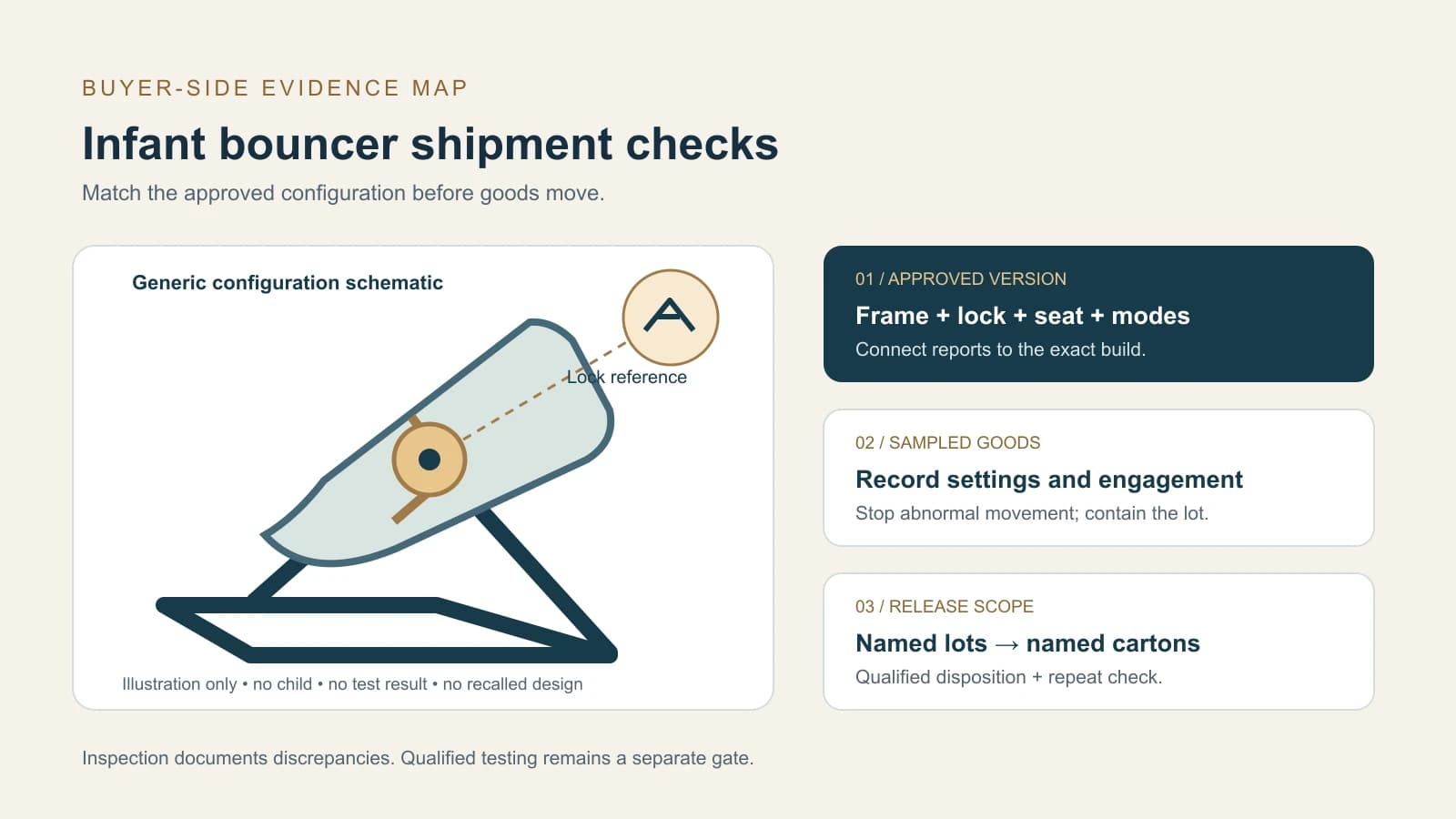
Use three release gates: confirm each intended mode and the applicable evidence with the importer and qualified laboratory; compare sampled finished units with the approved frame, latch, seat, restraints, and instructions; then tie findings and corrective actions to specific lots and cartons. A brief factory demonstration is not a durability test, and a passing sampled inspection is not a safety certification.
CPSC’s bouncer guidance identifies 16 CFR part 1229 and includes locking mechanisms, stability, structural integrity, collapse, and restraint requirements. Ask the importer and qualified lab to establish the exact scope for every intended mode. A “3-in-1” sales description does not establish test coverage. Keep product classification and qualified testing separate from a buyer-side shipment comparison.
Buyer-side release module
Four checks before balance payment or pickup
Agree the sample plan and stop rules while the goods remain accessible. Keep qualified testing and certification separate from a shipment inspection.
- 1
Freeze every configuration
List model, intended modes, height settings, frame and lock revision, seat and restraint version, factory, lot, quantity, and carton range. Keep a controlled reference sample.
- 2
Connect qualified evidence
Ask the importer and qualified lab to reconcile report photos, model scope, tested configuration, applicable requirements, changes, and the CPC. A similar-looking model is not a matching record.
- 3
Observe sampled assembly and locks
Against the approved instructions and safe agreed inspection plan, record setup, lock engagement at every claimed setting, seat attachment, restraints, accessible gaps, loose hardware, markings, and pack contents. Stop on abnormal behavior.
- 4
Contain and repeat-check
Segregate affected lots and mixed cartons. Obtain documented qualified disposition, any necessary retesting, controlled corrections, and repeat inspection before releasing identified stock.
At the factory
Make the lock and configuration visible.
Build the inspection plan around the actual assembly sequence. For sampled units from named lots, record each claimed height or use setting, how the lock engages, and whether the seat attachment and restraint routing match the approved reference. Photograph the relevant mechanism and unit identifier together. A click, a product video, or a supplier’s “same design” statement does not resolve a different latch revision.
Use only the importer-approved, safe check plan and written instructions. Never put a child in an inspection unit, bypass a lock, improvise loading, or treat a factory function check as the prescribed strength, collapse, drop, or durability test. Stop on unintended movement, incomplete engagement, damaged hardware, or unexpected deformation. Escalate the evidence to qualified specialists.
Keep the containment boundary practical: model, hardware revision, production dates, line or lot identifiers where available, and carton range. If the factory cannot separate changed units from the approved build, hold the mixed scope. After correction, retain the old and new part references and re-inspect identified stock; do not accept a replacement photograph as proof that all cartons were corrected.
Request one release pack
- Destination, responsible importer, exact models, intended modes, factory, lots, quantities and carton map.
- Approved sample, frame and latch drawings, bill of materials, seat/restraint version, settings and controlled change log.
- Complete test reports, tested-sample photos, lab scope, relevant configuration coverage and CPC.
- Product labels, warnings, assembly instructions, registration materials, retail pack and listing claims.
- Failed-unit IDs, lot containment, qualified disposition, any required retest, corrective action and repeat inspection.
Check CPSC’s CPC guidance when reconciling the certifier, product and test basis. A certificate is not a substitute for the underlying evidence.
Evidence to decision matrix
Turn a mismatch into a named lot decision.
A successful setup demonstration does not clear a changed lock, untested configuration, mixed batch, or unresolved failure.
Public case example
Flyboss: collapse warning, not a disclosed root cause
What happened: On September 10, 2026, CPSC warned consumers about China-made Flyboss 3-in-1 infant bouncers that can collapse during use. It reported 191 collapses, including 115 infant head impacts; at least 20 consumers sought medical attention. The notice covers about 14,200 units.
What evidence was public: The warning identifies three height settings, product images, sales period, importer Dougllass LLC, and stop-use/disposal advice. CPSC says the importer was unresponsive to recall or information requests. This is a warning, not an announced cooperative recall. The public notice does not identify a particular latch defect or publish a complete test file.
Buyer lesson: Check configuration control and documented lock behavior before payment, then contain mismatched units by lot and carton. The choice to inspect locks is buyer-side analysis; it is not a finding about the cause of the Flyboss collapses.
Limits of comparison: This case does not establish that other bouncers or suppliers share the hazard. Huang Sourcing did not inspect or participate in this case. Qualified testing and importer decisions remain necessary.
Evidence basis for this advice.
This guide uses current public CPSC records and guidance, independent reporting, and buyer-side sourcing analysis. Official records control case facts; the proposed release workflow is our analysis.
- The September 2026 Flyboss warning is current evidence of a documented collapse risk. It does not disclose a latch-specific root cause.
- The bouncer guidance supplies the regulatory scope; exact configurations and production changes require qualified review.
- An inspection records sampled goods and discrepancies. It does not certify every unit or replace the importer’s evidence obligations.
Scope limits and stop rules
Review intended modes and sales claims before approving artwork. CPSC’s infant-sleep FAQ says supervised-sleep claims can bring products into the sleep-product rules; marketing does not become acceptable simply by adding “supervised.” Separately, bouncer guidance addresses product identification, registration and certification. Have qualified parties confirm the requirements for the exact product and manufacture date.
Hold stock when locks behave abnormally, the production build differs from the approved version, reports cannot be matched, required materials are missing, or cartons mix untraceable revisions. Removing an unverified sleep claim does not prove the underlying design is safe. Obtain documented specialist disposition, any required new testing, controlled correction and a repeat shipment check before limited release.
Make the hold or release scope explicit.
Share exact models and modes, frame and lock revision, approved sample, full reports, CPC, labels, lots, carton map, and pickup date. Huang Sourcing can scope a China-side comparison and document gaps for qualified review.
Sources
Public sources checked October 1, 2026 Beijing time. CPSC controls case and regulatory facts. News 12’s September 10 coverage is an independent attention signal, not proof of search volume or a separate incident set. None implies Huang Sourcing involvement.