
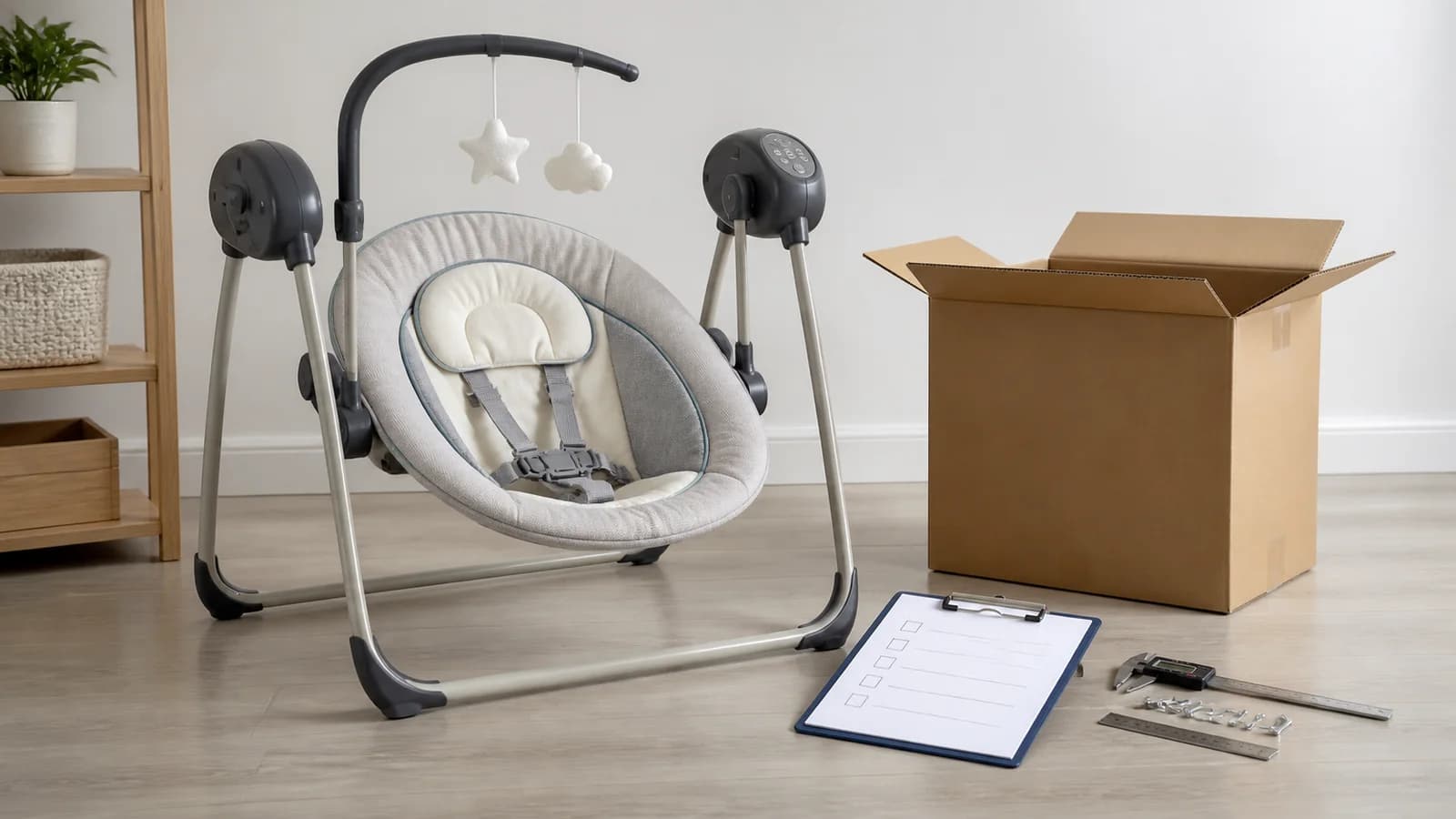
Quick answer
What should buyers check before baby swings leave China?
Match the exact finished swing to qualified performance evidence and a controlled production file. Inspect the sampled lot for frame, feet, seat, restraints, strap routing, locks, drive components, identity, tracking, instructions, registration materials, packaging, quantities, and workmanship. Hold any mismatch; do not treat a supplier video, certificate image, or improvised load as proof of required stability, structural, folding, restraint, or strap-accessibility performance.
- 1Freeze the destination, importer, intended age and use, product class, model, factory, frame, feet, seat, restraints, hanging straps, openings, folding and locking design, drive components, production date, batch, retail pack, and carton version
- 2Have the importer and qualified advisers map infant-swing, combination-product, toy-accessory, chemical, electrical, labeling, certification, registration, and import-filing requirements
- 3Map complete qualified reports to the exact manufacturer, factory, model, configuration, materials, test sample photos, dates, methods, results, limitations, and current production revision
- 4Confirm qualified evidence addresses the applicable stability, structural integrity, dynamic and static loading, unintentional folding, restraint, seat-angle, opening, pinch, and strap-accessibility topics
- 5Compare sampled production with approved drawings and references for identity, dimensions, frame, feet, seat, restraint routing, locks, fasteners, drive parts, accessories, edges, workmanship, and visible condition
- 6Check permanent product and tracking identity, warnings, instructions, registration form or method, retail-pack identity, barcode, carton marks, quantities, destination segregation, and packing list
- 7Hold mixed models, unexplained substitutions, unsupported combination products, missing or mismatched reports, incomplete certificate data, failed samples, unapproved rework, or cartons without batch traceability
- 8Release only named models, production dates, batches, quantities, and cartons after documented correction, qualified disposition, and repeat inspection or testing where required
China-side evidence module
Baby swing release checklist
Connect qualified product evidence to sampled mass production and pack-out. This checklist does not turn an onsite comparison into prescribed performance testing, certification, legal advice, or a safety guarantee.
Identity and product scope
- Destination, importer, product class, intended age and use, exact model, manufacturer, factory, construction, production date, batch, sales channel, and approved changes are controlled
- PO, approved sample, drawings, bill of materials, reports, certificate data, labels, registration materials, package, listing, and cartons describe one production version
Qualified performance evidence
- Complete reports identify the tested sample and address the applicable stability, load, structural, folding, restraint, seat-angle, opening, pinch, strap, electrical, and accessory requirements selected by qualified parties
- Laboratory identity and scope where relevant, dates, methods, results, sample photos, model or family coverage, deviations, limitations, and relationship to current production are reviewable
Finished goods and pack-out
- Sampled units match approved frame geometry, feet, joints, seat, restraints, strap routing, locks, fasteners, drive or power parts, accessories, markings, instructions, and workmanship limits
- Tracking identity, warnings, registration materials, barcode, protective retail pack, carton quantity, carton marks, destination, and packing list are consistent and readable
Hold, correction, and release
- Affected quantity, hold tags, carton map, supplier change, controlled rework, qualified retest decision, revised documents, and repeat inspection remain traceable
- Cleared and unresolved models, dates, batches, and cartons stay separated; final release names the exact scope and every open condition
Why baby swing release evidence matters now
On August 13, 2026, the U.S. Consumer Product Safety Commission recalled a Taleco Gear group covering baby jumpers, a baby swing, and two 2-in-1 jumper-and-swing configurations. CPSC said the products could become unstable and that hanging restraint straps and seat openings could create strangulation hazards. The notice reports about 41,100 units sold in the United States across the recalled group, at least 52 hazard reports, and at least 32 reported injuries including head bumps and a bloody nose.
Health Canada published a coordinated notice for the black 2-in-1 Jumper & Swing-A, model Jumper-01. It identifies Shanxi Yida Technology Co., Ltd. in China as manufacturer and records 150 Canadian sales; the Canadian notice also preserves the U.S. incident and injury scope. These are public recall records, not a finding about every baby swing or China factory.
Current search results combine official swing rules with broad supplier checklists, but they rarely connect product classification, exact-model laboratory evidence, production revisions, inspected cartons, and the buyer’s payment or pickup decision. That handoff is where a China-side evidence check is most useful.
- A supplier statement that a swing is “CPSC,” “ASTM,” or “CPSIA” compliant needs complete source evidence and exact model scope
- A jumper, swing, cradle swing, travel swing, or combination product may follow a different requirement map; the commercial name alone does not settle classification
- Changes to frame geometry, feet, joints, folding locks, seat angle, restraints, straps, openings, motor, controller, adapter, toys, fasteners, factory, or materials can change the evidence question
- Correction leverage is strongest before final payment and pickup, while affected batches and cartons can still be held, tested, reworked, relabeled, repacked, or rejected
Evidence checked: CPSC Taleco Gear recall, Health Canada coordinated recall, CBME China buyer compliance overview.
Freeze the exact swing, product class, factory, and batch
Build one controlled model record connecting the marketplace SKU to the product class, manufacturer, factory, drawings, bill of materials, frame and foot geometry, seat, restraints, hanging straps, openings, joints, locks, drive or power system, accessories, warnings, packaging, production date, and batch. A shared shell, seller listing, or model-family name does not prove that two swings use the same safety-critical construction.
Keep every change visible. If the factory substitutes tubing, feet, joints, pivots, locks, seat fabric, restraint webbing, buckles, fasteners, plastics, motor, controller, adapter, toys, labels, packaging, tooling, subcontractor, or production site after testing, hold the affected lot until qualified parties decide whether review, new samples, retesting, or certificate changes are required.
Classify combination products before relying on a report. A 2-in-1 product may present swing, jumper, activity, toy, electrical, or other questions that are not answered merely because one mode has a report.
- Control approved drawings, specifications, tolerances, bill of materials, sample photos, packaging artwork, test-sample identity, and change log
- Identify the first affected date, batch, quantity, and carton range for every approved change
- Photograph repeatable identity points on the frame, seat label, drive housing, power supply, retail pack, and cartons
- Reject unexplained model aliases, unsupported family coverage, or report photos that do not match production
What should qualified infant-swing evidence connect?
CPSC business guidance says the U.S. infant-and-cradle-swing rule is codified at 16 CFR part 1223 and incorporates the Commission-accepted ASTM F2088 version. For products manufactured after September 14, 2024, the guidance identifies ASTM F2088-24. Listed requirement areas include structural integrity, stability, unintentional folding, restraint systems, seat angles, openings, scissoring, shearing and pinching, tethered strap accessibility, powered-swing provisions, labeling, and toy accessories.
The importer and qualified product-safety specialists should select the controlling destination rules, standards, methods, laboratory, sample plan, and acceptance criteria. Review the full report rather than a cover page: record the laboratory and relevant scope, client, manufacturer, factory, exact model and configuration, sample photos, receipt and test dates, methods, results, deviations, and limitations.
For U.S. children’s products, CPSC guidance says manufacturers and importers must issue a Children’s Product Certificate based on appropriate testing and identifies 16 CFR part 1223 as the infant-and-cradle-swing citation. Certificate data and underlying reports should describe current production; neither a logo nor a generic certificate image proves coverage.
- Confirm reports with the claimed laboratory or official database where a source-verification route exists
- Match sample photos, frame, feet, joints, locks, seat, restraint routing, openings, drive parts, accessories, materials, labels, and identifiers to the approved reference and current lot
- Escalate cropped files, edited results, inconsistent dates, missing photos, unclear methods, unsupported combination-product coverage, or reports issued to another product
- Keep qualified prescribed testing separate from routine buyer-side inspection and supplier demonstrations
Evidence checked: CPSC Infant & Cradle Swings Business Guidance, Huang Sourcing laboratory report verification guide.
What can a China-side finished-goods inspection check?
A buyer-side inspection can compare sampled production with approved references while the goods remain accessible. The useful output is a traceable record of model and batch identity, visible construction, dimensions, assembly, locks, restraint routing, components, workmanship, labels, packaging, quantities, defects, mismatches, and affected carton scope.
Inspect the frame, feet, joints, seat attachment, restraint webbing and buckles, strap routing, folding or latching points, fasteners, protective parts, exposed edges, drive housing, buyer-approved accessories, visible wiring, adapter identity, surface condition, markings, instructions, and retail-pack protection against approved criteria. Record the sampled unit, observation or buyer-approved measurement, result, photo, batch, and carton.
Stop and isolate a unit that tips during ordinary approved handling, collapses, unlocks, sheds a component, exposes a sharp edge, has damaged structure, has misrouted or missing restraint parts, or differs materially from the approved build. Preserve the evidence and affected quantity for qualified investigation instead of improvising a destructive or safety-critical test on saleable stock.
- Use buyer-approved sampling, defect classes, dimensions, visual references, tools, handling limits, stop rules, and photo requirements
- Check identity before and after assembly, folding, or adjustment so every finding remains tied to a model and batch
- Quantify mixed, incomplete, damaged, unstable, unlocked, misassembled, sharp, cracked, mislabeled, unreadable, or poorly packed units
- Keep prescribed stability, structural, impact, cyclic, load, folding, restraint, opening, strap, chemical, electrical, and toy-accessory testing outside ordinary inspection
Connect tracking, registration, instructions, and cartons
CPSC guidance says durable infant or toddler products must carry permanent English identification including the domestic manufacturer or importer, contact information, model name or number, and manufacture date, in addition to children’s-product tracking-label requirements. It also says product registration forms are required so consumers can be contacted about recalls or other safety information.
Match the swing, instruction manual, registration method, retail pack, online listing, test report, certificate data, packing list, and cartons. Warnings and instructions cannot repair an unsafe design, failed performance, missing restraint part, unstable structure, or unsupported model scope.
CPSC’s current certificate guidance states that revised certificate content and electronic filing took effect July 8, 2026 for general imported consumer products subject to certification. The importer should own the filing decision and verify the exact current requirements; an inspection can compare supplied identifiers and document versions but cannot file or approve the entry.
- Keep product and package identifiers linked to manufacturer, factory, production date, batch, destination, and carton map
- Do not let the listing, swing, instructions, registration materials, report, certificate data, adapter, retail pack, and carton describe different models or parties
- Hold unreadable, removable, missing, mixed, or contradictory identity and tracking information until corrected and rechecked
- Photograph identity and traceability details in product, retail-pack, inner-pack, and carton context
Evidence checked: CPSC swing labeling and registration guidance, CPSC certificate and eFiling update.
Where does inspection stop and qualified testing begin?
Mandatory stability, structural, static and dynamic loading, folding, restraint, seat-angle, opening, pinch, strap-accessibility, electrical, chemical, and other safety assessments use defined fixtures, forces, conditioning, sample preparation, cycle counts, acceptance criteria, and competent interpretation. Those tasks belong with qualified laboratories and responsible compliance parties.
An inspector should not use an infant, place an improvised load in the seat, alter safety parts, create a strap-entanglement scenario, or invent stability, drop, impact, endurance, or electrical tests. Any special or destructive check needs an approved method, controlled setup, selected samples, responsible party, and documented disposition.
A passed sampled inspection supports a buyer decision only within its stated scope. It cannot cure missing evidence, validate unapproved design changes, prove every unsampled unit, certify compliance, or promise customs, marketplace, recall, or safe-use outcomes.