
Gate openings · current standard · lot release
Retractable Safety Gate Checks Before Shipping from China
Before paying the balance or authorizing pickup for retractable child safety gates made in China, identify the exact model, manufacturing date, installation hardware, intended opening range, test sample, production lot, labels, and cartons. Hold any scope whose finished construction or qualified evidence cannot be matched to the goods.
Written by Huang Sourcing Editorial TeamPublished on September 25, 2026
Based on cited public records and buyer-side sourcing analysis; limits and specialist responsibilities are stated below.
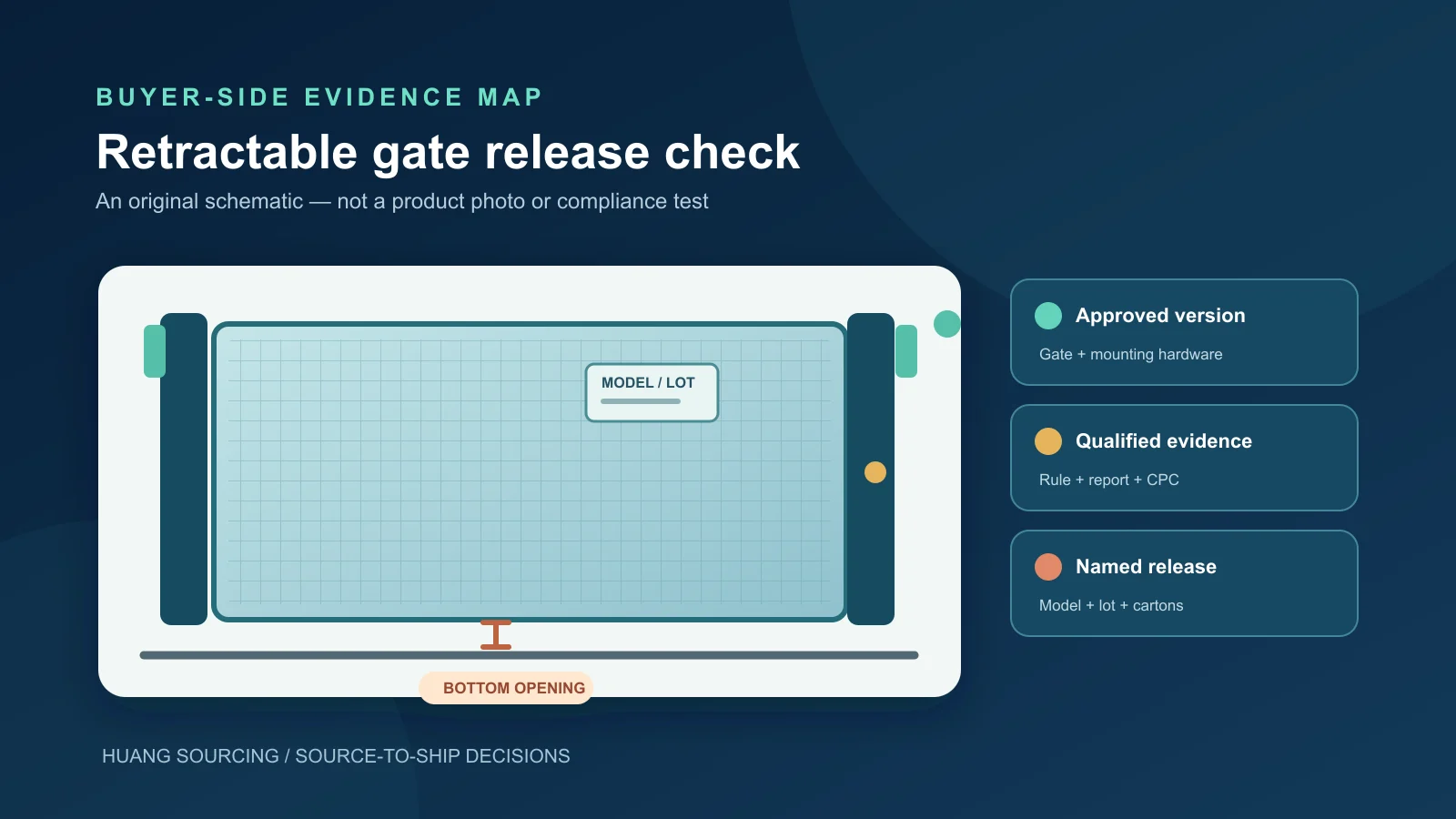
Quick answer
What must match before a retractable gate lot moves?
Ask the importer and a qualified test partner to determine the applicable U.S. rule and test the correct version. Then compare sampled finished gates, supplied hardware, instructions, and carton identity with that approved version. In an approved test fixture or realistic installation, document the gate-to-floor opening and locking behavior. Visual inspection cannot certify the required opening, strength, or durability tests.
Treat the report, the approved sample, the installation kit, and the goods as one version-controlled release pack. Photograph the sewn-in model and date labels, then reconcile frame, mesh, reel, latch, brackets, screws, opening range, warnings, instructions, registration card, retail pack, and master cartons. A changed bracket or mounting instruction can alter the installed opening even when the mesh looks unchanged.
Current public evidence
A 2026 rule update meets a documented opening hazard.
The current text of 16 CFR 1239.2 incorporates ASTM F1004-25 for gates and enclosures. The April 2026 Federal Register rule says the update took effect July 19, 2026 and applies to products manufactured after that date. Its substantive change prohibits features or openings within an in-scope gate or enclosure that allow unassisted pet entry or exit. A pet opening is a separate design question from the gate-to-floor gap seen in the recalls below.
On January 22, 2026, CPSC recalled about 4,520 Cumbor S5V2 retractable gates made in China. The agency said a child's torso could pass through the opening between gate and floor, creating entrapment risk. The notice identifies a sewn-in model and cohort label and reports no incidents or injuries. A separate January 8 BabyBond recall describes a similar bottom-opening hazard in another China-made model; it also reports no incidents or injuries.
Bureau Veritas independently covered the 2026 rule change. These records show a current buyer decision: verify the right standard version and exact production configuration, then examine the actual installation geometry. Neither recall establishes that a different gate, supplier, or lot is defective.
Buyer-side release module
Four gates before balance payment or pickup
Agree on the tested installation positions, sample plan, and stop rules before anyone evaluates a lot. Record configuration and visible deviations; leave mandatory performance tests to a qualified, accepted laboratory.
- 1
Freeze the exact gate
Map model, mesh, frame, reel, locking parts, brackets, screws, mounting surfaces, opening range, packaging, factory, manufacture date, and lots to approved files.
- 2
Confirm the applicable evidence
For U.S. scope, reconcile manufacture date, 16 CFR part 1239 version, complete accepted-lab report, CPC, tested configuration, instructions, and any design change.
- 3
Check installed openings
Using a buyer-approved setup, document gate-to-floor and side openings across stated installation positions, mounting hardware, tension, latch operation, and any pet passage feature.
- 4
Release named cartons only
Separate failed or untraceable models and lots; document qualified disposition, correction, repeat checks, quantities, and carton IDs before payment or pickup.
What an inspector can document
Compare the installed gate with the tested design.
Compare sampled units with the signed drawings and sample: mesh attachment, reel housing, frame, edges, stitching, latch engagement, supplied brackets, screws, anchors, mounting template, warnings, and instructions. Set up only the buyer-approved configurations and opening widths, on a suitable fixture or surface. Photograph the gate-to-floor and side openings with a scale and record the installation position, hardware, model, and lot for every observation.
The CPSC business guidance lists opening, bottom-spacing, strength, latch, label, registration, and CPC topics. Its on-page version table still lists an older revision, so use the current eCFR for the incorporated version. A factory visual check cannot replace the standard's small-torso-probe, strength, durability, or other prescribed tests. Do not infer a pass from an improvised gap measurement.
Request one controlled release pack
- Destination, responsible importer, purchase order, model and SKU list, manufacture dates, factory, lots, quantities, and cartons.
- Approved sample, drawings, bill of materials, mesh, reel, latch, mounting kit, intended wall or opening configurations, and change log.
- Full current-standard laboratory reports, tested sample and setup identity, CPSC-accepted laboratory scope, results, deviations, and CPC data.
- Permanent model and date marks, tracking information, warnings, instructions, registration form, retail packaging, and carton labels.
- Sampling plan, installation method, stop rules, failed-unit IDs, containment map, correction owner, and qualified re-test route.
Evidence to decision matrix
Turn each evidence gap into a named shipment decision.
A passing sample cannot clear an undocumented hardware change or a lot that cannot be traced to its test evidence.
Public case example
Cumbor S5V2: why installed openings and cohort identity matter
What happened: The January 22, 2026 CPSC recall says the recalled retractable gates could allow a child's torso through the space between gate and floor. The notice covers about 4,520 units, identifies model S5V2 and cohort A202504S5V2A001, and reports no incidents or injuries.
What evidence was public: CPSC published the product description, sewn-in label details, hazard, remedy, importer, manufacturing country, and affected scope. The separate BabyBond notice confirms a similar failure mode can appear in another model. Neither record provides a complete factory root-cause file or a test report for a buyer's proposed gate.
Buyer lesson: Require the approved installation kit and setup to match the tested sample; document the actual bottom and side openings and tie each observation to the exact model, manufacture date, lot, and carton. A new report for another bracket, width, or mesh construction does not clear this production scope.
Limits of comparison: These recalls predate the July 2026 ASTM F1004-25 effective date, and neither is presented as a pet-opening violation. They do not prove other retractable gates are unsafe. Huang Sourcing did not participate in either case, and buyer-side sampling cannot certify regulatory compliance.
Evidence basis for this advice.
This guide combines current U.S. rule text, two CPSC recall records, industry coverage, and buyer-side sourcing analysis. Product classification, test interpretation, certification, and legal release belong to the responsible importer and qualified specialists.
- The current eCFR text of 16 CFR 1239.2 and April 2026 Federal Register rule establish the U.S. standard version, effective date, and new pet-opening requirement.
- The January 2026 Cumbor and BabyBond CPSC notices independently document gate-to-floor entrapment concerns in particular China-made models; neither reports an injury.
- Bureau Veritas published independent industry coverage of the 2026 rule change. Buyer-side steps here are analysis of public records, not a claim that Huang Sourcing worked on either recall.
Scope limits and stop rules
For U.S. orders, the importer must identify the rule applicable to each manufacture date and exact product. The 2026 standard adds a pet-passage restriction to the existing gate requirements; it does not mean every older recall was caused by that new provision. Qualified testing, CPC issuance, labeling, registration materials, and destination-specific obligations remain separate tasks. A lab logo, supplier assertion, or visual sample check is not proof of compliance.
Hold affected stock for unexplained bottom or side openings, pet-passage features, changed brackets or latches, missing setup instructions, mismatched model and report identity, failed samples, missing date or lot traceability, or unresolved paperwork. Escalate to the importer and qualified technical party; record the correction and any required re-test before a controlled repeat inspection and limited release.
Make the hold or release scope explicit.
Share the gate model, installation kit, manufacture dates, approved sample, current reports, CPC data, labels, production lots, carton map, and pickup deadline. Huang Sourcing can scope a China-side comparison and document what still needs specialist review.
Sources
Public records checked September 25, 2026 Beijing time. The current eCFR and Federal Register control the cited rule facts; CPSC notices control case facts. Links do not imply Huang Sourcing involvement.