
Quick answer
What should buyers check before immersion heaters leave China?
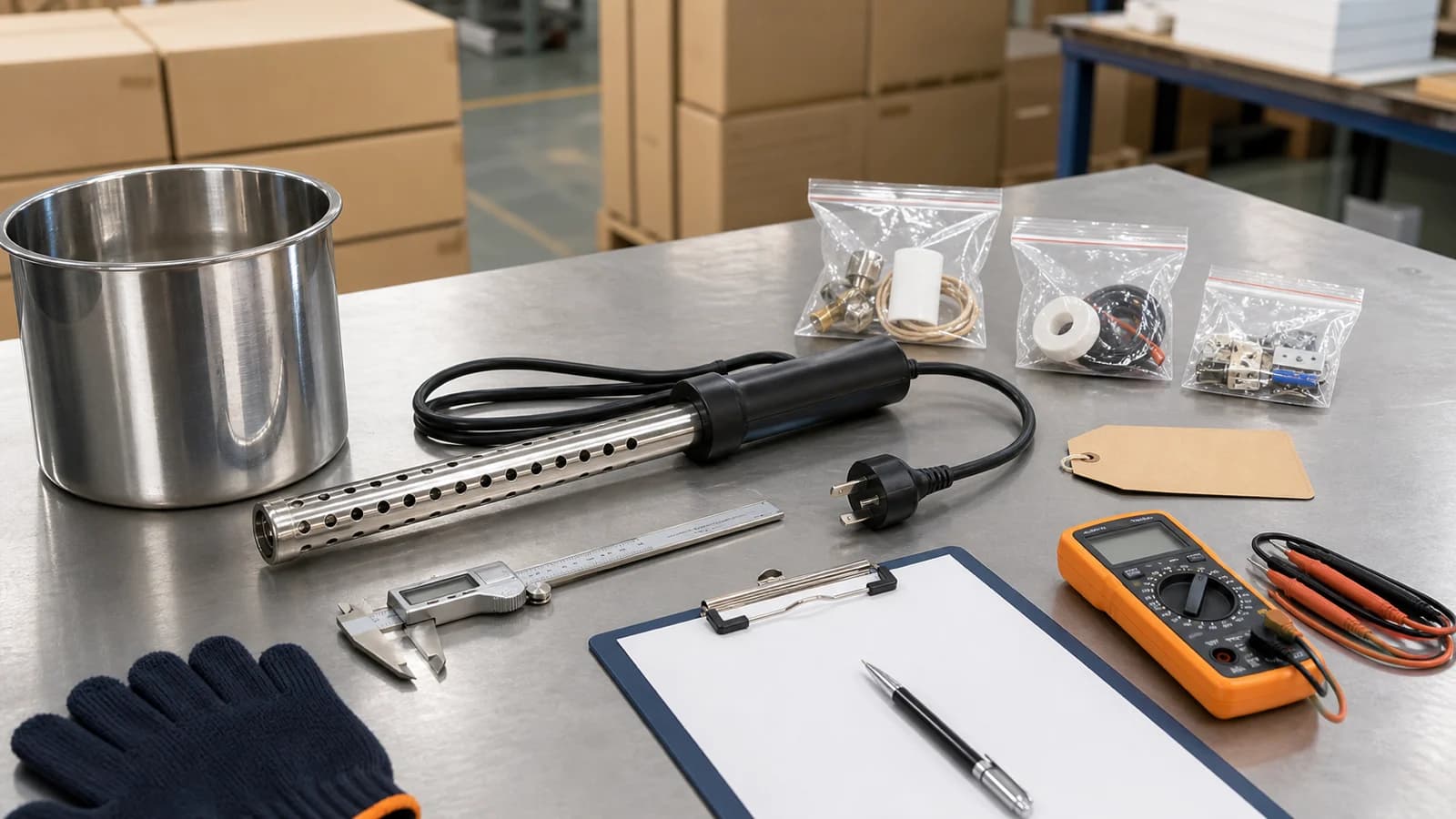
Match the exact production model, ratings, protection design, cord, plug, labels, instructions, and claims to qualified evidence and an approved reference. Inspect sampled goods and cartons for identity and visible conformity. Hold every unresolved model or lot instead of using a visual pass or brief heating demonstration as a fire-safety decision.
China-side evidence module
Immersion water heater release checklist
This checklist connects the physical shipment with buyer-approved and qualified references. It does not turn an ordinary sampled inspection into an electrical laboratory test, certification, importer filing, or fire-safety guarantee.
Model, ratings, and intended use
- Exact model and SKU, rated voltage, frequency, input power, plug type, cord specification, dimensions, heating-element and guard construction, intended container, water-level range, duty cycle, supervision conditions, factory, date, lot, and approved changes
- Purchase order, approved sample, drawing, bill of materials, test file, certification record, product label, manual, package, master carton, and packing list all identify the same production version
Protection and qualified evidence
- Dry-burn or over-temperature protection architecture, sensors, thermal limiting devices, control circuitry, safety-critical components, trip and reset behavior, abnormal-operation test plan, report sample photos, results, and limitations
- Certification body, file or control number, manufacturer, factory, product category, standard and edition, exact covered model, ratings, conditions of acceptability, current status, and authorization to use the displayed mark
Physical product and pack-out
- Sheath, guard holes, end caps, joints, seals, insulation, cord entry, strain relief, cord, plug, pins, grounding path where designed, controls, fasteners, markings, finish, assembly, and visible condition match approved references
- Model and lot marks, ratings, immersion range, warnings, instructions, retail package, barcode, accessories, carton quantity, carton marks, packing list, and destination file are consistent and readable
Correction and release control
- Affected quantity, hold tags, carton map, supplier-change record, approved work instruction, replacement components, qualified retest decision, revised labels and instructions, and repeat inspection remain traceable
- Cleared and unresolved models and lots are separated; balance-payment and pickup authorization names the exact scope rather than giving a blanket pass to the whole order
Why immersion water heater release evidence matters now
On July 22, 2026, the U.S. Consumer Product Safety Commission announced its first use of Consumer Product Safety Act Section 12 imminent-hazard authority in nearly four decades. Through the Department of Justice, the United States filed a complaint concerning certain China-made Lakkzoom portable immersion water heaters and sought court-ordered relief.
CPSC separately warned consumers to stop using the products. Its public warning identifies about 98,000 units, models including 1500W, 2000W, HT1500W or MJ-R13, and HT2000W, and 235 reports of fires. CBS News independently reported on the filing, the alleged absence of adequate overheating protection, and the federal testing described in the court record.
The complaint contains allegations that would need to be proved if the case proceeds. It does not establish that every China-made immersion heater, supplier, or order has the same design or risk. It does show why a buyer should not infer protection from a listing image, a warning label, a low price, or a certification logo without matching the exact production model to qualified evidence.
- A generic “dry-burn protection” claim is incomplete without the actual control architecture, safety-critical component identity, qualified test scope, production configuration, and change record
- A mark or “listed” claim should resolve to the exact manufacturer, factory, model, ratings, product category, file number, and current certification status
- Warnings and instructions do not repair a protection design that fails the qualified abnormal-operation or fire-risk evaluation selected by the responsible parties
- Correction leverage is strongest before balance payment and pickup, while segregation, redesign, retesting, re-inspection, replacement, or cancellation remains practical
Current records: CPSC Section 12 announcement, CPSC product warning, and CBS News coverage.
Freeze the exact model before relying on any evidence
Start with one controlled model record. It should connect the product name and SKU to ratings, heating-element construction, perforated guard, end caps, seals, insulation, cord entry, strain relief, cord, plug, controls, thermal devices, intended water container, immersion range, duty cycle, warnings, instructions, factory, date, and lot.
Do not treat wattage as a unique model identifier. Two heaters can share a 1500 W marketing name while using different cords, plugs, control boards, thermal cutoffs, guards, end caps, or factories. Those differences can change report and certification coverage and require a qualified review.
Create an approved change log for every safety-relevant revision. If the supplier changes a thermal limiter, sensor, polymer, seal, cord, plug, control board, element, enclosure, factory, or rating after the tested sample, hold the affected scope until the responsible laboratory, certification body, engineer, and importer decide what verification is required.
- Use a controlled specification, bill of materials, exploded drawing, wiring diagram, approved sample, model-label artwork, manual, packaging file, and carton map
- Photograph safety-critical construction and markings on the approved reference before mass production
- Require supplier changes to name the first affected lot and cartons, not just the change date
- Reject evidence that shows another manufacturer, factory, model alias, voltage, wattage, plug, cord, protection design, or product photo without a documented relationship
What should dry-burn and fire-risk evidence establish?
The federal complaint says CPSC tested 1500W and 2000W samples using a protocol modeled on UL 499, a voluntary standard for electric heating appliances, and observed flames and ignition of nearby combustible material. It also describes additional dry and partial-immersion testing and alternative heaters that used water-detection circuitry or thermal limiting devices to de-energize the element.
Use that record as a risk lesson, not a do-it-yourself test script. The importer and qualified technical parties should define the applicable standard, test edition, abnormal conditions, sample plan, instrumentation, acceptance criteria, certification route, and destination-market obligations. The evidence file should identify the tested sample and show whether the exact production protection system was evaluated.
A component datasheet alone does not prove the finished heater behaves as intended. Review the complete control path, component ratings and placement, tolerance stack, failure modes, reset behavior, wiring, enclosure, moisture exposure, production controls, and the relationship between the certified or tested configuration and mass production.
- Record the laboratory, accreditation or certification role, report number, issue date, standard and edition, clauses, sample photos, model, ratings, construction, test results, deviations, and limitations
- Confirm whether the protection is automatic, independent, self-resetting, manually reset, single-use, software-controlled, or dependent on a sensor position or water level
- Map every safety-critical component to approved manufacturer, part number, rating, certification status where relevant, incoming check, and substitution rule
- Escalate partial reports, edited screenshots, supplier-written summaries, unexplained model families, missing abnormal-operation results, or evidence that cannot be verified at its claimed source
Review the filed U.S. District Court complaint for the complete procedural context, allegations, test descriptions, and stated limits.
What can a China-side inspection check safely?
A buyer-side inspection can compare sampled production with approved references while the goods are still accessible. The useful output is a traceable record of exact models and lots, visible construction, ratings, plug and cord details, labels, instructions, packages, cartons, quantities, defects, mismatches, and affected scope.
Inspect the metal sheath and guard for dimensions, hole pattern, burrs, deformation, corrosion, loose parts, and finish. Compare end caps, joints, seals, cord entry, strain relief, cord print, plug construction, pins, grounding path where designed, control housing, fasteners, switches, displays, markings, and assembly with the approved sample and drawings.
Use only buyer-approved, low-risk observations and measuring methods. Do not energize a heater outside water, deliberately lower the water level, defeat a safety control, open live equipment, touch the water during operation, or stage a fire-risk condition in an ordinary factory inspection.
- Photograph model, lot, rating label, plug face, cord print, strain relief, protection markings, warning label, instruction pages, retail package, barcode, carton marks, and packing-list identity
- Record the sampled quantity and carton locations so mixed or changed lots are visible
- Compare critical dimensions and visible components only against buyer-approved methods and tolerances
- If any functional check is authorized, require a written safe method, suitable equipment, qualified personnel, defined stop conditions, and clear separation from laboratory compliance claims
Verify certification claims, ratings, warnings, and instructions
The complaint alleges that the subject products were advertised as UL listed or certified even though CPSC testing described in the filing found they did not meet the relevant UL 499 fire-risk requirements. Because that statement is an allegation in pending litigation, buyers should verify rather than assume.
For a UL claim, search UL Solutions Product iQ using the file number, manufacturer, model, category, and ratings, then confirm that the production nameplate and construction fall within the current record. For another certification body, use its official directory and confirm the body is recognized for the claimed standard and product category. A logo, supplier certificate PDF, or component mark is not automatically an end-product certification.
Make warnings and instructions product-specific and clear in the destination language. They should identify the intended use, ratings, immersion conditions, supervision, safe connection and disconnection sequence, prohibited uses, cleaning, storage, damaged-product action, and responsible contact without contradicting the design or marketing claims.
- Do not translate “UL Recognized component” into “UL Listed finished product”
- Do not use a certificate covering another voltage, wattage, plug, control system, factory, or model family without documented scope
- Do not present a voluntary-standard claim as a government approval or a guarantee of safe performance
- Do not let retail packaging promise “safe,” “anti-scalding,” automatic shutoff, continuous unattended use, or other behavior that the approved evidence does not support
Check claimed UL records through the official UL Solutions Product iQ guidance, then map the result to the exact production model and construction.
Where does inspection stop and qualified testing begin?
Fire-risk and abnormal-operation evaluations can involve energized equipment, high temperatures, water, moisture, electrical shock risk, ignition indicators, combustible materials, defined test setups, and emergency controls. They belong with the qualified laboratory or engineering team selected by the responsible parties.
The importer should also decide whether the exact product is subject to any CPSC rule, ban, or standard that requires a certificate and eFiling. CPSC explains that eFiling applies to imported regulated consumer products that already require certification; a voluntary UL claim by itself does not create a CPSC certificate.
Huang Sourcing can organize buyer-approved files and compare visible goods with controlled references. It does not design the protection system, select legal requirements, certify a product, issue a laboratory report, authorize a certification mark, submit importer filings, or make a fire-safety guarantee.
- Do not improvise dry-operation, partial-immersion, fault, leakage-current, dielectric, grounding, temperature, endurance, moisture, or fire tests during an ordinary inspection
- Do not infer finished-product protection from one thermal fuse, one sensor, one label, a supplier video, or a brief heating demonstration
- Do not use a passed visual inspection as a substitute for the complete qualified evidence and responsible-party release decision
- Record unresolved technical, certification, regulatory, or importer decisions as open conditions and hold the affected scope until they are closed
CPSC's current eFiling FAQ explains which regulated consumer products require certificate data. Use the China laboratory report verification guide for report-source and exact-model checks.