
Electrical evidence · production identity · shipment release
Heated Blanket Checks Before Shipping from China
Before paying the balance or allowing pickup for heated blankets or heating pads made in China, identify the exact model and production lot, then match the finished goods to approved controller, cord, connector, heating-element, textile, label, and carton records. Hold the affected stock when a critical part or its evidence cannot be tied to the actual units.
Written by Huang Sourcing Editorial TeamPublished on September 24, 2026
Based on cited public records and buyer-side sourcing analysis; limits and specialist responsibilities are stated below.
Quick answer
What must match before a heated blanket lot moves?
Use three gates: the importer and qualified specialists define the market requirements and test evidence; the factory controls the approved construction and every change; buyer-side inspection compares accessible finished goods, labels, quantities, and cartons with those references. A visual or short powered check cannot establish electrical or thermal safety, long-term performance, or legal compliance.
Record the approved model, voltage, controller and timer version, power cord and plug, connector, heating-element layout, textile and size, manufacturing lot, label, instructions, retail package, barcode, packing list, and carton IDs. If one of these differs from the qualified evidence or approved sample, keep the affected goods on hold while the importer and qualified technical party assess the change.
Current public evidence
Two 2026 recalls point to different failure nodes.
On September 17, 2026, the U.S. Consumer Product Safety Commission announced a recall of about 195,000 JKMAX heated blankets and heating pads imported from China. Its notice says internal wire heating elements can overheat. JKMAX was aware of 577 reports of smoking, melting, or burning, including 53 burn injuries. Model identity appears on the remote and product packaging. These are reported case facts for the recalled models, not an estimate for the category. Read the CPSC JKMAX recall.
A separate July 30 CPSC recall covered about 178,000 OCTROT electric throws and blankets sold on Amazon. That notice identifies a detachable electrical cord that can ignite and reports 555 incidents of melting, sparking, or smoking, including 27 fires and 15 burn or electrical shock injuries. The two cases have different products and stated hazards; a buyer should therefore control both the internal heating assembly and the cord or connector configuration. Read the CPSC OCTROT recall.
CBS News covered the JKMAX recall on September 18. This independent coverage confirms current public attention; the CPSC notices supply the case facts used here. Neither recall proves that any other supplier or order has the same problem.
Buyer-side release module
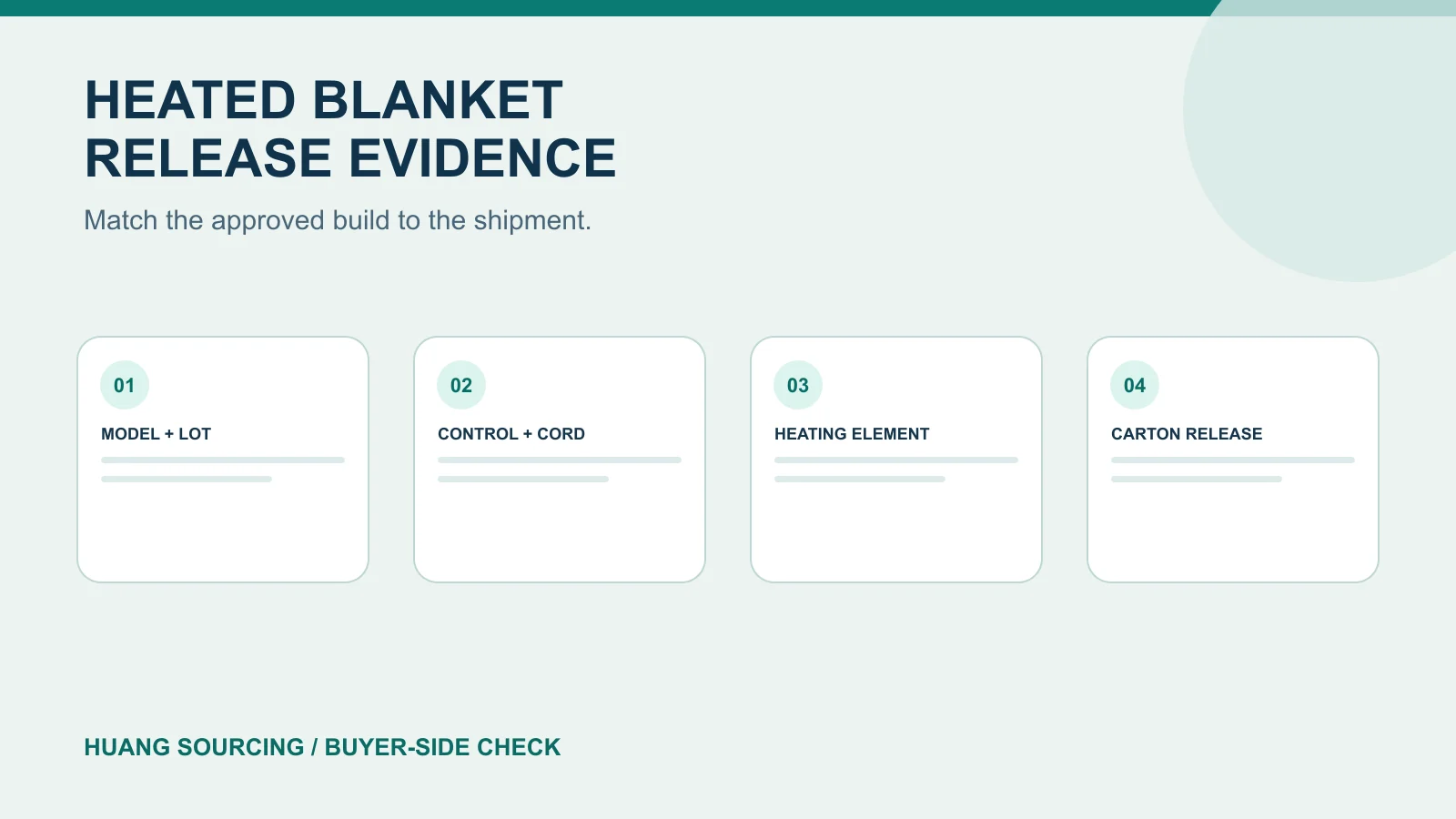
Four evidence gates before balance payment or pickup
Agree on the requirements, reference files, sampling plan, and stop rules before an inspector reaches the factory. A short function demonstration is one observation, not a substitute for qualified thermal and electrical assessment.
- 1
Freeze the saleable version
Map each retail SKU and exact model to factory, voltage, controller, cord, connector, element layout, textile, size, timer, labels, instructions, production lot, and cartons.
- 2
Verify qualified evidence
Ask the responsible party to map current destination requirements and complete test or certification records to the same construction, sample, factory, model, and limitations.
- 3
Compare production
Use an approved sampling plan to compare accessible parts, stitching, wire routing, connector fit, controls, markings, packaging, and specified functions with approved references.
- 4
Close the release scope
Record failures, substitutions, affected quantities, corrective action, qualified disposition, repeat checks, and the exact lots and cartons authorized to move.
What a buyer-side check can record
Compare the finished units with the approved build.
Photograph the model and lot labels on the blanket, detachable controller, retail pack, and master carton. Compare cord and plug specification, connector shape and retention, controller housing and controls, seams, accessible wiring, strain relief, fabric, dimensions, stitching, care labels, instructions, packaging, and accessories with the signed reference. Record what was inaccessible without disassembly.
A buyer-approved powered check may record basic control response, indicated settings, timer behavior, visible faults, odor, abnormal heat, and connector condition under a safe written method. Stop for smoke, sparking, excessive heat, damaged insulation, exposed wiring, loose connections, or inconsistent controls. Preserve the unit ID and lot evidence for qualified review; do not improvise endurance or fault testing on the factory floor.
Request one controlled release pack
- Purchase order, destination, responsible importer, exact models, voltage variants, sizes, quantities, factory and production dates.
- Approved sample photos, drawings, bill of materials, controller and timer revision, cord and connector details, element layout, textile specification, and change log.
- Complete qualified test and certification or listing evidence, including issuer, sample identity, model coverage, methods, results, dates, deviations, and limitations.
- Approved labels, warnings, instructions, retail package, barcodes, carton marks, packing list, lot map, and any complaint or rework record.
- Sampling plan, safe powered-check method, stop rules, hold authority, corrective action owner, and re-inspection or testing route.
Evidence to decision matrix
Turn evidence gaps into a named shipment decision.
Keep the disposition attached to exact versions, lots, quantities, and cartons. A passing sample cannot clear an unexplained part substitution or a lot with no traceable evidence.
Public case example
JKMAX: why the heating assembly and lot identity matter
What happened: The September 17, 2026 CPSC JKMAX recall notice says internal wire heating elements in the recalled heated blankets and pads can overheat, posing fire and burn hazards. It lists the affected models and the location of model labels on the remote and packaging. The notice reports incidents and injuries as described above; it does not present a factory root-cause investigation for every unit.
What evidence was public: The agency published the affected product description, model identifiers, hazard, importer, manufacturing country, unit estimate, incident reports, and consumer remedy. CBS reporting separately brought the recall to public attention. The public record does not reveal the complete technical file, production history, or batch-level findings.
Buyer lesson: For an order awaiting release, require a controlled link from approved element and controller versions through qualified evidence to the actual production lot and cartons. If a part changed, record which stock received it and obtain qualified disposition before release.
Limits of comparison: This recall does not establish that all heated blankets or Chinese factories share the hazard. Huang Sourcing did not participate in the case. Buyer-side sampling cannot certify electrical safety, prove thermal endurance, or determine whether a product meets every destination rule.
Evidence basis for this advice.
This guide uses the two cited CPSC primary records, independent news coverage, and buyer-side sourcing analysis. Product-specific compliance and engineering decisions belong to the responsible importer and qualified specialists.
- Two separate CPSC recalls published July 30 and September 17, 2026 were checked directly. They concern different products and mechanisms: OCTROT cord detachment and ignition; JKMAX internal heating-element overheating.
- CBS News coverage of the September JKMAX recall was checked as an independent current-attention signal; CPSC remains the primary record for case facts.
- The checklist is buyer-side process guidance derived from those records. The cited cases do not prove a particular proposed supplier, model, factory, or lot is defective.
Scope limits and stop rules
Visual sampling, record comparison, and limited functional observations do not prove every unit is safe. They cannot replace qualified electrical, temperature, abnormal-operation, durability, material, or certification work. The importer must determine the current requirements for the destination and exact product. A lab report cover, logo, marketplace listing, or supplier claim does not by itself prove that the shipped version was tested.
Hold and escalate when model or component identity is missing, reports do not cover the build, the factory changed the controller, cord, connector, element, textile or process without disposition, sampled units fail, or the carton map cannot separate cleared from unresolved lots. Release only after the responsible party has documented correction, any needed qualified retest, and the exact authorized quantity.
Make the hold or release scope explicit.
Share your models, approved construction, reports, production changes, lots, sample plan, cartons, and payment or pickup date. Huang Sourcing can scope a China-side comparison and document what still needs specialist review.
Sources
Public sources checked September 24, 2026 Beijing time. The CPSC records establish the case facts; the news report is an independent attention signal. Links do not imply Huang Sourcing involvement in either case.