
Quick answer
What must match before the handbags leave China?
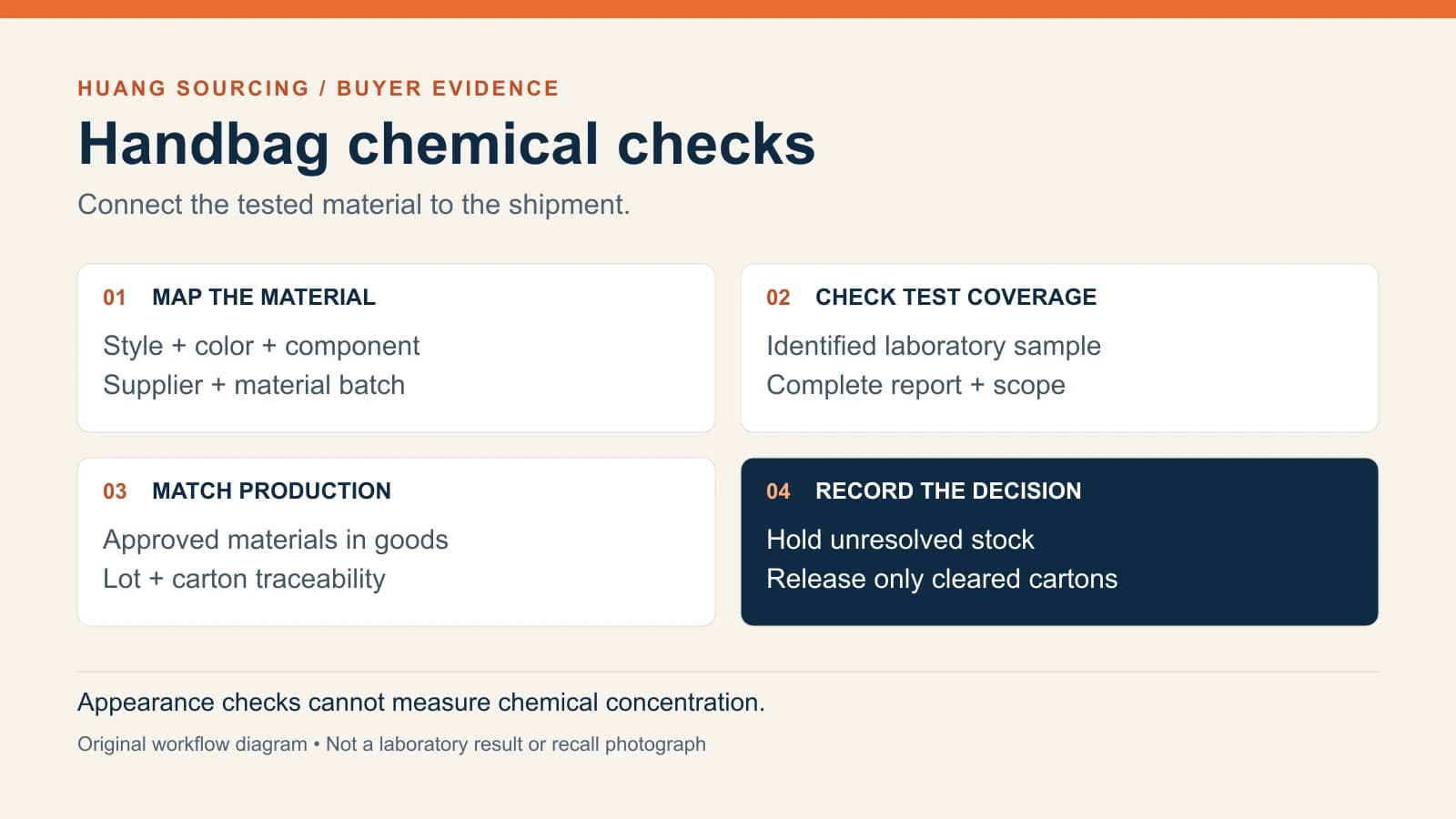
- 1List destination, intended users, handbag style, colorway, quantity, factory, production lot, and carton range.
- 2Map the outer material, coating, lining, handles, straps, trims, and other components to controlled material references.
- 3Connect complete chemical reports to identified samples and the importer-approved test scope for that destination.
- 4Record material suppliers, batch codes, substitutions, and which finished lots used each material batch.
- 5Compare sampled finished bags and pack-out with the approved references; keep untested laboratory samples traceable.
- 6Hold unresolved scope; authorize only named lots and cartons after technical questions and corrections close.
China-side evidence module
Handbag chemical evidence release checklist
Material-to-report map
- Use one row per style, colorway, and component. Record material code, supplier, sample photo, report number, and coverage decision.
- Do not assume a report for black outer material covers a camel version, a different coating, or the lining. Have the laboratory justify grouping.
Sample custody
- Agree who selects samples, which material batches they represent, and how they are sealed and identified.
- Keep selection photographs, sample IDs, dispatch records, laboratory receipt, and retained references together. A report alone does not prove where its sample came from.
Production identity
- Link incoming material batches and approved substitutions to finished lots and carton ranges.
- Where records cannot distinguish affected stock, keep the wider uncertain scope on hold until it can be separated or assessed.
Shipment disposition
- Record each open finding, responsible party, correction, required evidence, and decision deadline.
- Keep laboratory clearance and commercial release as separate signed decisions. Tell the forwarder exactly which cartons may move.
Why revisit handbag chemical evidence now?
The September 2, 2026 OPSS recall of ASDA ladies’ handbags identifies excessive DEHP and lists China as the country of origin. An earlier, separate French recall record identifies excessive phthalates in a Kiabi handbag. These records make material evidence a useful question before another order leaves the factory; they do not establish a failure rate for handbags or Chinese suppliers.
The buyer question is whether the tested material can be traced into the bags awaiting payment. This guide adds a component, colorway, and lot workflow to general laboratory-report verification. The recommendations below are Huang Sourcing’s buyer-side analysis, not findings about how either recalled product was manufactured.
Evidence checked: OPSS ASDA handbag recall; RappelConso Kiabi COH67 recall.
Set the destination and test brief before collecting reports
Name the market precisely. HSE explains that UK REACH applies in Great Britain, while EU REACH operates separately and continues to apply in Northern Ireland. A supplier’s undifferentiated “EU/UK compliant” statement is not a usable test brief.
Ask the importer and qualified laboratory to identify applicable restrictions, substances, methods, concentration basis, limits, and sample grouping for the actual materials and intended use. Record other applicable obligations separately. This is especially important if one purchase order serves multiple markets or includes products intended for children.
Evidence checked: HSE: UK REACH and EU REACH scope.
Does the report cover the component you are buying?
Read the complete report, including sample descriptions, photographs, test methods, results, units, reporting limits, and any exclusions. Match it to the order’s component map. A report naming only “bag material” leaves the buyer unable to tell whether it covers the body, coating, strap, lining, or another part.
Ask the laboratory whether the tested sample and any grouping can support the intended decision. Do not infer coverage across colors, formulations, suppliers, or production revisions. If several materials were combined for testing, obtain a written explanation of what the combined result can and cannot establish for the individual materials.
Have the issuer confirm a questionable report through its own contact channel. Preserve the original file and verification response. An authentic report can still be irrelevant to the material used in this order.
Why an SVHC declaration is not the whole answer
Restriction compliance and Candidate List communication are different questions. HSE describes restrictions as limits, bans, or conditions on substances, including substances in articles. Its SVHC guidance describes separate duties to communicate information about Candidate List substances in articles.
Request a destination-specific restriction assessment as well as any applicable SVHC information. Record the scope and date of each document. A one-page “REACH certificate,” an old Candidate List declaration, or a marketing statement such as “vegan” does not identify all applicable requirements or the tested production materials.
Evidence checked: HSE: restrictions under REACH; HSE: SVHC supplier responsibilities.
Which material changes should stop an automatic release?
Treat a new material supplier, coating formulation, adhesive, trim, recycled input, or color recipe as a review trigger. The trigger does not automatically mean the product is noncompliant; it means previous evidence needs a documented coverage decision.
Ask the factory to identify the first affected material batch and every finished lot using it. Preserve samples and records while the laboratory or responsible technical party decides whether existing evidence remains suitable or additional testing is needed. If old and changed stock are mixed, do not release the mixed cartons on the strength of the earlier report.
What can an inspector check at the factory?
Scope the visit around accessible evidence and goods. Compare the agreed sample set with approved material references, component descriptions, workmanship criteria, colorway identification, labels, packaging, quantities, and the carton map. Record discrepancies with sample and lot context.
Odor, texture, appearance, and a successful zipper or strap check cannot measure phthalate concentration. Likewise, repacking, airing, or relabeling is not evidence that a chemical finding has been resolved. Where chemistry is unresolved, hold the affected scope for qualified assessment.
If the buyer releases a cleared portion, document the exact order lines, quantities, lots, and cartons. Keep the held stock separately identified and obtain the forwarder’s collection instruction against that same list.