
Grounding assembly · configuration evidence · lot release
Electric Grill Checks Before Shipping from China
Before paying the balance or authorizing pickup for electric grills made in China, connect each model and production lot to its approved electrical configuration, grounding assembly, qualified evidence and retail pack. Hold stock when a safety-related connection has changed without assessment, a report describes a different build, or date codes cannot be reconciled to cartons.
Written by Huang Sourcing Editorial TeamPublished on October 6, 2026
Based on cited public records and buyer-side sourcing analysis; limits and specialist responsibilities are stated below.
Quick answer
What must match before an electric grill shipment moves?
Separate three questions: does the responsible specialist accept the exact design and evidence, does sampled production match that accepted configuration, and which lots are covered by the release? A grill heating up normally answers a function question. It does not establish grounding integrity, connection durability or the safety of every unit in the shipment.
The September 2026 CPSC Bistro Pro recall concerns a grounding connection that can disconnect. The sourcing implication is to connect the accepted assembly and its change history to actual production, rather than relying only on appearance or a power-on demonstration.
Buyer-side release module
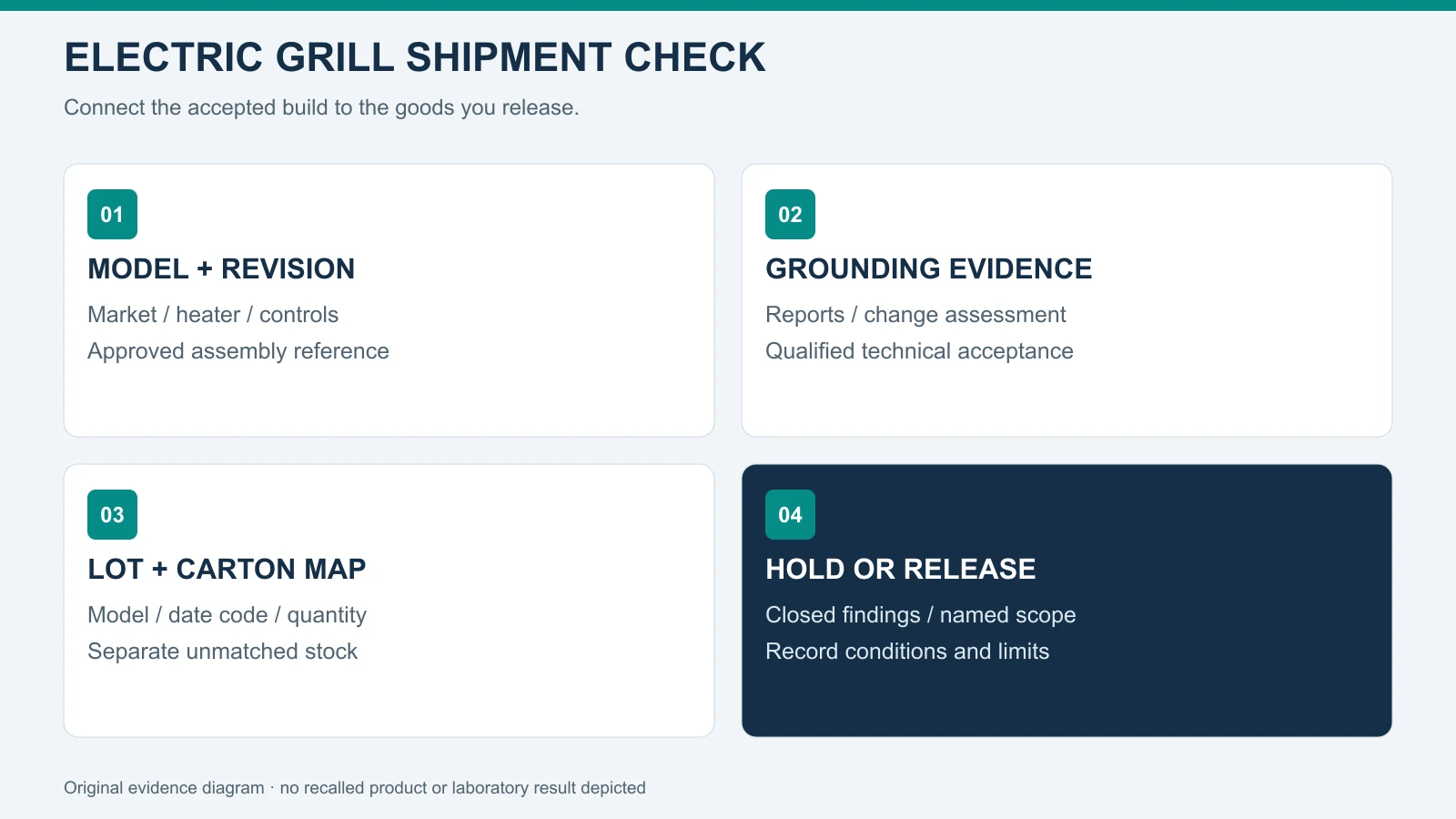
Four checks before balance payment or pickup
Agree what can be compared at the factory, what requires a qualified specialist and who can accept open issues. Keep the lot identity with every finding.
- 1
Freeze the model and assembly reference
Record market, model, full-size or tabletop version, voltage configuration, heater and control identities, grounding connection reference, bill of materials and revision. Identify who owns technical acceptance.
- 2
Reconcile evidence and changes
Match complete reports and sample photographs to the current build. Ask qualified parties to assess changes to the grounding connection, fasteners, routing, heater or enclosure. Keep the accepted assessment and any required retesting with the lot file.
- 3
Compare sampled production and packs
Use an agreed safe inspection scope to compare accessible construction, markings, approved assembly records and pack contents. Record deviations and unit/date-code identity. Restrict specialist electrical work to qualified personnel and approved procedures.
- 4
Release named lots after closure
Map models, revisions, date codes and quantities to cartons. Segregate changed or unmatched stock, close corrections, obtain responsible-party acceptance and repeat relevant checks before authorizing that exact scope.
At the factory
How do you check a connection that may be hidden?
Arrange evidence before the relevant assembly is closed. Ask for the approved drawing or connection reference, component and fastener identities, assembly-control records and documented changes. Production-stage observations may be more useful than attempting to infer internal construction from a sealed finished unit. A supplier photo should identify the model, revision and lot it describes.
Have qualified parties define the acceptance criteria and any required electrical or durability evaluation. Record which reports cover the current configuration and which features or variants require separate assessment. A screw substitution, routing change or different heater assembly should trigger a coverage question; do not assume every change demands the same test or invent a universal torque value.
For shipment inspection, compare only what the agreed scope can safely establish. If an internal connection cannot be observed without specialist access, report that limit and identify the supporting production evidence. Do not open energized equipment, defeat protection or improvise a live fault test. A production QC plan can schedule evidence collection while assembly remains accessible.
Send one configuration and lot file
- Destination, importer, model, voltage version, full-size/tabletop configuration and revision.
- Approved heater, control, power cord and grounding assembly references; current bill of materials.
- Complete reports, tested-sample photos, model coverage and qualified change assessments.
- Production dates, assembly records, findings, corrections and affected-lot boundaries.
- Approved markings, instructions, accessories, unit/date-code labels and carton map.
Use the laboratory-report verification guide to frame a coverage request. A report cover page, certification logo or supplier statement alone does not connect all current variants to accepted evidence.
Evidence to decision matrix
Turn a mismatch into a named lot decision.
Keep configuration acceptance, sampled observations and shipment authorization in separate records that can be reconciled.
Public case example
Char-Broil Bistro Pro: grounding connection and date-code scope
What happened: On September 17, 2026, CPSC recall 26-773 identified China-made Bistro Pro electric grills whose heating-element grounding wire can disconnect, removing fault protection and creating an electric shock hazard. The notice reports no incidents or injuries and specifies a repair remedy.
What evidence was public: CPSC lists affected models in full-size and tabletop configurations and limits its recall to date codes 2510, 2511 and 2512. The manufacturer’s recall notice supplies model and UPC identifiers, including a separately identified Canadian version, and directs affected consumers to stop use and request the authorized repair kit.
| Configuration | Model example | Affected date codes |
|---|---|---|
| Full-size grill and griddle, black | 25302145 | 2510 / 2511 / 2512 |
| Tabletop electric grill, black | 25302149 | 2510 / 2511 / 2512 |
Buyer lesson: Match model and manufacturing code together before making a stock decision. For new orders, connect the accepted grounding assembly to production records and identify exactly which revisions and cartons are covered. This evidence workflow is our sourcing analysis, not a regulator-prescribed inspection method.
Limits of comparison: The records do not establish the construction or safety of another supplier’s grill, reveal a complete root-cause investigation or provide a universal inspection procedure. A code outside the published recall scope does not prove general safety. Huang Sourcing did not inspect, supply or participate in this case.
What should you reconcile on the packed shipment?
Compare sampled unit markings with the retail box, instruction revision and packing list. Keep the market and electrical version visible in the reconciliation. Check that the approved accessory set belongs to that model and that assembly instructions describe the supplied configuration. Mixed tabletop, full-size or accessory versions need explicit mapping rather than a single generic carton description.
Record model, date code, production lot, quantity and carton range in one release file. Where a code cannot be read or its meaning is unclear, obtain supplier records and a responsible-party explanation. Do not reconstruct manufacturing dates from an assumed format. If affected or unknown inventory is mixed with accepted goods, segregate it and document the boundary before pickup.
After authorized correction, keep the correction record with the original finding and the verification result. A replacement label, an unrelated test report or a photograph of one repaired sample does not establish the status of every carton. Confirm the responsible party has accepted the correction and identify the re-inspected scope before using the release record for balance payment.
Evidence basis for this advice.
This guide uses cited regulator and manufacturer records for the case. Configuration, inspection and release recommendations are buyer-side sourcing analysis.
- The official records establish their own recall scope and remedy. They do not establish safety for other models or suppliers.
- Qualified design and laboratory assessment must resolve technical acceptance. A routine shipment comparison cannot replace that work.
- Sampling findings apply to the agreed scope. The release file should state who accepted evidence, which lots are covered and which stock remains held.
What can a shipment check establish?
It can record sampled identity, visible condition, pack contents and alignment with approved references, and expose evidence gaps while goods remain accessible. It cannot certify electrical safety, connection durability, every unit in the order or destination-market compliance. Have the importer and qualified specialists determine the requirements and evaluate the exact design, market and intended operating modes.
For recalled stock, follow the applicable manufacturer recall process and obtain authorized disposition for commercial inventory. Do not treat this article as repair instructions or clear affected goods using an ordinary spot check. Stop on exposed wiring, electrical damage or unresolved abnormal operation and preserve unit and lot identity for assessment.
Make the hold or release scope explicit.
Share the model variants, approved assembly references, full reports, changes, date codes and carton map. Huang Sourcing can scope a China-side comparison and document open gaps before your balance-payment or pickup deadline.
Sources
Public sources checked October 6, 2026 Beijing time. WMUR’s September coverage provides a separate editorial attention signal. Case facts rely on the primary records; no source implies Huang Sourcing involvement.
- CPSC — Char-Broil Bistro Pro recall 26-773
September 17, 2026: grounding hazard, China manufacture, affected U.S. models and date codes, and repair remedy.
- Char-Broil — official Bistro Pro recall information
Manufacturer notice with model/UPC identifiers, market variants and the authorized recall process.
- WMUR — September electric-grill recall coverage
Separate editorial attention signal. Case facts in this guide rely on the primary records above.