
Toy parts · age scope · tested version · lot release
Busy Board Toy Checks Before Shipping from China
Before paying the balance or authorizing pickup for a China-made busy board, identify the intended age, exact model, every attached part and coating, approved sample, qualified test evidence, production lots, retail packs, and cartons. Hold a model or lot when a detachable part, painted component, or changed construction is not covered by the approved evidence.
Written by Huang Sourcing Editorial TeamPublished on September 26, 2026
Based on cited public records and buyer-side sourcing analysis; limits and specialist responsibilities are stated below.
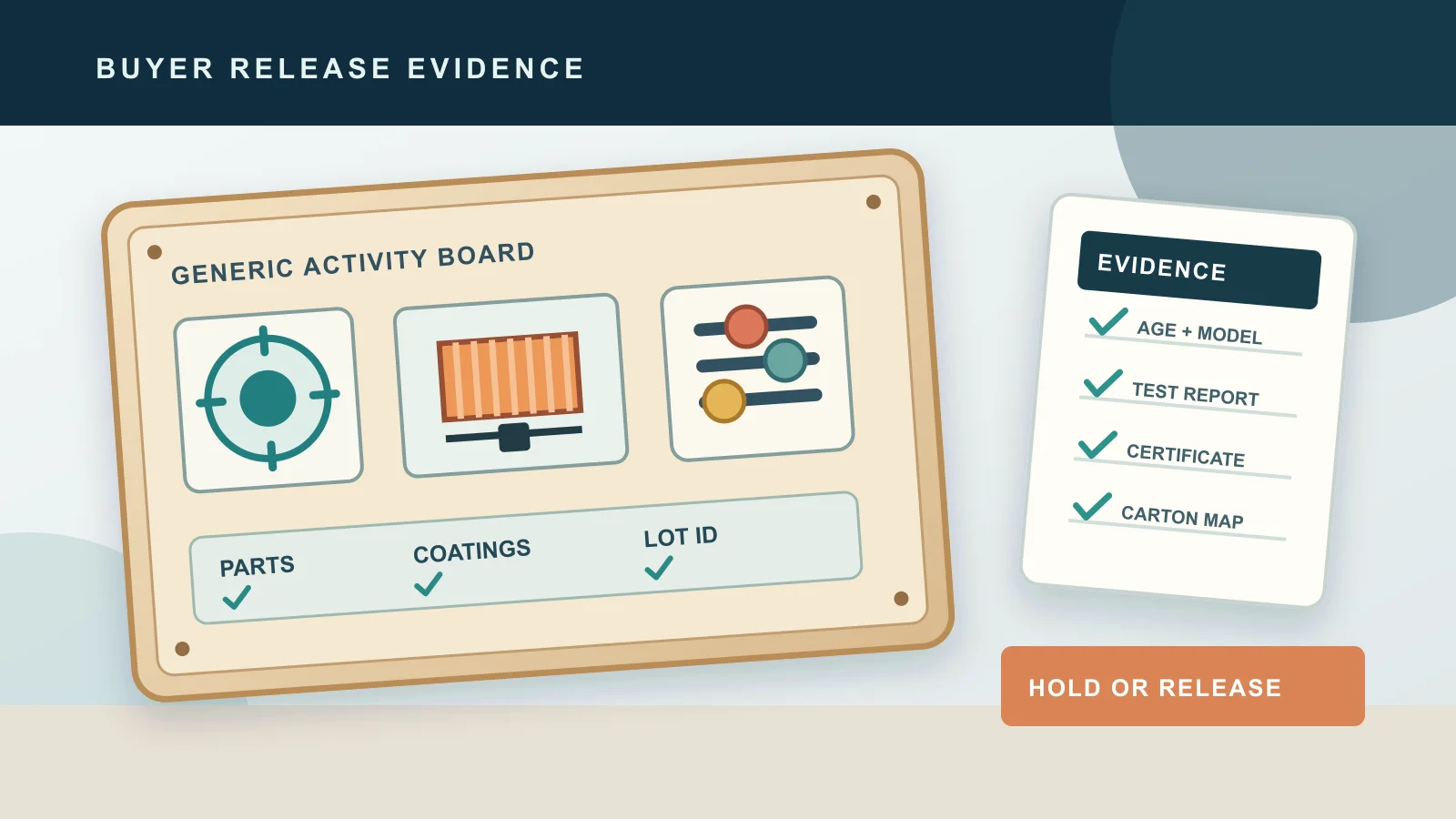
Quick answer
What must match before a busy board lot moves?
Use an age-and-evidence gate, a component-and-coating gate, and a model-and-lot release gate. A qualified party determines applicable U.S. rules and testing; buyer-side inspection compares sampled finished boards with the tested version and approved files. Release only named lots and cartons after any mismatch is resolved and documented.
The intended age on the listing, retail pack, and instructions must describe the same product. Match each knob, zipper, latch, switch, fastener, coating, battery feature if present, and accessible edge to the approved component list and tested sample. Then tie the finished model, factory, date code, tracking mark, lot, and cartons to the certificate and inspection record. A supplier statement or a report cover with a similar product name does not close that chain.
Current public evidence
Three different failures in multi-part activity toys
On September 17, 2026, CPSC recalled about 276,000 Esjay toddler busy boards made in China. Its notice says red knobs on the second page can detach and violate the small-parts ban; it reports no incidents or injuries. A separate Melissa & Doug fire-truck activity-board recall that day identified a detachable hose port, 26 reports of it coming loose, and one report of a minor cut. Both notices are product-specific.
A September 10 Lontcs busy-board recall concerns a different hazard: CPSC says the zipper's paint exceeded the federal lead-paint limit. These records point to separate inspection and qualified-test questions for attachment, accessible edges, and coatings. News 12 covered the fire-truck recall, an independent attention signal; it is not a measure of search demand.
The current CPSC small-parts guidance explains the under-three ban, intended-use scope, and small-parts cylinder. CPSC toy-safety guidance addresses other applicable hazards. The responsible U.S. importer must determine the full rule set for the exact toy, not assume that one recall or test covers every board.
Buyer-side release module
Four checks before balance payment or pickup
Agree the production scope, sample plan, destructive-test handling, and stop rules before inspection. Record actual differences. Leave formal compliance testing and certification to qualified parties.
- 1
Freeze age and model
Reconcile intended age, listing, artwork, SKU, bill of materials, component count, approved sample, factory, version, and production lots.
- 2
Map tests to the finished board
Obtain complete reports, tested sample photos, applicable rule list, CPSC-accepted lab scope, CPC, coating records, and material-change history.
- 3
Inspect actual parts and packs
Sample named lots; record knobs, zippers, latches, fasteners, edges, coatings, attachment changes, tracking marks, warnings, retail packs, and carton IDs.
- 4
Hold or release by lot
Quarantine failures or undocumented variants. Record qualified disposition, correction, any needed retest, repeat inspection, and the exact released carton range.
At the factory
Compare every accessible feature with the approved version.
Sample across the named models, lots, and cartons. Photograph component count and placement; compare knob shape and fastening, zippers and painted pulls, latches, keys, hinges, mirrors, cords, closures, and any battery access against the signed sample and drawings. Record visible looseness, exposed edges, coating damage, and substitutions with unit and carton IDs. Do not return any destructively checked unit to saleable stock.
A buyer-side tug, visual check, or handheld gauge may flag a concern but cannot establish a regulatory pass. The small-parts method includes prescribed evaluation, and CPSC third-party-testing guidance covers initial, material-change, and periodic testing. A new component, coating, or attachment method can change the evidence needed for the production version.
Request one release pack
- Destination, responsible importer, intended age, sales listing, purchase order, SKU, model, version, factory, lots, quantities, and carton map.
- Signed sample, drawings, bill of materials, attachment specifications, coating and component suppliers, and change log.
- Complete relevant reports, tested-sample photos, CPSC-accepted laboratory scope, applicable-rule list, and Children’s Product Certificate.
- Age marks, tracking labels, warnings, instructions, retail packaging, barcodes, and outer-carton identity.
- Sampling and stop rules, failed-unit IDs, containment record, qualified disposition, correction, and repeat-check plan.
Evidence to decision matrix
Turn each mismatch into a named lot decision.
A passing sample cannot clear a changed knob, untested coating, or mixed cartons that cannot be mapped to the approved version.
Public case example
Esjay: a detachable knob changed the shipment decision
What happened: The September 17, 2026 CPSC notice says red knobs on the second page of Esjay toddler busy boards can detach. CPSC described a small-parts-ban violation, about 276,000 affected units, China manufacture, and no reported incidents or injuries. The remedy is to remove the affected page under the recall instructions and obtain a replacement page.
What evidence was public: The notice identifies the blue felt five-page board, the affected red-knob page, sale channel, manufacturer, hazard, and remedy. It does not publish the factory attachment specification, tested sample file, or a complete root-cause report for another buyer's order.
Buyer lesson: Compare the production knob and attachment to the approved sample and full qualified evidence, then trace the actual version to dated lots and cartons. A replacement page or updated fastening method is a change requiring its own documented disposition; it does not automatically clear earlier stock. CPSC CPC guidance requires product identification sufficient to match the certificate to the covered product and no others.
Limits of comparison: The recall does not prove that another busy board or supplier is defective. The Melissa & Doug and Lontcs notices concern different components and hazards. Huang Sourcing did not work on these recalls. Visual sampling cannot certify compliance or guarantee every unit in a lot.
Evidence basis for this advice.
This guide combines current CPSC guidance, three distinct CPSC recall records, independent news coverage, and buyer-side sourcing analysis. Classification, test interpretation, certification, and legal release belong to the responsible importer and qualified specialists.
- The September 17 Esjay CPSC recall identifies detachable red knobs on a China-made toddler busy board; it reports no incidents or injuries.
- Separate 2026 CPSC notices describe a loose fire-hose port on a fire-truck activity board and lead paint on a Lontcs busy-board zipper. These are different products and hazards, not proof of a common root cause.
- Current CPSC small-parts, toy-safety, third-party-testing, and CPC guidance frame the U.S. evidence boundary. The release workflow is buyer-side analysis of public records; Huang Sourcing did not participate in the recalls.
Scope limits and stop rules
U.S. requirements depend on intended age, construction, materials, and use. An age label chosen to avoid testing does not settle intended use. CPSC guidance says small parts may be entire objects, separate components, or pieces liberated through prescribed use-and-abuse testing. Other toy and coating rules may apply; the importer and qualified lab must define them.
Hold affected stock for loose or different attachments, new coatings, unapproved component substitutions, inconsistent age claims, missing or mismatched reports or CPC, incorrect tracking labels, mixed versions, or untraceable cartons. Obtain a documented qualified decision and any required new testing before correction, re-inspection, and limited release. Do not present a factory inspection as a safety certification.
Make the hold or release scope explicit.
Share the intended age, exact model, component and coating list, approved sample, complete reports, CPC, factory, lots, labels, carton map, and pickup deadline. Huang Sourcing can scope a China-side comparison and document the gaps that need specialist review.
Sources
Public records checked September 26, 2026 Beijing time. CPSC notices control case facts; current CPSC business guidance controls the described U.S. rule framework. Links do not imply Huang Sourcing involvement.